Executive Summary: A Paleontological Breakthrough
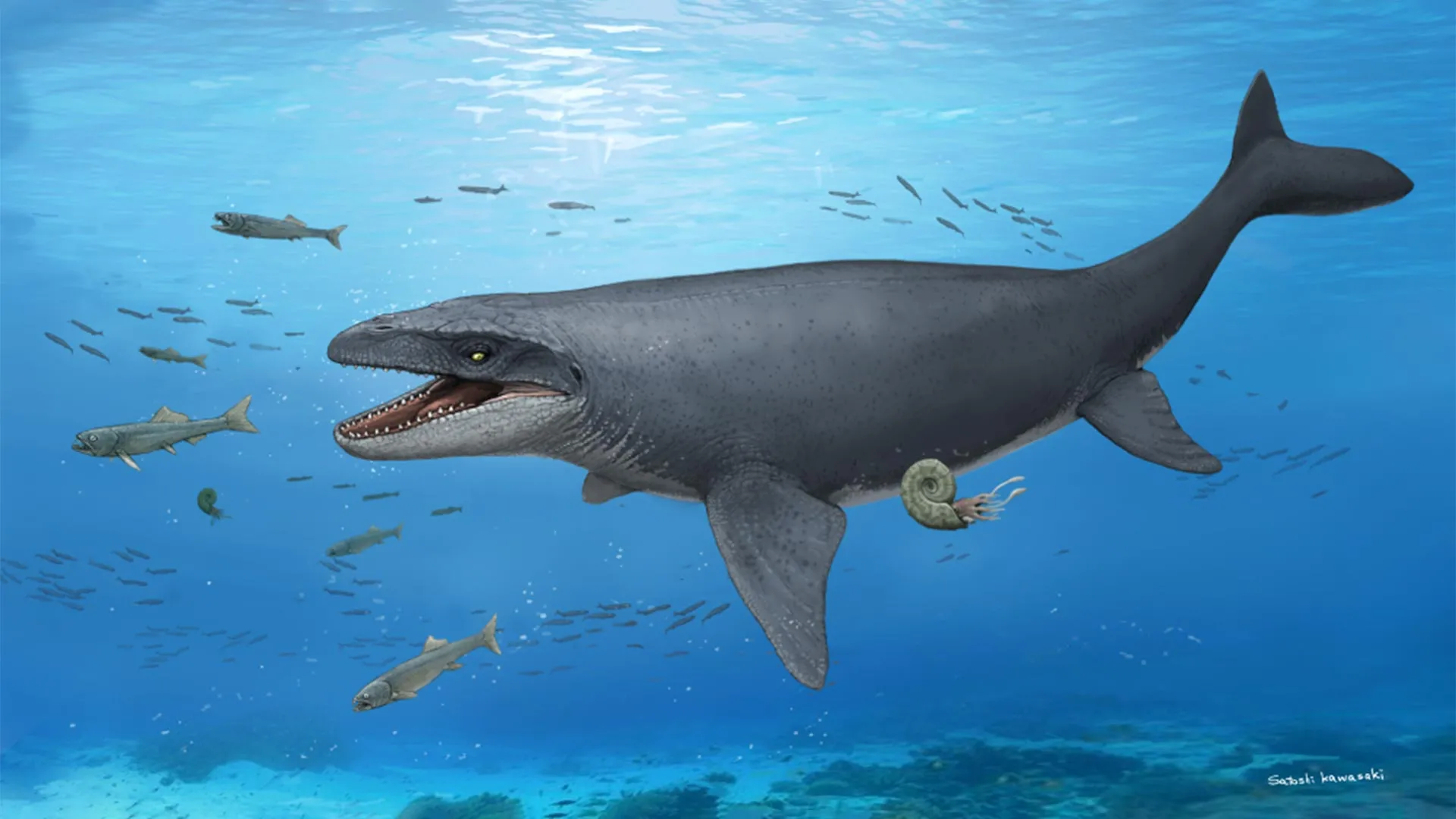
In a striking testament to the enduring value of museum archives, a collaborative team of paleontologists from the Okayama University of Science, Tokyo City University, and the Natural History Museum, Kishiwada City, has announced the discovery of four fossilized bones previously overlooked for over 30 years. These remains, extracted from rock samples collected in the early 1990s in Osaka Prefecture, Japan, have been identified as belonging to a mosasaur—a fearsome apex predator of the Late Cretaceous seas.
The discovery is headlined by the identification of a premaxilla—the foremost bone of the upper jaw—which marks the first time this critical cranial element has been confirmed in a Japanese mosasaur specimen. Furthermore, the analysis of a basisphenoid bone, characterized by unique, horn-like projections, suggests that the fossils may represent a species previously unknown to science. This revelation underscores a growing trend in modern paleontology: that the key to unlocking the mysteries of the deep past may lie not in new field excavations, but in the meticulous re-examination of the vast, silent collections already resting within our research institutions.
Chronology of Discovery: From Sobura to Science
The story of these fossils began between 1990 and 1992, during a period of active geological exploration in the Sobura area of Kaizuka City, Osaka Prefecture. At the time, the fossils were recovered alongside other mosasaur remains and deposited into the care of the Natural History Museum, Kishiwada City.
For over three decades, the specimens remained largely dormant, stored in their original matrix—the hardened rock and sediment in which they were entombed millions of years ago. In the early 1990s, the technological tools for non-invasive imaging and the comparative database for mosasaur morphology were significantly limited. As a result, the finer, more fragile bones embedded within the larger rock fragments went unnoticed, preserved by the very material that hid them from view.
In recent years, a multi-institutional research initiative sought to re-evaluate these legacy collections. By applying advanced preparation techniques and leveraging the global increase in anatomical data compiled over the last thirty years, the researchers began to carefully strip away the surrounding stone. It was during this painstaking process that the four "missing" bones were finally revealed, shedding new light on a specimen that had been classified as an incomplete find for a generation.
Supporting Data: Anatomical Anomalies
The significance of the discovery lies in the specific morphology of the identified bones. Mosasaurs, which thrived between 98 and 66 million years ago, were the undisputed rulers of the Cretaceous oceans. However, their taxonomy remains complex, as their rapid evolution led to a high degree of variation across the globe.
The Premaxilla: A Missing Piece of the Puzzle
The premaxilla is a vital component of the skull, serving as the anchor for the snout and the front-most teeth. Previously, Japanese mosasaur specimens were largely comprised of vertebrae, rib fragments, or incomplete jaw sections. The identification of a premaxilla provides researchers with a primary diagnostic tool. By examining the shape, dental sockets, and structural integrity of this bone, scientists can now draw much more accurate comparisons between the Osaka specimen and mosasaur lineages identified in North America, Europe, and the Middle East.
The Basisphenoid and the "Horned" Trait
Perhaps more intriguing than the premaxilla is the analysis performed on the basisphenoid—a complex bone located at the base of the braincase. The team observed two distinct anatomical departures from known mosasaur morphology:
- Horn-like Projections: The bone features lateral projections that extend outward, a feature not typically associated with the standard mosasaur cranial architecture.
- Absence of a Ventral Median Groove: In most known species, a distinct groove runs along the bottom of this bone. Its absence in the Osaka specimen is a major taxonomic red flag, suggesting that the animal followed a different evolutionary path than its contemporaries.
These deviations have led the research team to cautiously suggest that they are dealing with a new, undescribed species. While the scientific community maintains a rigorous standard for defining new species, the combination of these traits suggests that the specimen represents a unique evolutionary experiment in the northwestern Pacific region.
The Evolution of Paleontological Methodology
The success of this study highlights a paradigm shift in how natural history museums operate. In the 20th century, the focus of many institutions was the acquisition of large, high-profile fossils—the dramatic teeth and massive vertebrae that capture the public imagination. Today, the focus has shifted toward "re-preparation."
The "Museum as a Living Archive"
Museums are no longer merely repositories for display; they are active, evolving databases. The researchers involved in the Kishiwada project argue that the "unprepared" sections of fossil blocks often contain micro-fossils, cranial fragments, or internal structures that were ignored by previous generations of collectors who lacked the microscopic tools or the comparative knowledge to identify them.
By returning to the Sobura collection, the team demonstrated that the scarcity of findings in the 1990s was not due to a lack of fossils, but to a lack of context. With the digital integration of worldwide mosasaur databases, today’s scientists can compare a single bone from Osaka against specimens housed in museums across three continents in a matter of seconds. This interconnectedness was the catalyst for identifying the unique features of the Osaka specimen.
Implications for Northwestern Pacific Marine Ecosystems
Understanding the marine life of the Late Cretaceous in the northwestern Pacific is a monumental task. Much of what we know about mosasaurs comes from the Western Interior Seaway of North America, where sediment preservation is exceptional. Japan’s geological history—marked by intense tectonic activity and volcanic subduction—often makes for fragmented and difficult-to-study fossil records.
This discovery provides a rare, high-quality data point for the Pacific region. If this specimen is indeed a new species, it indicates a higher degree of biodiversity in the ancient Pacific than previously hypothesized. It challenges the "homogenized" view of global mosasaur populations, suggesting that regional isolation or specific environmental pressures in the northwestern Pacific may have driven unique adaptations in these marine reptiles.
Furthermore, this finding encourages further exploration of the sedimentary layers in Osaka and surrounding prefectures. It signals to the paleontological community that the region remains a high-potential zone for discovery, provided that researchers are willing to look at the "hidden" contents of existing archives.
Official Presentation and Future Outlook
The findings were formally presented on June 27, 2026, at the 177th Annual Meeting of the Palaeontological Society of Japan, hosted at Osaka Metropolitan University. The presentation generated significant interest among the academic community, sparking a debate on the specific evolutionary lineage of the specimen.
While the team has stopped short of officially naming a new species, the process of formal peer review and comparative analysis is currently underway. This involves high-resolution CT scanning of the bones to look for internal vascular channels and density patterns that might reveal more about the animal’s life history—such as its growth rate and diet.
As the scientific community awaits the final classification, the researchers continue to work closely with the Natural History Museum, Kishiwada City, to catalog the remaining rock samples from the original 1990s site. There is a palpable sense of optimism among the team; if four bones could be missed for thirty years, they posit, what else might be waiting to be found in the museum’s quiet back rooms?
Conclusion: A Legacy of Persistence
The story of the Osaka mosasaur is more than just a discovery of a new creature; it is a lesson in patience and the value of scientific stewardship. It reminds us that our understanding of history is never static. As our tools sharpen and our knowledge expands, the very objects we thought we understood begin to tell new stories. Whether this specimen is confirmed as a new species or identified as a rare variant of a known genus, it has already succeeded in doing what all great fossils do: it has forced us to look at the past with fresh eyes and renewed curiosity.
The research team, comprised of experts from Okayama University of Science, Tokyo City University, and the Natural History Museum, Kishiwada City, remains committed to the ongoing preparation of the site’s collection, ensuring that the treasures of the Cretaceous period are fully realized for future generations to study and admire.