More than 10 million years ago, long before the modern Amazon rainforest defined the South American landscape, the continent was home to a vastly different, more surreal ecosystem. During the Miocene epoch, a sprawling, complex system of wetlands and vast, shallow lakes blanketed much of the interior. In this watery wilderness, the rules of survival were dictated by size, armor, and a predatory hierarchy that placed reptiles at the very pinnacle of the food chain.
New research, published in the Journal of Vertebrate Paleontology, offers a chilling look into this lost world. While popular imagination often favors the saber-toothed cats or the "terror birds" of the Cenozoic era, scientists have now concluded that the true masters of the South American Miocene were not mammals, but giant crocodylians.
The Crucible of the Miocene: A World of Giants
To understand the scale of this ancient world, one must first visualize the sheer abundance of the Miocene environment. Roughly 10 to 16 million years ago, South America was a continent defined by its isolation and its ecological excess. The expansive wetlands provided a nutrient-rich foundation for a staggering variety of megafauna.
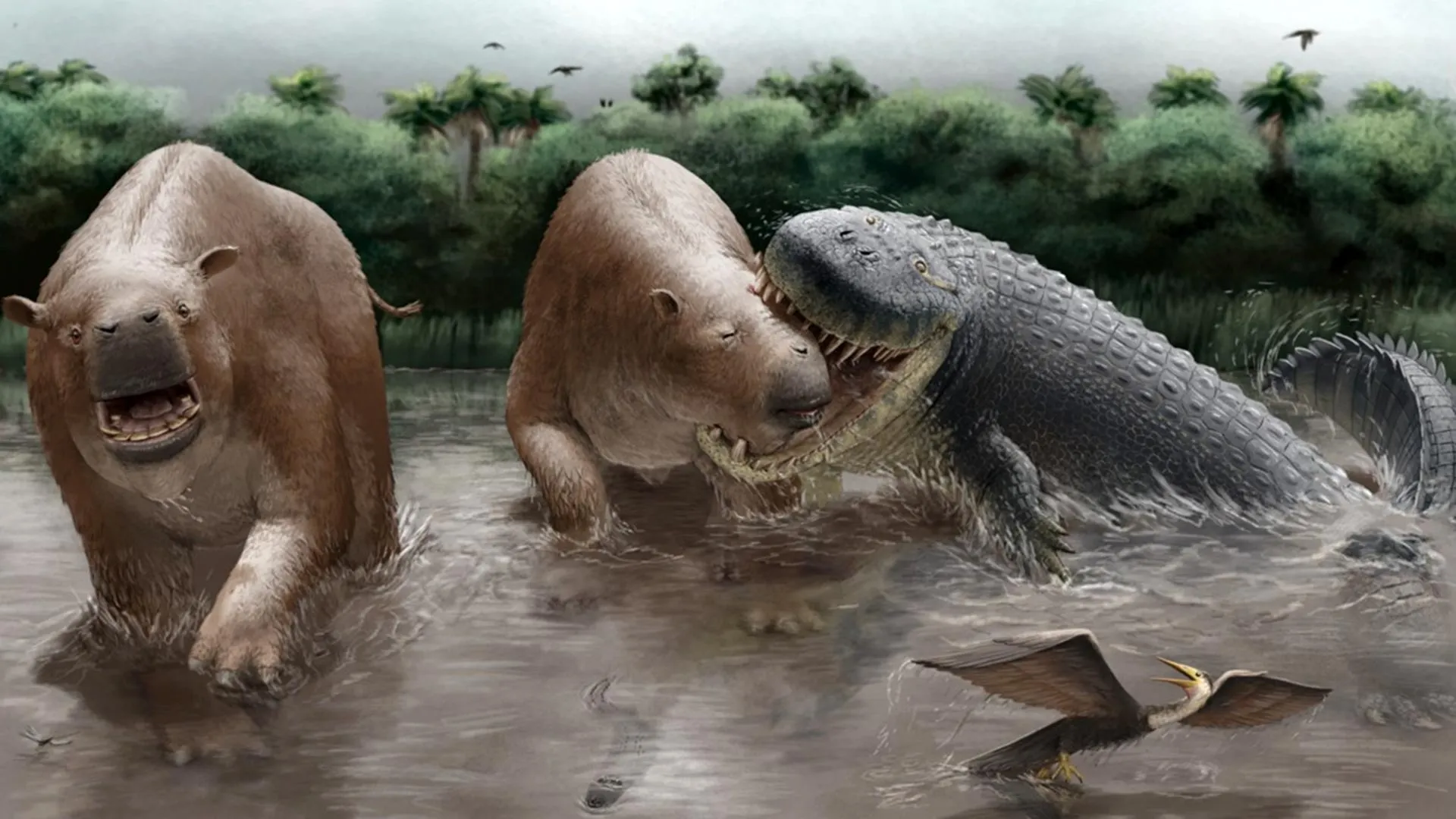
The herbivores of this era were nothing short of monstrous. Giant ground sloths, some the size of elephants, lumbered through the marshlands. They shared the landscape with glyptodonts—heavily armored, tank-like relatives of the modern armadillo—and a bewildering array of ungulates. These hoofed mammals, including the massive "lightning beasts" (astrapotheres) and the resilient toxodontids, evolved in total isolation from the rest of the world, resulting in strange, robust body plans that allowed them to reach weights exceeding a metric ton.
This unprecedented concentration of biomass acted as an evolutionary engine for predators. In such an environment, the caloric requirements of the local fauna were massive, leading to an arms race of predatory evolution.
A Chronology of Conflict: The Rise of the Apex Reptile
The Miocene epoch, which began roughly 23 million years ago and concluded 5.3 million years ago, saw several distinct predatory guilds vying for dominance.
The Early Stages
During the early to middle Miocene, the landscape was already shifting toward a wetland-dominated mosaic. As the continent’s drainage patterns formed the massive lake systems, semi-aquatic predators began to find an advantage. While terrestrial mammals—such as early, primitive carnivores—were present, the environment favored animals capable of exploiting both land and water.
The Zenith of the Crocodylians
By the middle of the Miocene, the ecosystem had reached a point of extreme specialization. Fossil evidence indicates that the most significant pressure on the herbivore population came from within the water. The crocodylians of this era were not merely opportunistic scavengers; they were the primary drivers of ecological change.
The Transition
As the Miocene drew to a close, geological shifts—most notably the initial rise of the Andes and the subsequent reorganization of river systems—began to drain the vast lakes. This contraction of habitat likely signaled the beginning of the end for the giant crocodylians, eventually giving way to the drier, more mammalian-dominated landscapes of the Pliocene.
Supporting Data: The Forensic Evidence of the Past
For decades, paleontologists relied on inferential data—using the size of an animal’s skull or the sharpness of its teeth to guess its role in the food chain. However, the study conducted by researchers at the University of Helsinki, led by postdoctoral researcher Oscar Wilson, took a more forensic approach.
The team turned to museum collections, meticulously analyzing fossilized bones for direct evidence of predation. By examining the bite and tooth marks left on the remains of herbivores, the researchers were able to bypass speculation and observe actual ecological interactions that occurred millions of years ago.
The "Purussaurus" Signature
The most compelling evidence centered on Purussaurus neivensis. This massive crocodylian, a relative of the modern caiman, was a titan of the river systems. Stretching up to seven meters in length and weighing approximately 1,800 kilograms, it possessed a bite force capable of crushing bone with ease.
"The frequency of marks likely made by Purussaurus suggests that it was an important predator in these tropical ecosystems," Wilson noted. By mapping these marks across multiple specimens, the researchers identified a consistent pattern of predation that indicates Purussaurus was not just a occasional hunter, but a primary consumer of the continent’s largest mammals.
Official Perspectives: Rethinking the Predator Hierarchy
The scientific community has long held a bias toward mammalian predators, often assuming that animals like the saber-toothed mammals or the flightless, predatory "terror birds" held the top spots in the ecosystem. This new research forces a recalibration of that perspective.
"There was so much prey available that mammalian predators couldn’t have eaten it all," says Oscar Wilson. This realization highlights the sheer abundance of the Miocene. In a world where food was seemingly infinite, the competition was not necessarily for sustenance, but for the ability to handle the largest, most armored prey.
The study argues that crocodylians occupied a unique niche. While mammals had to deal with the energy costs of being endothermic (warm-blooded) in a tropical environment, the ectothermic (cold-blooded) Purussaurus could survive on less food relative to its size while maintaining the ability to ambush massive, unsuspecting herbivores at the water’s edge.
Implications: Shaping the Ancient Tropical Community
The findings have profound implications for our understanding of ancient biodiversity. By identifying Purussaurus as the primary predator, researchers have unlocked a new understanding of how these ancient tropical communities were regulated.
Population Control
The study suggests that Purussaurus was influential enough to affect the size and density of herbivore populations across the entire region. This "top-down" control is a hallmark of apex predators. If a predator is powerful enough to limit the number of large herbivores, it indirectly dictates the health of the vegetation and the structure of the entire habitat.
Comparative Ecology
This research also highlights the difference between modern and ancient ecosystems. Today, in the Amazon, the black caiman is a significant predator, but it does not dominate the landscape in the same way its Miocene ancestors did. By studying the Purussaurus, scientists can better understand the potential for reptiles to dominate ecosystems under the right conditions—specifically, high prey density and expansive, stable wetland environments.
The Value of Fossil Forensics
Perhaps most importantly, this study underscores the necessity of moving beyond skeletal reconstruction. The use of bite-mark analysis serves as a blueprint for future paleontological research. It demonstrates that the story of an animal’s life is often written on the bones of its neighbors. By looking for the marks of struggle, injury, and consumption, researchers can reconstruct the social and predatory dynamics of a lost world with a level of accuracy previously thought impossible.
Conclusion: A Legacy in the Mud
The Miocene of South America was not a gentle place. It was a violent, vibrant, and gargantuan theater where reptiles reigned supreme. The rise of Purussaurus neivensis and its kin serves as a powerful reminder of how environmental conditions—in this case, the vast, flooded heart of a continent—can elevate a specific lineage to the height of power.
As we continue to excavate the fossil record of South America, we are reminded that we are looking at a system that functioned with a different logic than our own. The giants of the past—the hoofed "lightning beasts" and the armor-plated crocodylians—did not simply exist; they engaged in a constant, brutal dance of survival.
With this new research, we have moved one step closer to understanding the rhythm of that dance. The "terror birds" and the saber-toothed mammals were indeed formidable, but in the dark, murky waters of the Miocene lakes, it was the cold, unyielding gaze of the crocodylian that truly defined the food chain. The study serves as a definitive correction to the history books, placing the reptile back at the head of the table in the ancient South American wild.