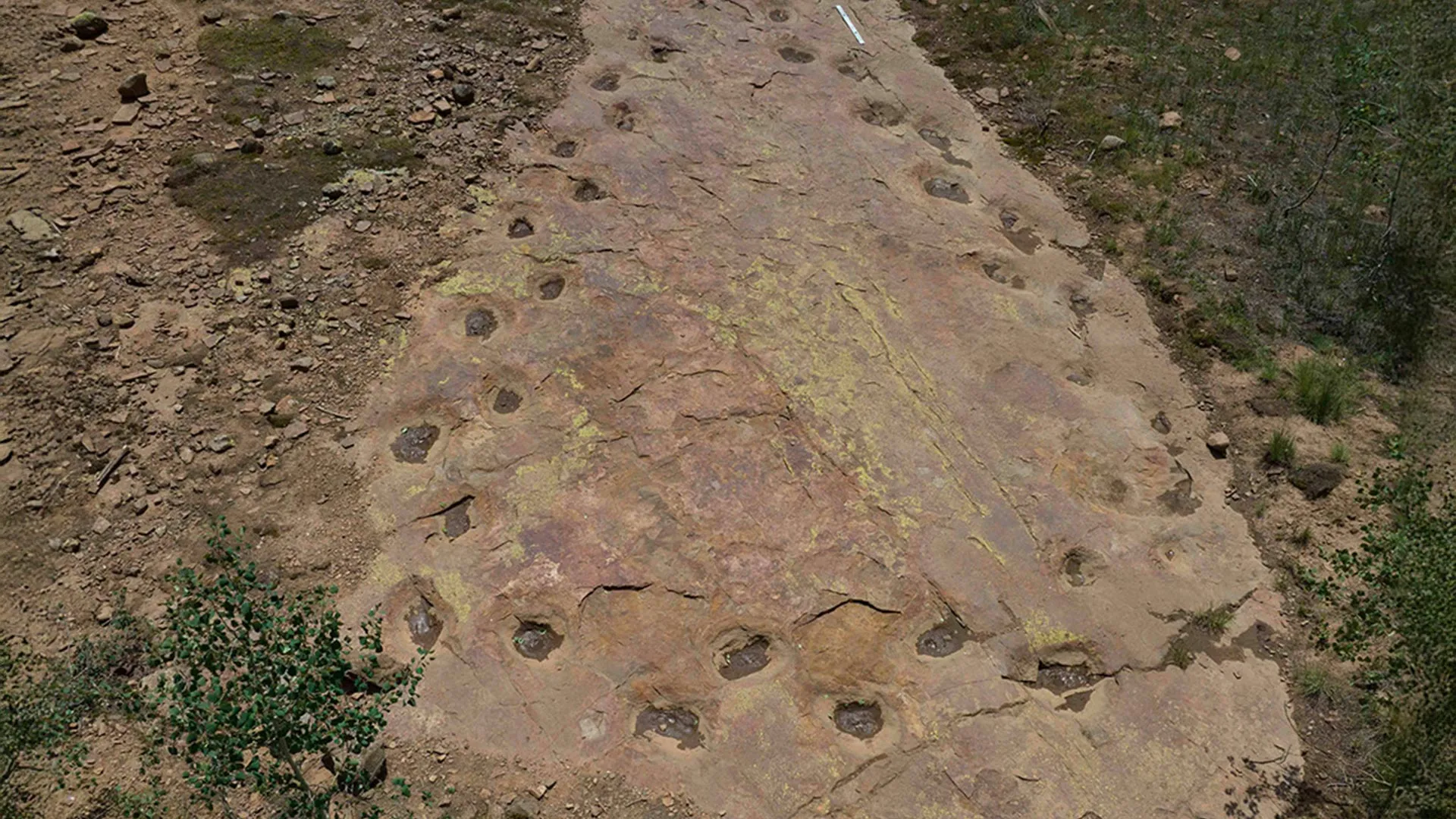
Deep in the rugged, high-altitude landscape near Ouray, Colorado, lies a silent record of a prehistoric journey that occurred 150 million years ago. Spanning 95.5 meters, a rare and exceptionally continuous trackway of fossilized footprints has recently become the subject of a pioneering scientific study. By combining state-of-the-art drone technology with paleontological expertise, researchers have uncovered a "looping" trail that provides an unprecedented window into the locomotion and behavioral nuances of a giant sauropod.
This discovery is not merely a record of a dinosaur’s passage; it is a complex behavioral archive that suggests these massive, long-necked creatures possessed far more fluid and varied movement patterns than previously assumed. As scientists delve deeper into the data, they are uncovering evidence that may indicate the dinosaur was walking with a persistent limp—a find that humanizes these ancient titans and opens new doors for the study of paleobiology.
Main Facts: The Ouray Trackway
The West Gold Hill Dinosaur Tracksite, situated within the fossil-rich strata of the Late Jurassic period, has long been a site of interest for paleontologists. However, the sheer scale of the trackway—consisting of more than 130 distinct footprints—rendered traditional ground-level documentation nearly impossible.
The trackway belongs to a sauropod, likely a relative of the iconic Diplodocus or Camarasaurus. What makes this specific site extraordinary is the geometry of the trail. The dinosaur did not simply walk in a straight line; it executed a tight, full-circle loop, retracing its path and eventually resuming its original course. For paleontologists, this loop is a "Rosetta Stone" of sauropod movement. It captures the animal’s biomechanical adjustments as it navigated a turn, offering a rare glimpse into the physics of moving a multi-ton body through a complex maneuver.
Chronology: From Jurassic Earth to Digital Lab
To understand the significance of the Ouray trackway, one must look at the timeline of the research and the geological context of the find.
The Late Jurassic Setting
Approximately 150 million years ago, the region now known as Colorado was a vastly different world. It was a lush, terrestrial landscape teeming with some of the largest creatures to ever walk the planet. Sauropods, characterized by their immense size, pillar-like legs, and elongated necks and tails, dominated the ecosystem. The sediment that now preserves these tracks was once a soft, damp substrate that captured the weight and movement of the dinosaur with remarkable precision before hardening over aeons of geological pressure.
Modern Discovery and Documentation
The recent investigation, led by Dr. Anthony Romilio of The University of Queensland’s Dinosaur Lab, represents a shift in how paleontologists interact with large-scale sites. Because the trackway spans nearly 100 meters, ground-based surveys were prone to spatial distortions and lacked the "bird’s-eye" perspective necessary to map the curvature of the trail accurately.
In collaboration with the San Diego Natural History Museum, the research team deployed advanced drone technology to capture high-resolution imagery of the entire site. By stitching these aerial images together, the team generated a highly accurate 3D model. This digital twin allowed researchers to analyze the site at a millimeter-scale, providing a level of precision that traditional mapping techniques simply could not match.
Supporting Data: Unlocking the Biomechanics
The core of the study lies in the subtle variations found within the 130 footprints. By applying digital analysis to the 3D model, the team identified two critical patterns that challenge traditional assumptions about sauropod walking styles.
The "Step Width" Variability
One of the most striking findings concerns the width between the left and right footprints. In many trackway studies, researchers look for a "trackway gauge"—the width of the path—to determine how a dinosaur distributed its weight. Traditionally, if a short segment showed a consistent gauge, it was assumed the animal maintained that gait throughout its journey.
The Ouray trackway disproves this simplification. Dr. Romilio’s team observed that as the dinosaur navigated the loop, the step width shifted from "quite narrow" to "distinctly wide." This fluctuation indicates that the dinosaur’s gait was dynamic and adaptive. A narrow, efficient stride may have been used for straight-line travel, while a wider stance likely provided the stability needed to execute a tight turn. This suggests that short, fragmented trackways—which are common in the fossil record—may be misleading, as they capture only a single "frame" of what was actually a fluid, ever-changing movement pattern.
The Mystery of the Limp
Perhaps the most intriguing piece of data is the consistent 10-centimeter (4-inch) discrepancy between the step lengths of the left and right limbs. While it is difficult to definitively categorize this as an injury, the persistence of the pattern throughout the 95.5-meter trail suggests something beyond mere environmental obstacles.
Whether this represents a permanent limp resulting from a past injury, a localized muscular issue, or simply a dominant-side preference similar to human "handedness," remains a subject of intense discussion. However, the fact that such a subtle behavioral trait can be extracted from a 150-million-year-old fossil is a testament to the power of high-resolution digital modeling.
Official Responses: Insights from the Field
The collaboration between international research institutions and local agencies has been crucial to the success of this study. Dr. Paul Murphey, a co-author of the study from the San Diego Natural History Museum, emphasized the necessity of the technological pivot.
"It has been challenging to document these footprints from the ground because of the size of the trackway," Dr. Murphey stated. "We used drones to capture the entire trackway in high resolution. With these images, we generated a detailed 3D model, which could then be digitally analyzed in the lab at millimeter-scale accuracy."
Dr. Anthony Romilio echoed these sentiments, highlighting the behavioral revelations: "This trackway is unique because it is a complete loop. While we may never know why this dinosaur curved back on itself, the trackway preserves an extremely rare chance to study how a giant sauropod handled a tight, looping turn before resuming its original direction of travel."
The U.S. Forest Service, which manages the land housing the West Gold Hill site, has played a pivotal role in supporting the investigation, ensuring that this irreplaceable piece of natural heritage is both protected and rigorously studied.
Implications: The Future of Paleontology
The implications of the Ouray study extend far beyond the specifics of one sauropod’s loop. The research sets a new gold standard for how paleontologists should approach large-scale fossil sites.
Challenging Existing Paradigms
For decades, the study of dinosaur locomotion relied heavily on skeletal morphology—reconstructing muscles and joints in a lab to guess how an animal might have moved. The Ouray trackway provides the empirical reality of that movement. By proving that gait width and step length are highly variable, the study suggests that our current understanding of dinosaur speed, energy expenditure, and social behavior may need to be recalibrated.
New Methodologies for Old Fossils
The success of the 3D drone-mapping technique serves as a blueprint for future excavations. There are countless long trackways across the globe—in South America, Asia, and Europe—that have remained largely unanalyzed because they were too large or too fragile to document manually. The Ouray method demonstrates that these sites can be "mined" for behavioral data, turning what were once static geological features into active, living stories of prehistoric life.
The Human Element
Finally, the potential discovery of a limp adds a layer of depth to the study of extinct species. It reminds researchers and the public alike that these were not just biological machines or specimens for a shelf; they were sentient, living animals that dealt with pain, injury, and the physical demands of surviving in a harsh environment. As technology continues to bridge the gap between the present and the deep past, we are likely to find that the creatures of the Jurassic were far more complex and individualistic than the fossil record previously suggested.
As the scientific community continues to analyze the 3D models generated from the Ouray site, one thing is certain: the giant that walked this loop 150 million years ago is still teaching us, step by measured step, about the mechanics of life on Earth.