In a stunning turn of events that has sent shockwaves through the landscape of American higher education, Michigan State University (MSU) President Kevin Guskiewicz has abruptly rescinded his resignation, choosing to remain at the helm of the East Lansing institution. The reversal, announced on a Monday morning, marks the conclusion of a tumultuous two-month period defined by public infighting, accusations of governance failures, and a high-stakes leadership vacuum.
The decision comes just weeks after Guskiewicz made international headlines for a scathing departure letter in which he explicitly accused unnamed members of the MSU Board of Trustees of manipulation, personal agendas, and conduct that he characterized as detrimental to the university’s mission. While Guskiewicz is staying, the conditions of his retention—a lucrative new contract and a promise of a "one-team" governance approach—have raised as many questions as they have answered regarding the long-term stability of the university’s leadership.
A Chronology of Volatility
To understand the gravity of this reversal, one must look back at the dramatic timeline that brought Michigan State to this precarious juncture.
May 27, 2026: In an unconventional resignation letter that bypassed traditional pleasantries, Guskiewicz announced he would be stepping down from the MSU presidency to accept the top leadership role at Clemson University. In the message, he leveled sharp critiques at the Board of Trustees, citing a "lack of alignment" and interference that rendered effective leadership nearly impossible.
June 2026: Following the resignation announcement, the university descended into a period of acute instability. Public backlash against the Board of Trustees intensified, with influential voices—including legendary men’s basketball coach Tom Izzo—publicly criticizing the board’s handling of the presidency. Izzo’s comments, in which he lamented the loss of "the best president to ever be here," served as a rallying cry for alumni and donors who felt the board’s internal politics had compromised the university’s trajectory.
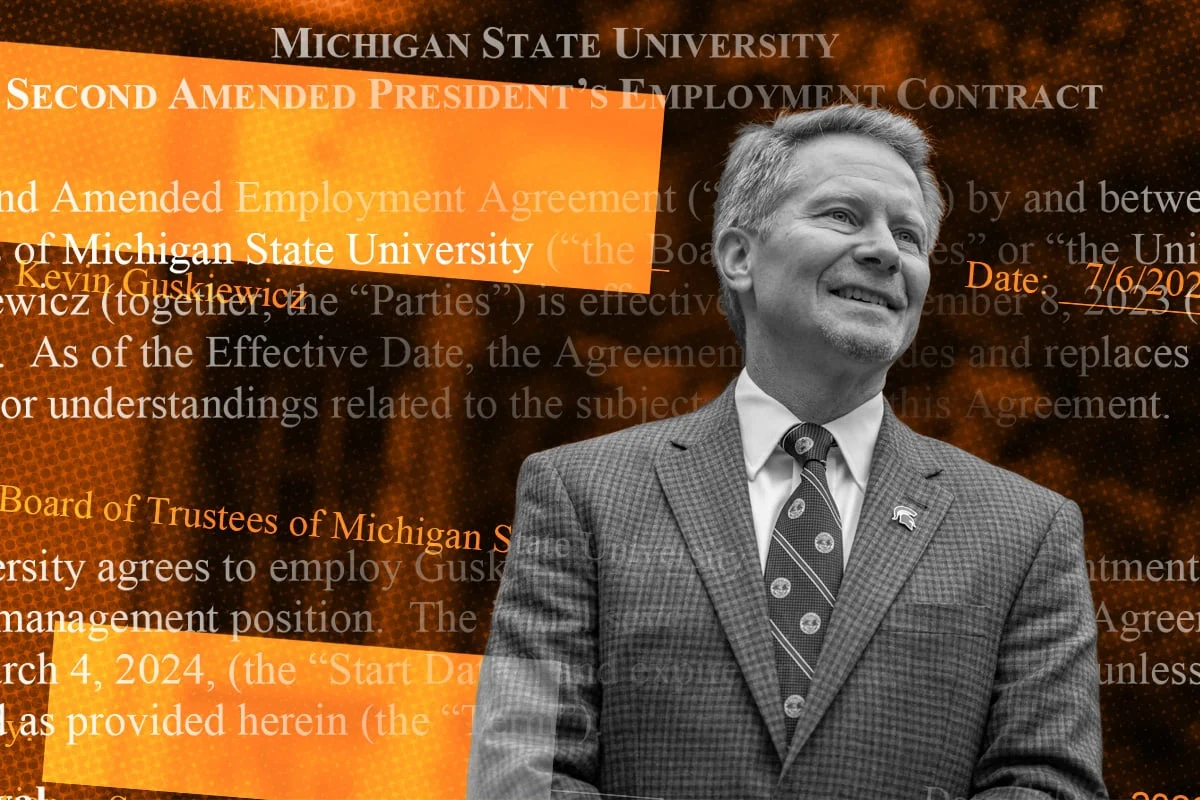
July 6, 2026: In a sudden pivot, Guskiewicz issued a follow-up statement to the campus community. He announced that, following "productive conversations" with Board Chair Brianna Scott and Vice Chair Renee Knake Jefferson, he had decided to honor his tenure at MSU. He concurrently signed a new contract, which effectively locked him into the position through 2031, accompanied by a significant compensation package increase.
The Financials: A Raise Amidst Controversy
The new agreement signed by Guskiewicz and Board Chair Brianna Scott is nothing short of substantial. While his base salary is set at $1.5 million—a figure lower than the $2 million originally discussed in previous board authorizations—it still represents a nearly $500,000 increase over his previous annual compensation.
Beyond the base salary, the contract expands his deferred compensation from $200,000 to $250,000 annually and extends his term of service by two years, moving the expiration date from 2029 to March 2031.
However, the most controversial element of the new agreement is a provision regarding personal transportation. The contract stipulates that the university will provide Guskiewicz with access to a private aircraft for personal, non-business travel for up to ten hours of flight time annually. The cost of this benefit is slated to be covered by "philanthropic funding sources," though the identity of these donors remains undisclosed.
Experts in higher education governance have expressed profound skepticism regarding this clause. James Finkelstein, a public policy professor emeritus at George Mason University, noted that such provisions are highly irregular. "Personal use—if I’ve seen it before, I can’t remember it," Finkelstein stated. "This seems to me beyond a breach of the board’s fiduciary duties. You’re paying for vacations." Furthermore, the contract lacks specificity regarding the caliber of the aircraft, leaving open the potential for significant, unbudgeted costs depending on the type of jet chartered.
Governance and the "One-Team" Approach
Guskiewicz has publicly defended his decision to stay by citing a "recommitment to this one-team approach." In an interview with The Chronicle of Higher Education, he articulated a vision where the board operates as a "board of the whole," with strategic priorities filtered through committee chairs and the board chair.
"We’ve had productive conversations about how the board can operate more strategically, more effectively," Guskiewicz said. "That means trying to function as a board of the whole, as I like to say, and functioning as one team."
However, this vision of harmony appears to be at odds with the reality on the ground. Several board members, including Trustee Mike Balow, expressed surprise at the announcement. Balow reported that he was informed of the president’s decision to stay only moments before a scheduled board meeting on Monday. He further noted that the contract itself was not presented to the full board for review or consensus prior to its signing.
When questioned about the lack of transparency, university spokesperson Amber McCann pointed to a previous board resolution from May, which authorized Chair Scott and Trustee Sandy Pierce to finalize contract negotiations. While legally defensible under the parameters of that specific resolution, the move has fueled internal resentment. An anonymous senior university leader suggested that the lack of broad board consensus on the new terms could lead to continued friction, noting that "not all board members were shown the contract before it was signed."
Expert Analysis: A Question of Sustainability
The academic community is watching the situation at MSU with a mix of fascination and apprehension. Judith Wilde, an independent researcher specializing in presidential transitions, questions whether the underlying tensions that led to the original resignation have truly been resolved.
"He stepped down with a letter that’s not like any we’ve ever seen before, basically saying he’s stepping down because of the unethical and disruptive behaviors of some of the board members," Wilde observed. She asks the central question currently facing the MSU administration: "How long will this last?"
The skepticism is shared by those who point out that the "Code of Ethics and Conduct" changes referenced by Guskiewicz were actually adopted in May—prior to his initial resignation—amidst a deeply divided board vote. The fact that the board had to censure members like Balow just last month for failing to sign an acknowledgment of that very code suggests that the "one-team" mentality remains an aspiration rather than a reality.
Implications for Michigan State University
For Michigan State, the stakes could not be higher. The institution is attempting to balance the need for visionary leadership with a board that remains visibly fractured. By securing Guskiewicz’s stay, the university has avoided the immediate chaos of a presidential search—a relief for faculty and students who feared another long period of uncertainty.
However, the cost of this stability is a contract that will be heavily scrutinized by taxpayers, donors, and the state legislature. The optics of a president receiving a $500,000 raise and private flight perks immediately after threatening to leave due to board toxicity may prove to be a political liability.
Meanwhile, at Clemson University, the reaction has been swift and decisive. While the administration acknowledged the reversal, they did not linger on the missed opportunity. Clemson has moved forward with its own search process, scheduling a board meeting to finalize the selection of a new president, demonstrating how quickly an institution must pivot in the high-pressure environment of top-tier university leadership.
Ultimately, Guskiewicz’s tenure at Michigan State will now be defined by his ability to bridge the divide he once publicly condemned. Whether the "one-team" approach is a genuine cultural shift or merely a fragile, expensive ceasefire will determine not only his own legacy but the future health of Michigan State University. For now, the administration must navigate a difficult path: fulfilling the promises of his new, long-term contract while convincing a skeptical board and an observant public that the turmoil is truly behind them.