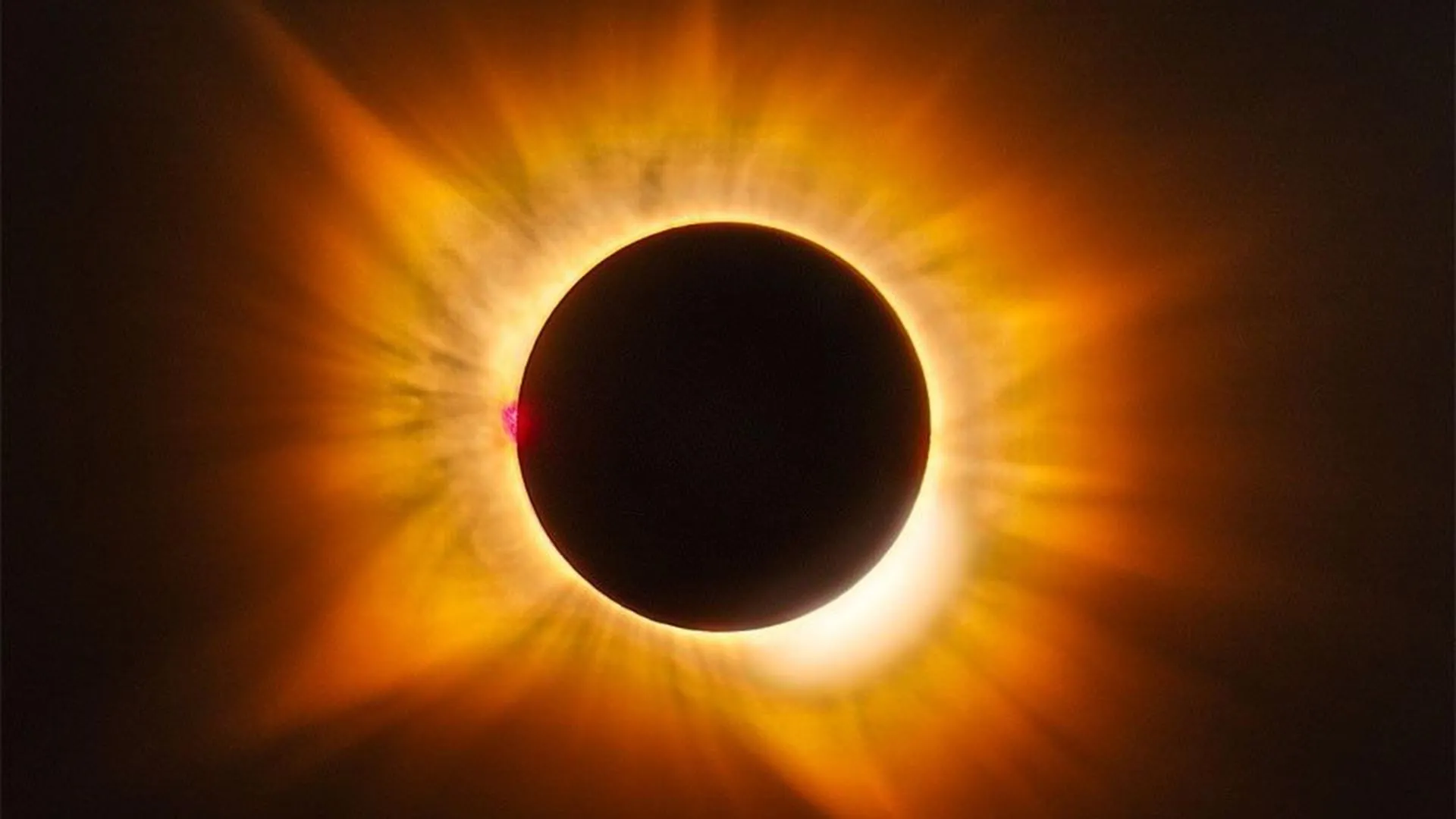
Last week’s total solar eclipse provided far more than a routine celestial alignment for the thousands of observers gathered across Spain. While the phenomenon of a total solar eclipse—where the Moon perfectly occludes the Sun’s photosphere—is a well-documented astronomical event, the specific conditions present last week produced a rare and stunning visual anomaly: a vibrant, golden-hued solar corona.
Typically characterized by a ghostly, pearly-white glow, the Sun’s outer atmosphere was transformed into a shimmering gold, a shift that has captivated both amateur astronomers and atmospheric physicists alike. This rare chromatic display, captured in high-definition detail from Benavente, Spain, serves as a poignant reminder of how Earth’s atmosphere acts as an active, filtering lens for the wonders of the cosmos.
Main Facts: A Celestial Phenomenon Transformed
At the heart of the event was the solar corona—a region of superheated plasma extending millions of kilometers into space. Under standard viewing conditions, the corona appears white or silver because it emits light across a broad spectrum, which our eyes perceive as white when combined.
However, the event in Spain was defined by a unique confluence of physics. As the Moon moved into position, the Sun was dipping toward the horizon. This low solar elevation forced the light of the corona to traverse an exceptionally thick layer of Earth’s atmosphere. The result was a filtering process akin to a dramatic sunset, where shorter wavelengths—the blues and violets—were scattered away, leaving only the warmer, longer wavelengths to reach the observers’ eyes.
Compounding this effect was the presence of particulate matter in the atmosphere, specifically smoke drifting from nearby forest fires. These particles acted as a secondary filter, aggressively scattering the remaining shorter-wavelength light and allowing the deep, saturated golden tones to dominate the visual field.
Chronology of the Event
The transformation of the solar eclipse followed a precise timeline dictated by both celestial mechanics and local environmental factors.
- 18:45 Local Time: As the eclipse entered its partial phases, observers in Benavente noted a subtle shift in the ambient light. The low angle of the Sun began to compress the light spectrum, signaling the onset of the atmospheric filtering effect.
- 19:12 Local Time (Totality): The Moon reached full occultation. In most regions, the corona would have appeared as a standard white ring. In Spain, however, the "golden transition" occurred instantly. As the disk of the Moon obscured the bright photosphere, the corona emerged not in silver, but in a rich, sunset-gold, owing to the extended light path through the thick, smoke-laden atmosphere.
- 19:15 Local Time: During the height of totality, a massive solar prominence—a loop of glowing plasma—became visible on the left limb of the Sun. Despite the golden ambient light, the prominence retained its characteristic vivid pink hue, providing a stark, beautiful contrast to the surrounding golden haze.
- 19:18 Local Time: As the Sun began to emerge from behind the Moon, the golden effect gradually dissipated, transitioning back into the harsh, bright white light of the solar photosphere, ending one of the most visually distinct eclipses in recent memory.
Supporting Data: The Physics of Scattering
To understand why the eclipse appeared golden, one must look to Rayleigh and Mie scattering. Under normal circumstances, Rayleigh scattering explains why the sky is blue; molecules in the atmosphere scatter the short-wavelength blue light more efficiently than the long-wavelength red light.
During a sunset—or in this case, a low-horizon eclipse—the light travels through a significantly longer "air mass." By the time the light reaches the observer, almost all the blue light has been scattered away, leaving the reds, oranges, and golds to dominate.
The data from the Benavente region confirms that the "Golden Corona" was further intensified by Mie scattering. Unlike Rayleigh scattering, which involves small molecules, Mie scattering involves larger particles—in this case, smoke from forest fires. These particles are particularly effective at scattering light across a wider range of the visible spectrum. The heavy concentration of smoke in the lower atmosphere effectively stripped away the remaining spectral components that would have contributed to the "white" appearance, leaving behind a saturated, golden-orange hue.
Official Responses and Expert Analysis
The imagery captured in Benavente has been analyzed by experts in solar physics and atmospheric science. Dr. Elena Vance, an atmospheric researcher, noted that while the effect is "physically predictable," its manifestation during a total solar eclipse is a "once-in-a-generation occurrence."
"We often focus on the Sun itself during an eclipse," Dr. Vance explained in a press statement. "We forget that we are observing these events through the chaotic, fluid, and often dirty lens of our own atmosphere. The images from Spain are not just photos of the Sun; they are photos of the interaction between the Sun’s corona and the specific composition of Earth’s atmosphere on that day."
Photographers utilizing High Dynamic Range (HDR) techniques were instrumental in documenting the event. By combining multiple exposures—some capturing the faint outer wisps of the corona and others capturing the intense solar prominence—they were able to produce a final image that accurately reflected what the human eye perceived: a gold-bathed corona punctuated by a brilliant pink plasma arc.
Implications: A Lesson in Planetary Perspectives
The events in Spain carry significant implications for how we interpret celestial data. For astronomers, this serves as a reminder of the "atmospheric bias" that must be accounted for when observing distant stars or solar phenomena from the ground. It highlights the necessity of sophisticated filtering and post-processing, such as the HDR techniques used here, to differentiate between the true nature of a celestial body and the atmospheric interference created by our own planet.
Furthermore, the prominence of the pink solar feature amidst the gold provides a case study in spectral integrity. Because the prominence emits light at specific hydrogen-alpha wavelengths, it was able to "cut through" the atmospheric haze that turned the rest of the corona gold. This demonstrates the robustness of specific spectral lines, a principle that is vital for solar observation satellites like the SOHO (Solar and Heliospheric Observatory).
Future Outlook and Research
As global temperatures rise and the prevalence of wildfires increases, the chemical composition of our atmosphere is changing. Scientists suggest that the "Golden Eclipse" may become a more common visual phenomenon as particulate matter from environmental events continues to influence light refraction at lower altitudes.
The photographic data gathered from Benavente is currently being processed by international research teams to better model how smoke density correlates with light-scattering intensity. This research could eventually lead to better air quality monitoring, using solar light as a probe to measure the density of aerosols and smoke in the upper atmosphere.
In conclusion, the golden eclipse of last week was a rare convergence of astronomical precision and terrestrial circumstance. It offered a breathtaking spectacle that served as a reminder of the intricate, fragile, and deeply interconnected relationship between the Sun, our atmosphere, and the planet we call home. While the Moon moved on and the sky returned to its familiar blue, the images of the golden corona remain as a testament to the beauty of atmospheric science, leaving researchers and observers alike with a profound appreciation for the complexity of the light that illuminates our world.