For decades, the global strategy for mitigating climate change has rested on a fundamental, seemingly intuitive premise: as atmospheric carbon dioxide ($CO_2$) levels rise, forests will act as increasingly powerful carbon sinks. The logic held that more $CO_2$ would fuel higher rates of photosynthesis, which in turn would accelerate tree growth, locking away vast quantities of carbon in woody biomass for centuries.
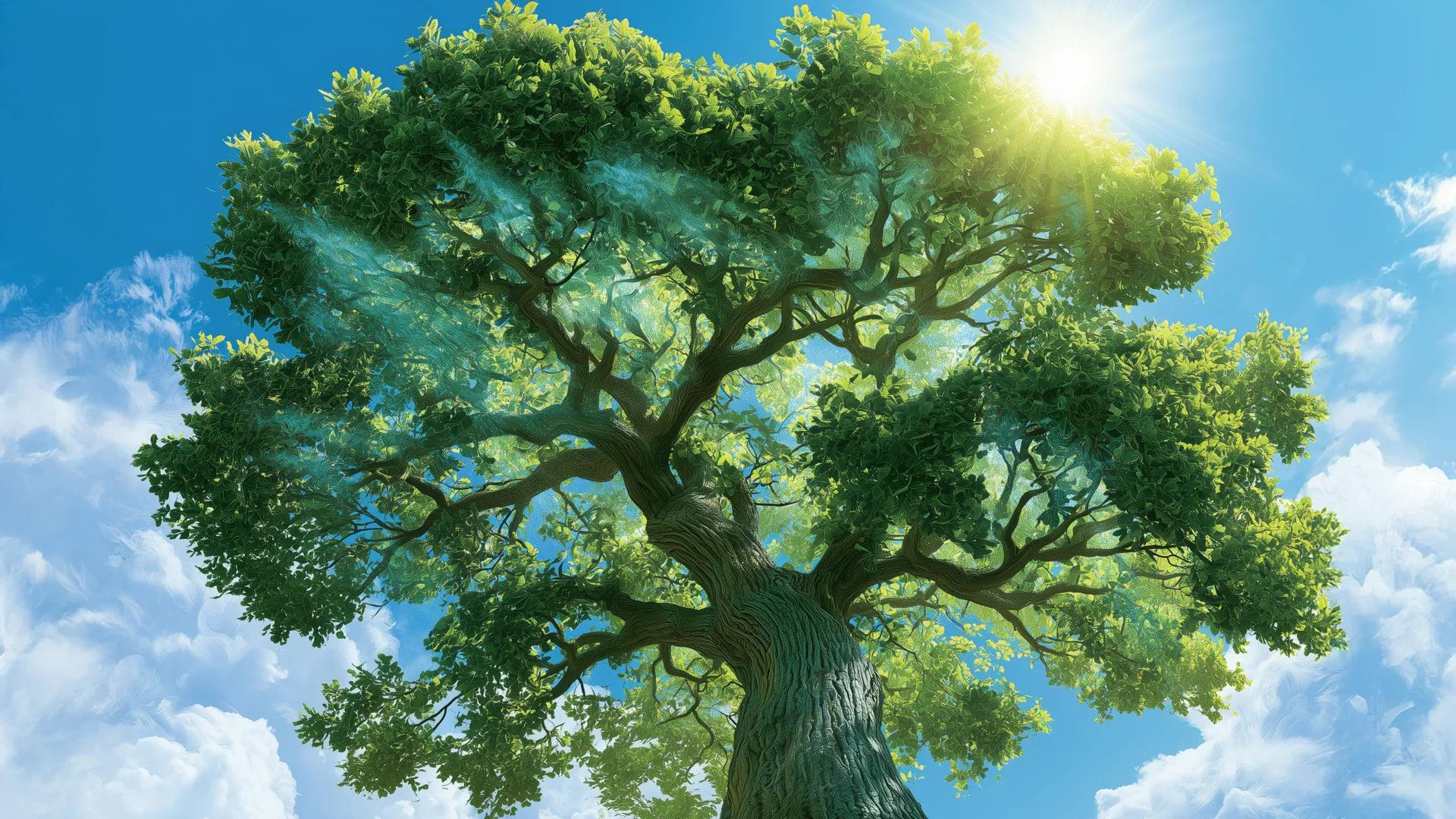
However, a groundbreaking study published in the journal Science Advances has thrown a wrench into these long-standing climate models. Researchers have discovered that trees do not necessarily continue to grow for as long as they photosynthesize. In fact, oak trees across the United States are absorbing significant amounts of carbon long after their annual growth has ceased—suggesting that our current climate projections may be drastically overestimating the amount of carbon that forests can permanently sequester in their trunks, branches, and roots.
The Myth of Linear Carbon Storage
The prevailing wisdom in climate science has long been that photosynthesis and growth are essentially two sides of the same coin. When a tree pulls $CO_2$ from the air, it uses solar energy to convert that gas into sugars. Scientists assumed that a large portion of these sugars would be allocated toward structural growth—the creation of cellulose and lignin that forms the wood of a tree.
This "growth-equals-carbon-storage" assumption is baked into almost every global climate model used to predict the future of the planet. If the assumption is wrong, the implications are profound. If trees continue to pull in carbon but shunt it into short-lived metabolic functions rather than long-term woody biomass, the "carbon sink" capacity of our global forests could be significantly weaker than anticipated.
"Right now, most models assume that if you have photosynthesis, you have growth. We find that’s not the case," says Mukund Palat Rao, an ecoclimatologist at the Lamont-Doherty Earth Observatory and lead author of the study. "Just because there is more photosynthesis might not necessarily mean more tree growth in the future."
Chronology of a Discovery: From Satellite Imagery to Sensor Data
The study represents a Herculean effort to synchronize disparate datasets to see exactly what happens inside a tree on a day-to-day basis. To reach their conclusions, Rao and his colleagues synthesized information from 137 oak forest sites across the eastern United States and California, spanning data from 1950 to the present.
The research process followed a rigorous, multi-layered approach:
- Macro-Analysis (1950–Present): The team analyzed long-term tree ring records and historical temperature data to establish a baseline for how these forests have historically behaved.
- Remote Sensing: They utilized high-resolution satellite imagery capable of detecting the chemical signatures of active photosynthesis across diverse forest ecosystems.
- Real-Time Canopy Monitoring: Scientists placed instruments within the tree canopies to measure $CO_2$ uptake at hourly intervals, providing a granular look at when the trees were actively "breathing."
- Dendrometer Measurements: Perhaps most crucially, the team attached high-precision sensors to tree trunks. These sensors tracked minute changes in trunk diameter. Trees are dynamic structures; they expand at night as roots pull up water and contract slightly during the heat of the day as they transpire. By filtering out these daily fluctuations, the researchers were able to pinpoint exactly when the long-term, permanent growth of the tree stopped.
By layering these datasets, the researchers created a high-definition timeline of the life of an oak tree, revealing a clear and unexpected separation between the metabolic act of photosynthesis and the structural act of growth.
The Seasonal Divide: When Growth Stops but Carbon Intake Continues
The data revealed a striking temporal mismatch between photosynthesis and biomass production.
In the eastern United States, oak trees typically engage in active growth from May through July. However, the study found that these trees continue to photosynthesize well into October. The statistical breakdown is startling: approximately 36 percent of the trees’ annual carbon assimilation occurs after the growth phase has completely shut down.
The pattern in California, while governed by a different seasonal rhythm, was equally telling. California oaks grow primarily between December and April. As the region transitions into the hot, dry summer, their growth slows and eventually ceases by August. Yet, like their eastern counterparts, these trees continue to absorb carbon for months after the growth engine has stalled. Roughly 26 percent of their annual carbon uptake happens during this "post-growth" period.
The Physiology of the "Carbon Disconnect"
Why would a tree continue to work—absorbing energy and $CO_2$—if it is not growing? According to Rao, the answer lies in the harsh reality of hydraulic constraints.
"The moment you have dry and hot conditions, growth activity stops pretty instantly while photosynthesis seems to continue at a slightly decreased rate," Rao explains.
Tree growth is a pressurized process. It requires a specific internal water pressure, known as turgor pressure, to expand cell walls and create new woody tissue. When a tree experiences heat stress or drought, its priority shifts from expansion to survival. It shuts down growth to conserve water and prevent structural damage. Photosynthesis, however, is more resilient. Even under mild stress, a tree will continue to convert light and $CO_2$ into sugars to support other, non-structural functions.
Where does this "extra" carbon go? The researchers identify several "sinks" that are not wood:
- Maintenance Respiration: The carbon is oxidized to provide energy for the basic, ongoing survival of living cells during the winter months.
- Starch Reserves: Trees store carbon as starch to provide a "safety net" to fuel the explosive growth at the start of the next season.
- Root and Leaf Turnover: Much of the carbon is diverted to produce fine roots or new foliage, which die off and decompose relatively quickly compared to a century-old trunk.
- Microbial Nourishment: Trees release carbon-rich compounds into the soil to feed the fungal and bacterial communities in the rhizosphere, which in turn help the tree absorb nutrients and defend against pathogens.
Implications for Global Climate Forecasting
The findings from the Columbia Climate School carry significant weight for global climate policy. If we are to reach "net-zero" goals, we rely heavily on the assumption that forests will naturally soak up a larger portion of our emissions as the atmosphere warms.
If this new study is indicative of global trends, that assumption is flawed in two ways:
- The Overestimation Problem: Current models assume that carbon intake is synonymous with long-term storage. If a significant percentage of that intake is actually used for short-term metabolic needs, our current models are likely overestimating the amount of carbon being sequestered by forests globally.
- The Variability Problem: The team found that the disconnect between photosynthesis and growth becomes even more pronounced during years of extreme weather—specifically, when regions swing between unusually wet and unusually dry periods. As climate change increases the frequency and intensity of these weather extremes, this "growth-photosynthesis mismatch" is likely to become more common, potentially weakening the global forest carbon sink exactly when we need it most.
Future Research and Uncertainties
While the study provides a clear wake-up call, researchers are quick to note that this is only the beginning. The current study focused on oak trees, but forests are composed of thousands of species, from needle-leafed conifers to tropical rainforest giants, all of which may have different physiological strategies for handling carbon.
"I don’t really have answers yet," says Rao. "There are many questions still left to address."
The team is now expanding its research to investigate whether similar patterns appear in other tree species and different biomes, such as the boreal forests of the north or the dense jungles of the tropics. If these patterns are universal, climate scientists will need to recalibrate their models to account for the "carbon leakage" that occurs when trees stop growing but keep breathing.
Ultimately, the study underscores that forests are not static, passive carbon sponges. They are complex, biological organisms that make strategic decisions about how to allocate their resources based on a shifting climate. Understanding the nuances of these decisions is not just a matter of academic interest—it is a critical requirement for predicting the future of our planet’s climate. As we look toward a warmer, $CO_2$-rich future, we can no longer afford to assume that more photosynthesis will lead to more wood. We must look deeper, into the complex metabolic life of the forest, to understand where the carbon truly goes.