Across the Nile from the modern city of Luxor lies the Theban Necropolis, a sprawling landscape of ancient majesty containing more than 400 recorded tombs. For millennia, this site has served as a silent library of Egyptian funerary customs. However, a groundbreaking new study published in Frontiers in Environmental Archaeology is forcing historians to reconsider the narrative of "disorder" often assigned to crowded burial chambers. By focusing on Chamber Three of tomb TT 209, researchers from the University of La Laguna in Spain have unveiled a sophisticated, multi-generational system of "funerary memory" that challenges our understanding of how ancient Egyptians interacted with their ancestors.
The Architecture of Memory: A Multi-Generational Timeline
Constructed during the Twenty-fifth Dynasty (754–656 BCE), tomb TT 209 was never intended to be a static monument. Instead, it served as a dynamic space of communal interment that remained in active use through the Persian period and well into the Ptolemaic era (305–30 BCE).
The research team, led by Dr. Jared Carballo-Pérez and Professor Miguel Ángel Molinero Polo, meticulously excavated the site, documenting the orientation, position, and physical relationship of every artifact and human remain found within the chamber. What they discovered was not a history of abandonment or chaotic looting, but rather a deliberate, evolving dialogue between the living and the dead.
The Early Era: Prestige and Individualism
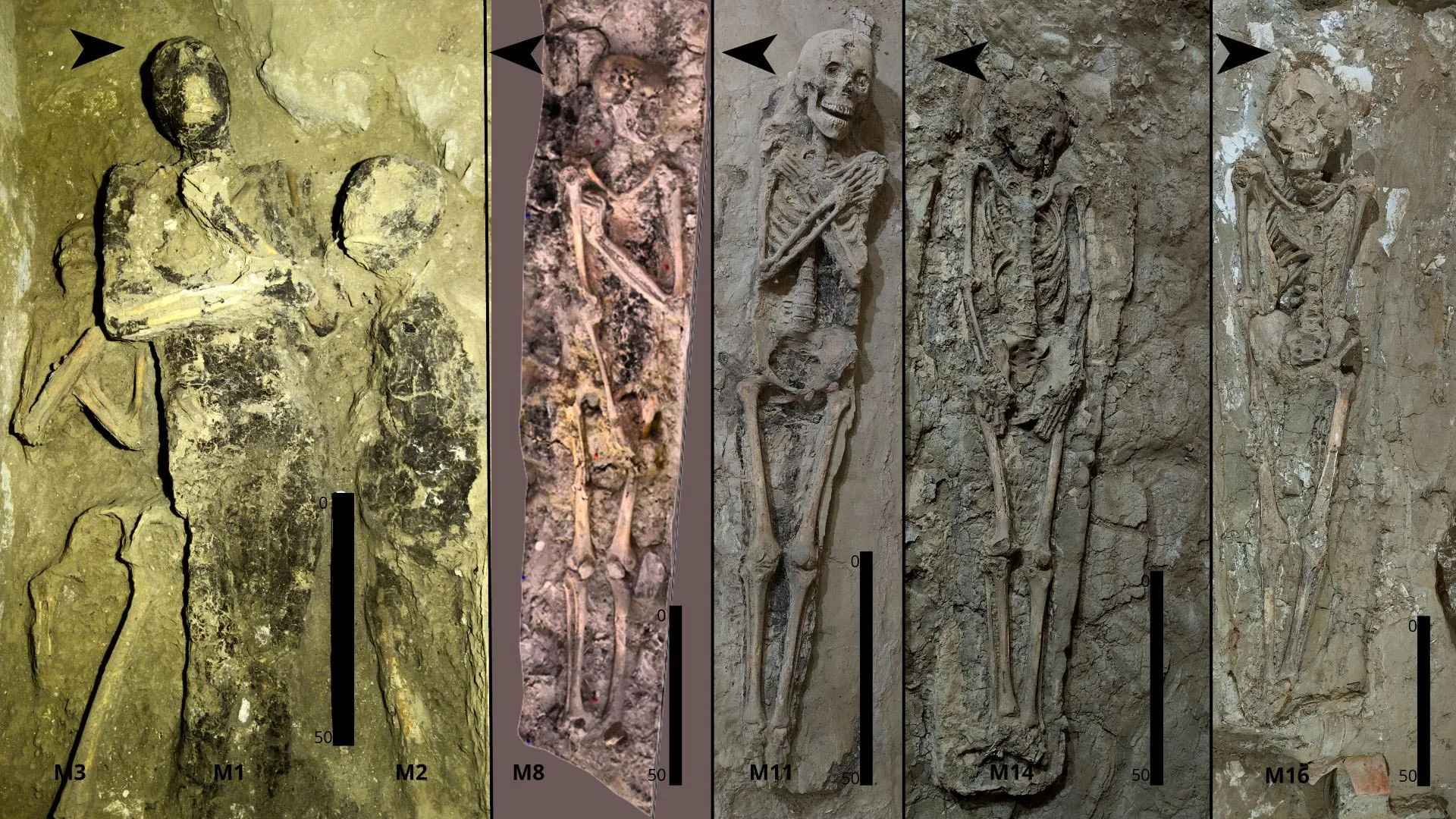
During the earliest phases of the tomb’s history, the space was characterized by a sense of order and exclusivity. The researchers identified nine distinct funerary deposits, with the earliest burials demonstrating clear signs of high social status. Individuals were interred within individual coffins, accompanied by elaborate funerary nets, protective amulets, and high-value grave goods, including Phoenician amphorae—vessels that likely held precious oils or wines intended for the journey to the afterlife. In this period, space was abundant; bodies were placed with careful spacing, respecting the sanctity of each individual’s final resting place.
The Persian Period Shift: Densification and Verticality
As time progressed, the nature of the chamber shifted. By the end of the Twenty-fifth Dynasty and throughout the Persian occupation (circa 680–404 BCE), the available floor space became increasingly scarce. Rather than abandoning the site, the Egyptian populace adapted.
The researchers noted a transition from individual horizontal burials to a more efficient, vertical configuration. Two-thirds of the chamber’s burials eventually featured bodies stacked on top of one another. This was not a result of carelessness, but of spatial pragmatism. Alongside this physical restructuring came changes in mummification style and body positioning. Where early burials featured arms extended along the sides, later interments frequently showcased arms folded across the chest in the "Osirian position," signaling a shift in religious iconography and the evolution of ritual identity over several centuries.
The Mystery of the Mummified Dog: Ritual or Companionship?
Perhaps the most poignant discovery within the southeastern quadrant of the chamber involves a cache dating to the Ptolemaic period. Here, the team unearthed four human mummies stacked vertically, topped with the mummified remains of a dog.
This specific arrangement provides a rare, intimate look at the emotional or symbolic lives of the ancient Egyptians. Dr. Carballo-Pérez notes that the placement of the dog directly atop the human remains is "quite beautiful," suggesting a potential emotional bond between the deceased. However, Professor Molinero Polo offers a more academic interpretation: the dog may have functioned as a psychopomp—a mythical guide tasked with assisting the soul in navigating the perils of the afterlife. This discovery serves as a vital data point in understanding how animal mummification intersected with human funerary rites, hinting that the "ritual" of the tomb was not a rigid script but a living tradition that incorporated new elements as the centuries passed.
Official Perspectives: Rethinking Funerary Behavior
The researchers emphasize that the history of TT 209 is a history of negotiation. "We have few details regarding how the people who entered tombs behaved, what their motivations were in each historical period, and how they conceptually reconfigured the pre-existing space," explains Professor Molinero Polo.
The study argues against the traditional archaeological tendency to label densely packed, multi-layered burials as "disturbed" or "chaotic." By carefully analyzing the stratigraphy, the team demonstrated that the chamber was repeatedly "re-read" by later generations. Each new burial involved a conscious effort to adjust to the presence of predecessors. The "funerary memory" described by the team refers to this continuous process: the act of entering an ancestor’s tomb, recognizing their presence, and finding a respectful way to accommodate a new arrival without destroying the existing legacy.
Challenges in the Archaeological Record
Reconstructing the timeline of a tomb that saw continuous use for over 700 years is a Herculean task. The chamber was not immune to the passage of time or the intervention of external forces. The study notes that the site suffered from multiple flood events and at least one significant fire, both of which shifted debris and disturbed the original arrangement of artifacts.
Furthermore, the team acknowledges that not every deposit can be fully decoded. In certain sections of the tomb, the sheer density of interments makes it impossible to distinguish between a "re-use" out of necessity and a later, perhaps less ritualistic, disturbance. Despite these natural and human-induced complications, the researchers argue that the overall pattern of the tomb is one of sustained cultural continuity rather than degradation.
Implications for Future Archaeology
The findings from TT 209 have significant implications for how Egyptologists and archaeologists interpret other crowded burial sites throughout the Nile Valley. For decades, the presence of stacked bodies and displaced coffins has often been written off as evidence of tomb robbing or administrative failure.
The University of La Laguna team suggests a paradigm shift:
- Redefining ‘Disorder’: Many sites previously categorized as "disorganized" may, upon closer inspection, reveal a high degree of spatial logic that honors earlier burials while making room for the new.
- Social Behavioral Insights: The study highlights that burial practices are reflective of social pressures—such as population density, shifting religious beliefs, and resource management—rather than just static religious dogma.
- The Continuity of Tradition: The transition from horizontal to vertical burials and the adoption of the Osirian position suggest that even when resources were limited, the commitment to proper burial remained a central pillar of Egyptian society.
A New Lens on the Past
By moving away from the assumption that ancient tombs were meant to be sealed forever in their original state, the researchers have opened a window into the lived experience of the ancient Egyptians. The tomb was a theater of memory, a place where the living constantly negotiated their relationship with the dead.
"What we present means that deposits that were previously considered ‘disordered’ can be reinterpreted," says Dr. Carballo-Pérez. "This helps us develop a better understanding of the social behaviors behind funerary practices."
As the scientific community continues to employ more precise digital mapping and high-resolution photographic analysis, the "disordered" tombs of Egypt may yet reveal their true, highly organized histories. The study of TT 209 serves as a profound reminder that the history of death in Ancient Egypt is, ultimately, a story about the endurance of the living.