Introduction: A Sea Reimagined
The Black Sea, historically celebrated for its deep, ink-like waters and strategic position between the crossroads of Europe and Asia, has undergone a dramatic aesthetic shift. For millennia, sailors and coastal dwellers have known these waters by their namesake dark hue. However, as the northern hemisphere warms each spring and summer, the sea sheds its somber mantle, erupting into a vibrant, milky turquoise.
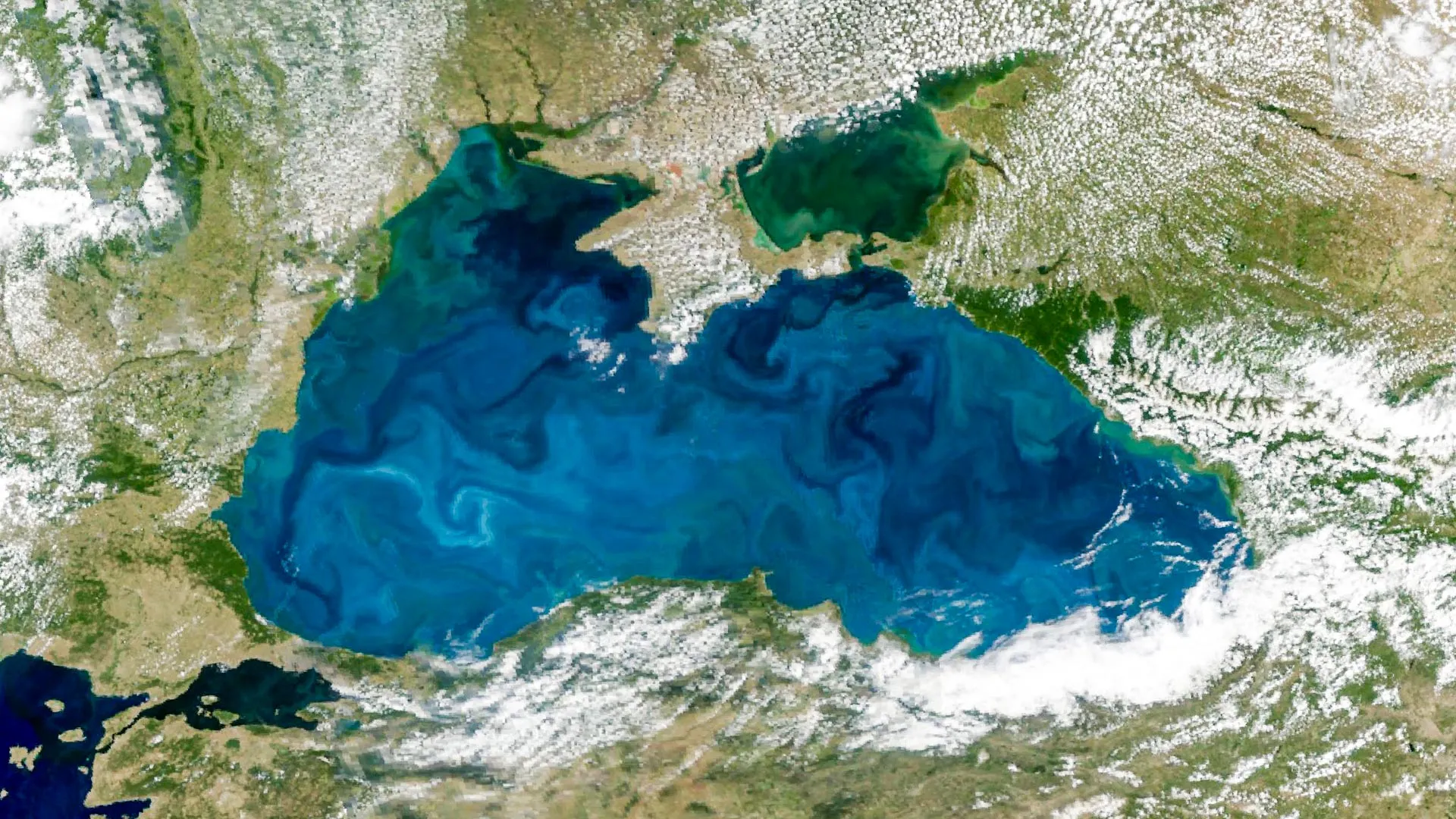
On June 22, 2026, the high-resolution sensors aboard NASA’s Plankton, Aerosol, Cloud, ocean Ecosystem (PACE) satellite provided an unprecedented look at this phenomenon. Utilizing the state-of-the-art Ocean Color Instrument (OCI), the satellite captured a sprawling mosaic of iridescent blues, confirming that this seasonal display is not merely a localized curiosity, but a vast, ecosystem-level event that reshapes the maritime landscape of the region.
Main Facts: The Science of the Bloom
At the heart of this oceanic transformation lies the coccolithophore—a microscopic phytoplankton that punches far above its weight class. Unlike typical marine algae, coccolithophores are encased in calcium carbonate plates, known as coccoliths. When these organisms multiply in the trillions, they fundamentally alter the optical properties of the water.
The Physics of the "Milky" Sea
The turquoise glow is a result of light scattering. As sunlight penetrates the surface layers of the Black Sea, it encounters the dense concentration of reflective, white calcium carbonate plates. These plates act like millions of tiny mirrors, scattering the light back toward the surface and creating the vivid, opaque turquoise appearance that is easily discernible from an orbital altitude of hundreds of kilometers.
Diatoms vs. Coccolithophores
The contrast between the seasons is stark. For much of the year, the Black Sea is dominated by diatoms, another type of phytoplankton. However, diatoms are equipped with silica shells, which absorb more light and lack the reflective, plate-like structures of their turquoise-inducing counterparts. Consequently, when diatoms hold sway, the water maintains the deep, dark appearance that gives the sea its name. The transition from a diatom-dominant environment to a coccolithophore-dominant one marks the definitive arrival of the summer season in the Black Sea basin.
Chronology of the 2026 Event
The 2026 bloom was tracked with a level of precision that was previously impossible, thanks to the synergy between low-Earth orbit satellites and human observation from the International Space Station (ISS).
- May 27, 2026: An astronaut aboard the ISS captured a stunning high-resolution photograph of the Bosphorus Strait. Even at this early stage, the bloom was evident, with swirling patterns of phytoplankton tracing the complex currents of the channel that connects the Black Sea to the Sea of Marmara. The images provided a unique perspective, showcasing the bloom’s interaction with the narrow geography of the Istanbul waterway.
- June 22, 2026: Nearly a month later, NASA’s PACE satellite passed over the region. By this time, the bloom had reached a peak, expanding across vast swaths of the sea. The OCI instrument captured spectral data that allows scientists to analyze not just the color, but the density and composition of the bloom.
- Ongoing Monitoring: Following the June peak, researchers began the process of integrating these satellite observations with regional water sampling data, creating a comprehensive timeline of the 2026 bloom’s lifecycle.
The Bosphorus: A Narrow Gateway to Color
The Bosphorus acts as a hydraulic gate, and the imagery from May 2026 demonstrated exactly how these blooms interact with the unique topography of the Turkish coastline. Because the Bosphorus is a narrow, winding conduit, the phytoplankton blooms are often funneled through the strait, creating distinct visual patterns.
The ISS imagery, captured using a Nikon Z9 camera with a 50-millimeter focal length, showed these blooms behaving like liquid paint, following the fluid dynamics of the current as it moved through the channel. This serves as a vital case study for oceanographers, who use these visual tracers to better understand the movement of water and nutrients between the Black Sea and the Mediterranean system.
Why These Blooms Matter: Ecological and Global Implications
While the turquoise waters are undeniably beautiful, they are also a critical indicator of the health and function of the marine environment.
Monitoring Remote Ecosystems
Collecting water samples in the center of the Black Sea can be logistically difficult, costly, and time-consuming. Satellite observations provided by PACE and the ISS serve as a "remote laboratory." By observing the color of the ocean, scientists can monitor population densities of phytoplankton, track the spread of nutrient-rich waters, and identify changes in marine health without ever needing to deploy a research vessel.
The Earth’s Carbon Cycle
The most profound impact of the coccolithophore bloom, however, is its role in the global carbon cycle. These organisms are biological carbon pumps. During their growth phase, they absorb carbon dioxide from the atmosphere and the surrounding water to construct their calcium carbonate shells.
When the blooms reach the end of their life cycle, the organisms die and sink toward the seafloor. This "marine snow" carries the sequestered carbon into the deep ocean. In the depths of the Black Sea, which is largely anoxic (lacking oxygen) below a certain depth, this organic matter can remain stored for centuries or millennia, effectively removing carbon from the atmosphere and preventing it from contributing to the greenhouse effect.
Official Responses and Data Transparency
NASA’s Earth Observatory has spearheaded the effort to synthesize this data. By utilizing the NASA EOSDIS LANCE (Land, Atmosphere Near real-time Capability for EOS) system and the Worldview interface, researchers have made the 2026 data accessible to the public and the global scientific community.
"The cooperation between the ISS crew and our orbital remote sensing instruments represents the pinnacle of modern earth science," noted a spokesperson from the NASA Johnson Space Center. The ISS Crew Earth Observations Facility ensures that the photographs taken by astronauts are not just artifacts of space travel, but tools for rigorous scientific inquiry.
The imagery captured in 2026 underwent significant processing—including cropping, contrast enhancement, and the removal of lens artifacts—to ensure that the data was as clear as possible for researchers studying the dynamics of the Black Sea. This transparent approach allows climate scientists, marine biologists, and students alike to examine the same data, fostering a collaborative approach to understanding our changing oceans.
Future Outlook: The Role of PACE
The PACE mission is designed to provide a "look under the hood" of the ocean’s biological processes. By measuring the light reflected from the ocean at a much higher resolution and across more wavelengths than previous satellites, PACE allows scientists to distinguish between different types of phytoplankton.
As climate change continues to alter ocean temperatures and nutrient availability, the frequency and intensity of these blooms are expected to shift. The 2026 event provides a baseline, a snapshot in time that will be compared against future years to determine if the "Turquoise Transformation" of the Black Sea is intensifying.
The Path Forward
The scientific community remains focused on three main objectives regarding these blooms:
- Quantification: Calculating the exact tonnage of carbon sequestered during the peak of the 2026 bloom.
- Predictive Modeling: Developing algorithms that can predict the start of the blooming season based on sea surface temperature and nutrient runoff data.
- Human Impact Analysis: Assessing how human-induced changes, such as agricultural runoff entering the Black Sea via the Danube and other rivers, might be influencing the size and duration of these blooms.
The Black Sea may be "black" by name, but as the 2026 data clearly shows, it is a dynamic, living, and fundamentally colorful body of water. As NASA’s PACE satellite continues its mission, the world can expect a clearer view of the invisible microscopic processes that maintain the balance of our planet’s climate. The turquoise glow is more than just a summer aesthetic—it is a vital, breathing pulse of the Earth’s biological machinery.