Introduction: The High Cost of the Digital Frontier
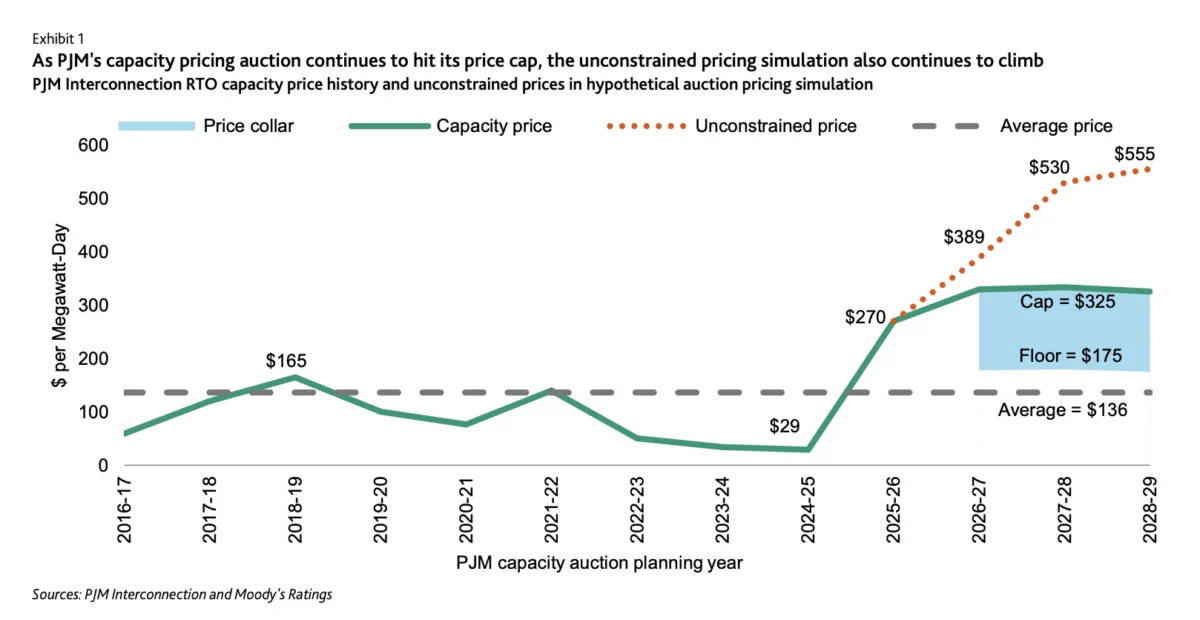
For the third consecutive capacity auction, the price of maintaining electrical reliability across a 13-state territory in the Eastern United States has collided with its legal maximum. On July 14, PJM Interconnection—the nation’s largest grid operator—announced that its capacity auction for the 2028-29 delivery year cleared at $325 per megawatt-day. This figure represents the absolute ceiling allowed under current market rules.
The result is more than a technical market signal; it is a klaxon for the American economy. As Big Tech accelerates its buildout of artificial intelligence (AI) and massive data centers, the infrastructure required to power this revolution is straining the grid to its breaking point. While the "AI Gold Rush" promises unprecedented technological advancement, a growing chorus of credit agencies, regulators, and consumer advocates warns that the bill for this expansion is being quietly shifted onto the shoulders of ordinary households and small businesses.
Main Facts: A Grid Under Unprecedented Strain
PJM Interconnection serves approximately 65 million people, spanning a geography that includes Illinois, Pennsylvania, New Jersey, Maryland, Virginia, and the District of Columbia. Its capacity auctions are designed to ensure that enough power generation is available to meet future demand, essentially paying power plants a "retainer" to be ready to produce electricity during peak periods.
The latest auction results reveal three critical, interconnected crises:
- Price Saturation: For the third time in a row, prices hit the regulatory cap. Without these caps, PJM’s simulations suggest the unconstrained price would have skyrocketed to $554.72 per megawatt-day across the region, and as high as $776.69 in the Chicago-area zone served by ComEd.
- Supply Shortfall: Despite the record-high prices intended to incentivize new generation, the auction fell 6.8 gigawatts (GW) short of the target needed to maintain the grid’s reliability buffer.
- Cost Socialization: Unlike other markets that require large-scale industrial users to fund the infrastructure they necessitate, PJM’s current framework "socializes" these costs. This means the multi-billion-dollar expense of building new plants and transmission lines to serve data centers is spread across the entire ratepayer base.
Chronology: The Road to the $16 Billion Bill
The current crisis did not emerge in a vacuum. It is the result of a "perfect storm" of rapid coal plant retirements, a sluggish interconnection queue for renewable energy, and an explosion in demand that caught planners off guard.
- 2022-2023: PJM began sounding alarms as the pace of traditional power plant retirements (primarily coal and older gas units) outstripped the entry of new resources. Environmental regulations and economic pressures led to a significant "missing" chunk of generation.
- Late 2023: The "AI Boom" hit full stride. Hyperscalers like Amazon, Google, and Microsoft began scouting and breaking ground on massive "gigawatt-scale" data center campuses, particularly in Northern Virginia (known as "Data Center Alley") and Ohio.
- January 2024: PJM’s previous auction results showed the first major signs of price stress, as the grid operator revised its load growth forecasts upward for the first time in nearly two decades.
- July 2, 2024: PJM recorded a peak electricity demand of 168.2 GW, shattering a record set nearly twenty years ago.
- July 14, 2024: The 2028-29 auction results were finalized, confirming that the market had hit the $325 ceiling and that the total capacity charges for the region would hit a staggering $16.4 billion.
- July 22, 2024: Moody’s Ratings issued a sector report flagging the "credit negative" nature of these high prices for regulated utilities and the inherent unfairness of the current cost-sharing model.
Supporting Data: Breaking Down the Numbers
The financial scale of the shift is immense. According to Monitoring Analytics, PJM’s independent market monitor, the $16.4 billion in total capacity charges represents a massive jump from previous years.
The Data Center Contribution
Of that $16.4 billion, approximately $6.3 billion is directly attributable to the projected demand from data centers. Over the last four auctions combined, the cumulative cost impact of data center demand on the PJM market has reached $29.4 billion. These are not theoretical costs; they are obligations that will eventually manifest in monthly utility bills.
The Supply-Demand Gap
The auction cleared only 525 megawatts (MW) of brand-new generation capacity. This is a pittance compared to the 6.8 GW shortfall. For context, 525 MW is roughly the output of one medium-sized natural gas plant, while the shortfall represents the equivalent of nearly seven large nuclear reactors.
Projections for Ratepayers
The consulting firm ICF has projected that households and businesses within PJM territory could see their electricity rates spike by as much as 60% over the next five years. This is corroborated by real-world anecdotes: Consumer Reports recently highlighted an Ohio resident whose monthly bill jumped to $281, a trend they link to the localized infrastructure upgrades required to support nearby data center corridors.
Official Responses: Dispassionate Warnings and Defensive Utilities
The reaction to these market signals has been divided between those sounding the alarm and those attempting to manage public perception.
The Credit Perspective: Moody’s Ratings
Perhaps the most significant critique came from Moody’s Ratings. As a credit rating agency, Moody’s is focused on financial risk rather than social advocacy. Their July 22 report was unusually blunt, stating: "The current system lacks adequate mechanisms to ensure that the cost of building new supply is borne by the new entrants and instead socializes new build costs across all customers."
Moody’s further noted that PJM is an outlier. Other U.S. markets, such as ERCOT in Texas, have more robust mechanisms requiring "large-load customers" to secure power under direct supply contracts. These contracts ensure the "hyperscalers" pay for the generation and transmission they require, rather than leaning on the general public.
The Regulatory Response: PJM and FERC
Recognizing that the market is failing to produce enough power, PJM has taken the extraordinary step of asking the Federal Energy Regulatory Commission (FERC) for permission to hold an emergency "backstop" capacity auction in September. This move is a tacit admission that the standard market-based approach is no longer sufficient to guarantee that the lights stay on in 2028 and beyond.
The Utility Stance
Publicly, many utilities are walking a tightrope. In earnings calls, executives often assure investors that the data center boom is a massive growth opportunity. To regulators, however, they maintain that they are working to protect ratepayers. Yet, as Harvard Law’s Electricity Law Initiative points out, utilities often benefit from "socialized" costs because it allows them to build massive amounts of infrastructure with a guaranteed rate of return, paid for by the entire customer base.
Implications: The Fairness Doctrine and Grid Reliability
The PJM auction results have sparked a debate that transcends energy policy, touching on themes of corporate responsibility and social equity.
1. The Fairness Debate
The central question is one of "who pays?" If a massive tech company builds a facility that consumes as much power as a small city, should the residents of that city pay for the new power plant required to run it? Currently, in the PJM region, the answer is "yes." This has led to a backlash in state legislatures, with lawmakers in Maryland and Virginia considering bills that would force data centers to pay higher "impact fees" or enter into direct power purchase agreements.
2. The Reliability Risk
Beyond the cost, there is the physical risk of blackouts. If the market continues to hit price caps but fails to attract new supply, the grid’s "reserve margin" will continue to shrink. In a world of increasingly frequent extreme weather events—both winter storms and summer heatwaves—a thin reserve margin is a recipe for catastrophic grid failure.
3. The Energy Transition at a Crossroads
The surge in AI demand is complicating the transition to clean energy. Because wind and solar are variable, the grid still requires "firm" capacity (like gas or nuclear) to back them up—especially for data centers that require 24/7/365 uptime. The scarcity of power is forcing some regions to delay the retirement of coal plants, potentially setting back climate goals in order to keep AI servers humming.
4. The Potential for Market Reform
Analysts suggest that the "PJM model" must evolve. Potential reforms include:
- Direct Contracting: Requiring any customer adding more than, for example, 100 MW of load to bring their own "new" power to the grid.
- Locational Marginal Pricing for Capacity: Charging more in specific zones (like Northern Virginia) where demand is highest, rather than averaging costs across the 13-state region.
- Expedited Permitting: Streamlining the process for new generation to enter the "interconnection queue," which currently faces years of delays.
Conclusion: A Bill Long Overdue
The $325-per-megawatt-day ceiling reached by PJM is a mathematical representation of a physical reality: we are running out of easy power. The AI revolution is not happening in a digital vacuum; it is tethered to the physical world by copper wires, transformers, and turbines.
As Moody’s and other watchdogs have observed, the "socialization" of these costs is a policy choice, not a law of nature. For the 65 million people living under PJM’s umbrella, the coming years will likely be defined by a struggle over these costs. While Big Tech companies report record profits fueled by AI, the residents of the Mid-Atlantic and Midwest are beginning to realize that they are the ones subsidizing the electricity that makes those profits possible. Without significant regulatory intervention, the "invisible tax" of AI is poised to become a very visible—and very expensive—fixture of the American utility bill.