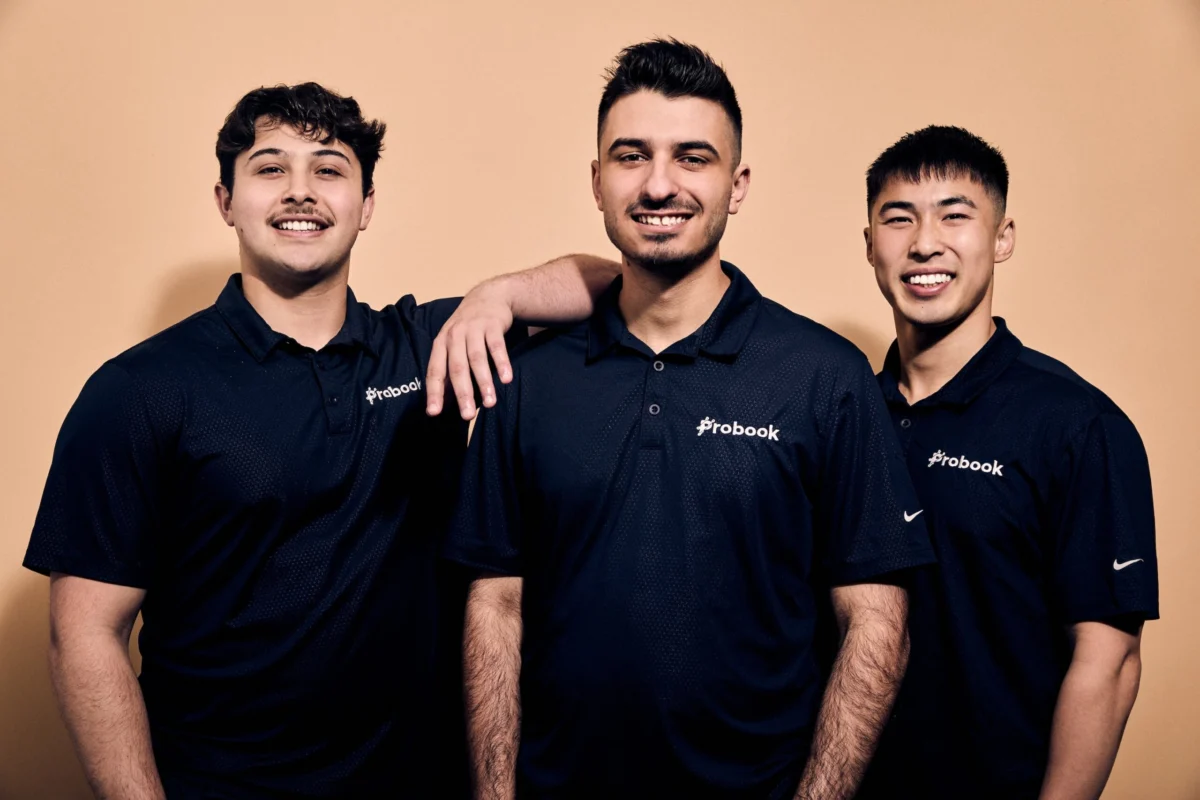
For six consecutive summers, George Eliadis did not spend his time at prestigious internships or coding at hackathons. Instead, he was on the front lines of the American trades, pressure washing houses across upstate New York alongside his father. It was grueling, manual work that provided a front-row seat to the logistical nightmares that plague small-to-medium-sized home service businesses.
Fast forward to today, and Eliadis, now 24 and a graduate of the University of Pennsylvania’s Wharton School, has translated that grit into a technological powerhouse. His New York-based startup, Probook, recently emerged from stealth with $40 million in funding from the two most storied names in venture capital: Andreessen Horowitz (a16z) and Sequoia Capital.
The investment—a $34 million Series A led by a16z and a $6 million seed round led by Sequoia—marks a significant bet on the "blue-collar AI" revolution. Probook is not just another software-as-a-service (SaaS) tool; it is being positioned as an "AI operating system" designed to solve the deep-seated inefficiencies of a $700 billion industry.
Main Facts: Automating the "Brain" of Home Services
At its core, Probook targets the "dispatch" function—the logistical nerve center of any HVAC, plumbing, or electrical contracting business. While the tech industry has spent the last decade digitizing white-collar workflows, the trades have largely been left with fragmented tools that often create more work than they save.
The Dispatch Dilemma
In a typical home service outfit, a dispatcher is tasked with a complex, real-time puzzle: assigning dozens of technicians to hundreds of jobs daily. This requires balancing geography, technician skill levels, estimated "ticket size" (potential revenue), and customer urgency.
"Dispatch is the brain of every home service business," Eliadis told Fortune. "That’s where customer experience is made or broken."
The Probook Solution
Probook’s platform functions as an autonomous scheduler. Unlike previous generations of software that required manual entry and human oversight, Probook’s AI:
- Answers and triages calls: Automatically identifying the nature of the service request.
- Optimizes scheduling: Using machine learning to decide which technician should go to which job to maximize profit and minimize travel time.
- Cleans data: Ensuring that job histories and customer information are accurate without human intervention.
- Customer communication: Sending real-time updates to homeowners, bridging the communication gap that often leads to poor reviews.
Chronology: From the Driveway to the Boardroom
The rise of Probook is a study in "founder-market fit"—the idea that a founder’s personal history makes them uniquely qualified to solve a specific problem.
The Early Years (2015–2021)
Eliadis’s journey began in the suburbs of New York, where he learned the mechanics of home services through his family’s pressure-washing business. While his peers were focused on the digital economy, Eliadis was observing the friction of the physical one: missed calls, lost leads, and the chaos of paper-based or rudimentary digital scheduling.
The Wharton Pivot (2021–2024)
At Wharton, Eliadis refined his understanding of the macro-economic forces at play. He recognized that while the trades were traditionally viewed as "low-tech," they were becoming an attractive asset class for institutional investors. He began developing the architecture for Probook, focusing specifically on the dispatch problem that he knew was the industry’s primary bottleneck.
The Funding Blitz (Early 2025 – Mid 2026)
Probook’s ascent was rapid. In early 2025, Sequoia Capital led a $6 million seed round, betting on Eliadis’s deep domain expertise. By mid-2026, the company’s growth and early pilot successes attracted Andreessen Horowitz. David Haber, a General Partner at a16z, spearheaded the $34 million Series A, recognizing that Probook had built a "structural moat" by solving the hardest problem in the trade stack first.
Supporting Data: The Economic Impact of Autonomous Dispatch
The home services industry is currently undergoing a massive transformation driven by private equity and a shortage of skilled labor. Probook’s value proposition is backed by startling early performance metrics from its pilot customers.
Efficiency Gains and Revenue Growth
Probook has moved beyond the "proof of concept" stage and is delivering tangible ROI for its users:
- The Indiana Case Study: A large operator in Indiana with 14 locations and 260 technicians reported booking 2,542 jobs in its first month on Probook without a single human touchpoint in the booking process.
- Headcount Optimization: A Florida-based operator was able to reduce its dispatch staff from 22 to 10, allowing the remaining staff to focus on high-value customer service rather than administrative data entry.
- Revenue Per Job: A Kansas-based shop reported a 20% increase in average job revenue, as the AI prioritized high-value calls and optimized technician-to-job matching based on historical sales performance.
The Private Equity Rollup Trend
The timing of Probook’s entry is critical. Investment firms have been aggressively acquiring local HVAC and plumbing shops, bundling them into massive regional entities to achieve economies of scale.
- Growth Rate: Private equity acquisitions in the home services sector saw an 88% year-over-year growth through mid-2025.
- The Need for Standardization: These rollups require a unified software layer to manage disparate shops. Probook’s "AI OS" offers a plug-and-play solution for PE firms looking to squeeze higher margins out of their portfolios.
Official Responses: Investors and the Competitive Landscape
The venture capital community’s enthusiasm for Probook stems from Eliadis’s authentic connection to the industry—a rarity in the world of high-growth tech.
The Sequoia Endorsement
Konstantine Buhler, the Sequoia partner who backed Eliadis from the seed stage, emphasized the importance of his background. "Most founders building for the trades have never worked in them," Buhler noted. "George has. He understands the psychology of the technician and the stress of the owner in a way a pure software engineer never could."
The a16z Perspective
David Haber of a16z described Probook’s approach as a "years-old structural moat." By focusing on the dispatch engine—the most difficult part of the business to automate—Probook has made itself indispensable. "They didn’t start with the easy stuff like chat widgets," Haber suggested in a statement. "They started with the brain."
The ServiceTitan "Coopetition"
The elephant in the room is ServiceTitan, the $6.3 billion giant that currently dominates the home services software market. While ServiceTitan has its own AI scheduling products, Probook is currently positioned as a partner rather than a direct rival.
- Integration: Probook is listed as a ServiceTitan partner, allowing it to sit on top of existing data.
- The Founder’s Stance: Eliadis describes the relationship as "complementary," arguing that Probook provides a specialized, deep-AI layer that generalist platforms cannot match. However, with ServiceTitan reporting nearly $1 billion in annual revenue, the long-term relationship between the incumbent and the challenger remains a point of intense industry speculation.
Implications: The Future of the "Deskless" Economy
The success of Probook signals a broader shift in the venture capital landscape. After years of focusing on "SaaS for SaaS," investors are looking toward the "real world" economy—industries that are recession-resistant and essential to national infrastructure.
1. The Democratization of AI
For decades, sophisticated logistics AI was the exclusive domain of giants like Amazon or UPS. Probook is effectively "democratizing" this technology, giving a local plumbing outfit with 40 trucks the same level of routing and dispatch intelligence as a global logistics firm.
2. Solving the Labor Shortage
The "Blue-Collar Shortage" is a well-documented crisis in the U.S. By automating the administrative and logistical burdens of the trade, Probook allows the existing workforce to be more productive. If a technician spends less time driving and more time on-site, the "capacity" of the entire industry increases without needing to hire more people—a critical advantage in a tight labor market.
3. The "Founder Obsession" Model
Eliadis’s hands-on approach—having slept on customers’ couches and attended their weddings—represents a return to a more "boots-on-the-ground" style of entrepreneurship. In an era of remote work and detached digital founders, the Probook story suggests that the next wave of billion-dollar companies may be built by those willing to get their hands dirty.
4. Margin Expansion in the Trades
As home services continue to professionalize under private equity ownership, the demand for "efficiency software" will only grow. Probook is positioned not just as a tool, but as a financial engine that directly impacts the bottom-line EBITDA of the businesses it serves.
Conclusion
George Eliadis has successfully bridged the gap between the pressure washer and the boardroom. With $40 million in the bank and the backing of Silicon Valley’s elite, Probook is set to prove that the most fertile ground for AI innovation isn’t in the cloud—it’s in the vents, pipes, and electrical panels of every home in America. As the $700 billion home services industry continues to modernize, Probook’s "AI Operating System" may well become the standard for how the physical world gets maintained.