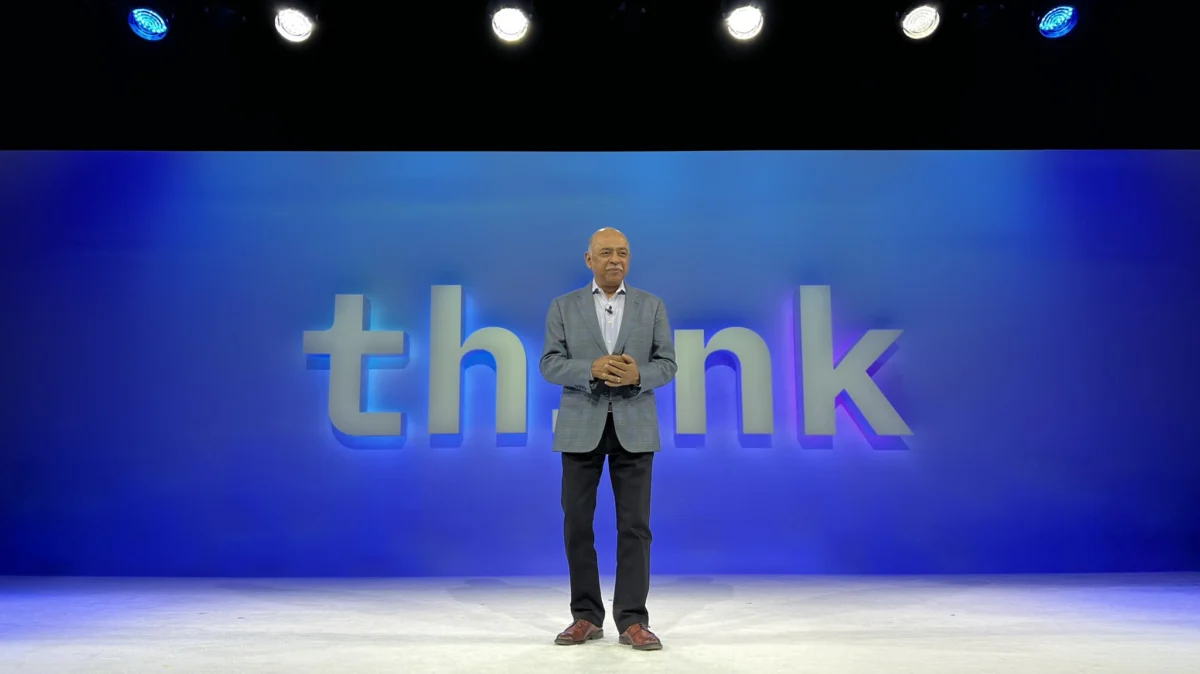
For the 115-year-old technology titan IBM, Wednesday served as a sobering reality check. While the company continues to operate as a high-margin cash-generation machine—posting $17.2 billion in revenue and $9.9 billion in gross profit—the numbers fell drastically short of the lofty expectations set by Wall Street. The resulting market reaction was not merely a disappointment; it was a historic reckoning that has sent shockwaves through the enterprise technology sector.
The quarterly report confirmed the fears whispered by analysts last week: the "AI boom," which had acted as a tailwind for IBM for much of CEO Arvind Krishna’s six-year tenure, has paradoxically become its greatest vulnerability.
The Chronology of a Collapse
The crisis did not arrive as a surprise, thanks to an unprecedented move by IBM leadership. Recognizing the magnitude of the impending shortfall, CEO Arvind Krishna and the board of directors took the rare step of issuing a formal warning to investors prior to the official earnings call.
The Warning Shot
Last week, Krishna published a candid "Letter to Investors," providing preliminary data that signaled trouble in the company’s "infrastructure" division. The letter warned of "abysmal" revenue figures and a contraction in profit margins, effectively ripping the bandage off early. The market’s reaction was instantaneous and brutal: IBM’s stock plummeted 25% in a single day—the largest single-day decline in the company’s storied history.
The Official Report
On Wednesday, the full extent of the damage was quantified. The company officially lowered its full-year growth forecasts, signaling that this was not merely a seasonal anomaly, but a structural shift that would weigh on the company’s performance for the remainder of the fiscal year.
Dissecting the Data: The Mainframe Deficit
The primary culprit behind the earnings miss was the company’s flagship mainframe business, which saw a staggering 42% decline in revenue. To understand the gravity of this, one must understand the "cascading" nature of IBM’s business model.
The Multiplier Effect
During the earnings call, CFO Jim Kavanaugh articulated the fundamental math of IBM’s operations: for every $1 of mainframe hardware sold, the company traditionally realizes $3 in associated software revenue. By losing the initial hardware sale, IBM effectively suffered a four-fold hit to its projected income.
The "Tens" That Mattered
Management characterized the shortfall as a result of "tens" of customers delaying their scheduled mainframe upgrades. While a dozen or so customers may sound like a negligible figure for a global conglomerate, these are not typical consumer transactions.
- Unit Cost: Individual mainframe systems often cost hundreds of thousands to millions of dollars.
- The Ecosystem: A single mainframe deal carries years of maintenance contracts, specialized middleware, and recurring software licensing fees that scale into the millions.
When "tens" of these massive contracts are deferred, the balance sheet feels it immediately.
The AI Paradox: Why the Boom Sank the Boat
Perhaps the most ironic aspect of this quarterly collapse is that the very phenomenon driving the rest of the tech industry—the rapid, AI-driven expansion of data centers—is the direct cause of IBM’s current distress.
Budgetary Cannibalization
IBM executives explained that their clients did not abandon the mainframe because of a lack of utility; they abandoned it because they ran out of money. As the AI arms race accelerated, the cost of fundamental data center hardware—servers, high-end storage, and processing units—surged.
Tech giants and enterprise clients alike faced a sudden reality: component costs, particularly for high-end memory, skyrocketed as demand from AI developers outstripped supply. Companies like Dell, HP, and Apple have all reported similar pressures, with some enterprise hardware prices climbing by as much as 30%.
"When they were faced with that issue, then they decided to move budget to those areas where they were having that extreme price," Krishna explained. Essentially, enterprise IT budgets, which are finite, were reallocated from long-term infrastructure (the mainframe) to immediate, high-cost AI-ready hardware.
Official Responses: A Narrative of Resilience
Despite the optics of the situation, the leadership at IBM remained steadfast in their messaging. Both Krishna and Kavanaugh spent the duration of the investor call emphasizing that this is a "temporary blip" rather than a fundamental erosion of the business.
The "No Evidence" Defense
CEO Arvind Krishna was categorical in his defense of the mainframe’s longevity. "We see no evidence of clients moving off the mainframe," he insisted. According to IBM, the customers who deferred their purchases have not moved to a competitor; they have simply hit "pause."
Kavanaugh bolstered this by noting that some clients have already returned to the fold this quarter, suggesting that the "missing" revenue is merely delayed rather than lost. The company’s strategy remains predicated on the belief that the mainframe remains the backbone of the global financial and enterprise system—a system that, for all its AI-driven upgrades, still relies on the reliability and security of IBM’s legacy architecture.
Broader Implications for the Tech Landscape
The IBM earnings miss raises critical questions about the current state of the global technology market.
The Resilience of Legacy
For decades, industry pundits have predicted the "death of the mainframe." Yet, the platform has survived the rise of the PC, the emergence of the cloud, and the transition to mobile. The current situation suggests that while the mainframe is not dead, it is increasingly sensitive to the volatility of broader hardware markets. When the AI-induced "hype cycle" forces prices upward elsewhere, the mainframe becomes a convenient target for budget cuts.
The Risks of Concentration
IBM’s reliance on the mainframe-to-software multiplier is a double-edged sword. When the hardware cycle is healthy, the model generates massive, high-margin revenue. When the cycle is interrupted—whether by macro-economic factors or sudden spikes in component costs—the company’s entire revenue stream suffers a multiplier effect in the opposite direction.
A Test of Leadership
Arvind Krishna is now facing the most significant test of his tenure. Having successfully guided the company toward a hybrid cloud and AI strategy, he must now prove that this strategy can withstand the cyclical pressures of the hardware market. If the "delayed" sales do not materialize in the coming quarters, the narrative of a "temporary blip" will quickly lose its efficacy, and pressure on the board to pivot further may become inevitable.
Conclusion: The Long Road Ahead
As the dust settles from the market reaction, the tech world is left with a complex picture of a company that remains immensely profitable, yet highly vulnerable to the volatile economics of the AI era.
IBM’s challenge is to bridge the gap between its legacy architecture and the new, AI-centric reality of data center procurement. While management maintains that their "tens" of lost customers will return, the market is currently in a "show me" phase. Investors are no longer content with the promise of future earnings; they are looking for stability in a market that, for the first time in years, seems to be pushing back against the high costs of the AI revolution.
For now, the mainframe lives on—but its survival is tied more closely to the unpredictable prices of computer memory and server components than anyone at Big Blue would prefer to admit. The coming quarters will determine whether this was truly just a "blip" or the beginning of a more permanent decline in the way enterprises build their computing foundations.