For over a decade, the North American automotive landscape has been conspicuously devoid of a Nissan-branded minivan. Following the quiet discontinuation of the Nissan Quest—a vehicle that once stood as a bold, if polarizing, competitor in the family-hauler segment—the Japanese automaker retreated from the segment in the United States, leaving the market to domestic stalwarts and a few remaining imports. However, while the American market shifted its focus toward three-row crossovers and SUVs, Nissan’s commitment to the MPV (Multi-Purpose Vehicle) segment never wavered in its home market.
Today, that commitment reaches a new zenith with the official launch of the 2026 Nissan Elgrand. Representing the fourth generation of a nameplate that has defined premium family transport since 1997, the new Elgrand is more than a simple successor; it is a technological statement of intent, blending hybrid efficiency with lounge-like luxury.
A Legacy Reborn: The Chronology of the Elgrand
To understand the significance of the 2026 model, one must look back at the trajectory of the Elgrand. When the first generation debuted in 1997, it revolutionized the concept of the Japanese "luxury van." It was designed to offer the utility of a commercial hauler with the refinement of a high-end sedan.
Over the decades, the Elgrand has evolved through three distinct iterations, each balancing the need for massive interior volume with increasingly sophisticated mechanical underpinnings. The fourth generation, first teased at the 2025 Japan Mobility Show, marks the most radical departure in the model’s history. By transitioning away from traditional internal combustion powertrains, Nissan is signaling a shift toward electrified family mobility that does not sacrifice power for sustainability.
Engineering the Future: The E-Power System
The most significant headline for the 2026 Elgrand is the total abandonment of the aging V6 and four-cylinder platforms in favor of Nissan’s proprietary E-Power architecture. This sophisticated series-hybrid system represents a masterclass in modern drivetrain engineering.
At the heart of the setup is a 1.5-liter three-cylinder turbocharged gasoline engine. Crucially, this engine does not drive the wheels directly; instead, it acts exclusively as a high-efficiency generator, providing electricity to a dual-motor electric system. This configuration allows the engine to operate within its most efficient RPM range consistently, drastically reducing emissions while maintaining a constant power reserve.
The vehicle utilizes the e-4ORCE all-wheel-drive system, which intelligently manages torque distribution across all four wheels. This provides the Elgrand with a level of stability and traction rarely seen in the minivan segment, particularly in inclement weather conditions. The immediate, linear torque delivery of the electric motors transforms the driving experience from the sluggish feel of traditional vans to something far more responsive and engaging.
A Sanctuary on Wheels: Interior Refinement
If the exterior is a futuristic exploration of shape and light, the interior is a masterclass in ergonomics and hospitality. The Elgrand has long been marketed as a "business class" vehicle, and the 2026 iteration leans heavily into this identity.
The centerpiece of the cabin is undoubtedly the second-row seating arrangement. In top-tier trims, passengers are treated to "Zero Gravity" captain’s chairs. These are not merely seats; they are high-tech recliners that integrate adjustable ottomans and lumbar support, designed to mimic the weightlessness of a zero-gravity environment to reduce fatigue on long journeys. For those who prioritize utility over individual luxury, Nissan continues to offer a traditional three-seat bench, ensuring the vehicle remains as versatile as it is opulent.
The front cabin is equally impressive, featuring a dual 14.3-inch screen array that spans the dashboard, providing the driver with critical telemetry and infotainment in a sleek, bezel-less interface. To enhance the "lounge" atmosphere, Nissan has incorporated 64-color ambient lighting that can be tailored to the mood of the passengers.
Audio fidelity is handled by a bespoke 22-speaker Bose sound system. By integrating speakers directly into the headrests, Nissan has created a personalized soundstage, allowing passengers to enjoy immersive audio without disturbing others in the cabin. The aesthetic is rounded out by authentic Kumiko wood trim—a traditional Japanese latticework technique—which bridges the gap between ultra-modern tech and timeless craftsmanship. In a nod to modern personalization, the interior is even available in a striking purple hue, a bold choice that underscores the Elgrand’s desire to stand out in a sea of beige and grey competitors.
Aesthetics: The "Futuristic Funk" of the Exterior
Designing a minivan is a notorious challenge for automotive stylists, as the boxy proportions required for interior space often conflict with aerodynamic and aesthetic goals. The 2026 Elgrand tackles this by embracing its geometry rather than hiding it.
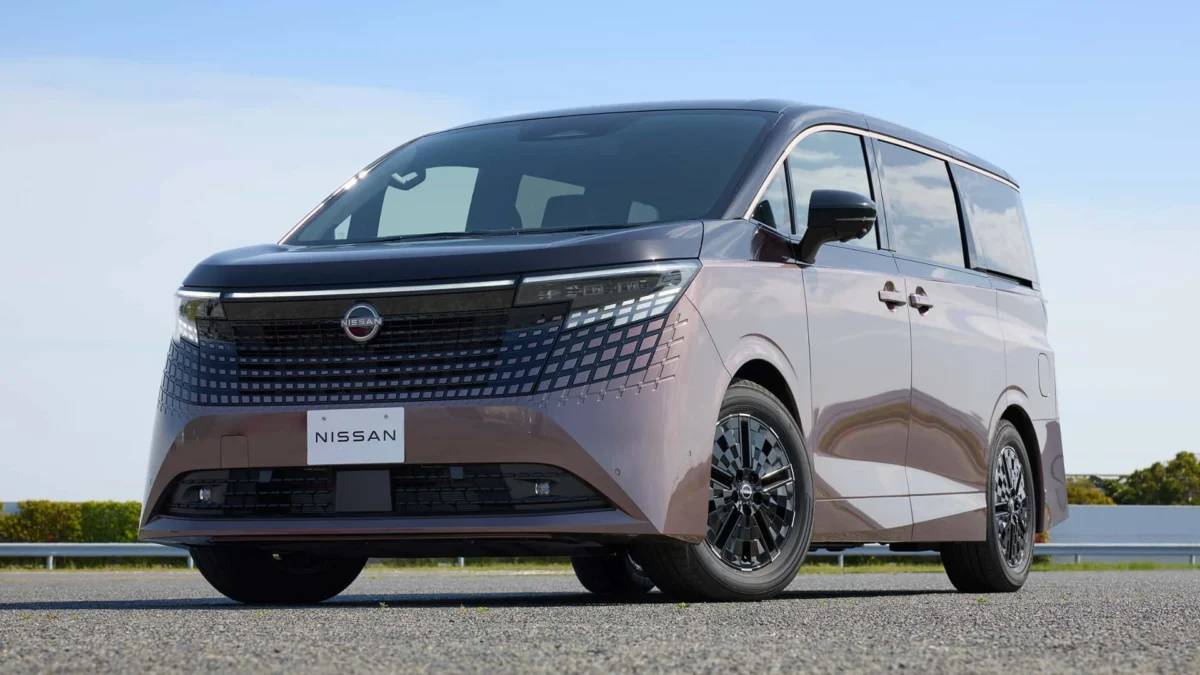
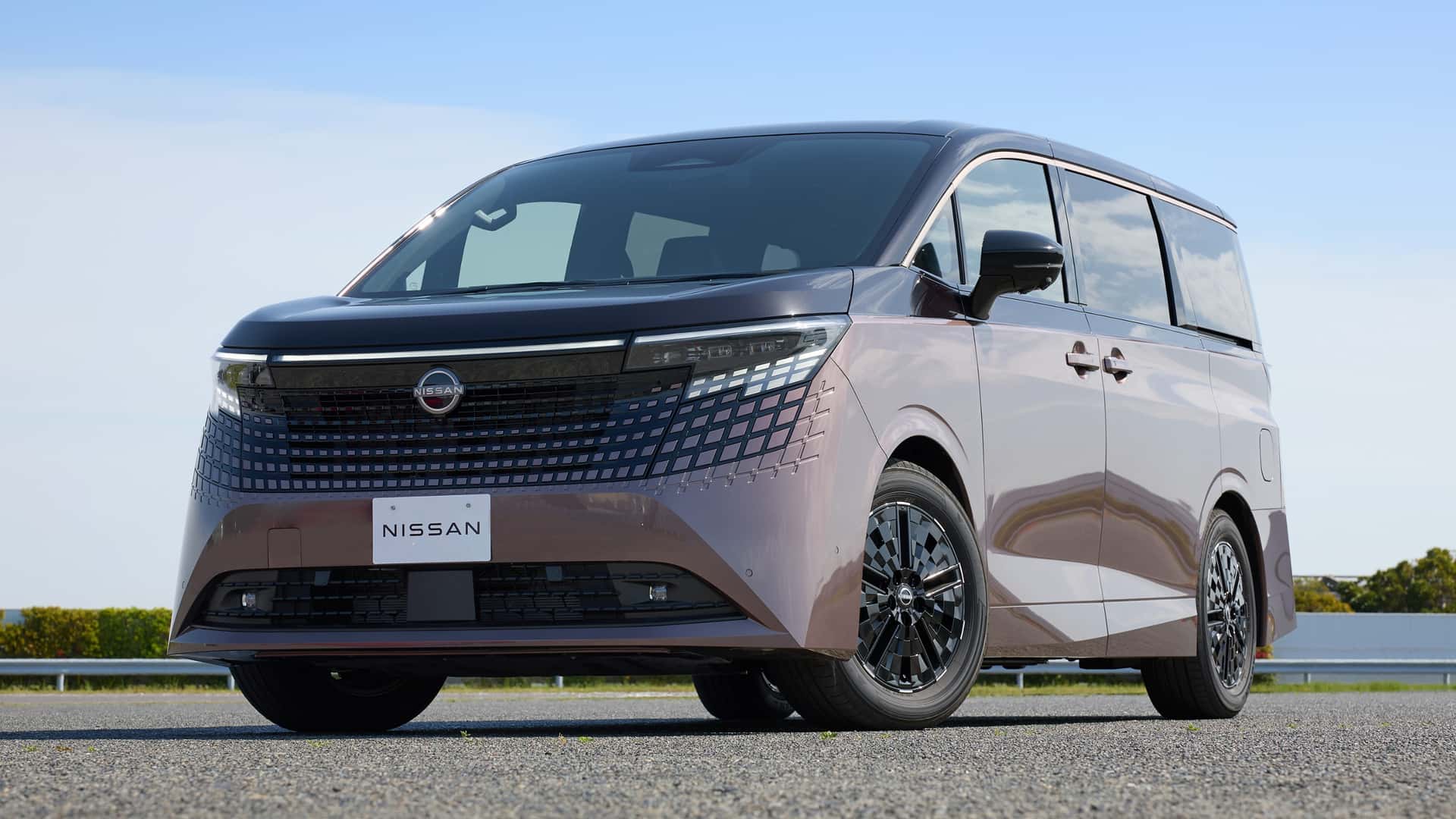
The front fascia is dominated by a complex, multi-layered grille. Instead of a traditional mesh, the grille is composed of individual square pieces that create a lattice effect, giving the van a solid, architectural presence. This is punctuated by a full-width light bar that acts as a signature daytime running light, providing a futuristic, high-tech glow.
The profile is accentuated by a daring two-tone paint scheme, featuring a metallic finish on the upper body and a distinct rose-gold accent on the lower panels. This design choice, while unconventional, serves to break up the "slab-sided" look typical of large vans. At the rear, the design language is mirrored by a one-piece light bar, wrapping around the corners to emphasize the width of the vehicle. It is, by all accounts, a design that demands attention—a sharp departure from the anonymity of the modern crossover.
Market Implications and the Case for a US Return
While the 2026 Elgrand is currently a Japan-exclusive product, its debut raises a pertinent question: Could it, or should it, return to the United States?
The North American minivan segment is currently experiencing a renaissance. Data from 2025 indicates a 21 percent surge in segment sales, with total volume nearing 400,000 units annually. This growth is driven by a demographic of families who have realized that, regardless of the aesthetic appeal of a three-row SUV, the sliding-door functionality and vertical interior space of a minivan remain the gold standard for practical living.
Furthermore, the luxury minivan space is seeing renewed interest. As premium manufacturers like Mercedes-Benz prepare to launch electric-focused people movers, a gap is opening for a brand that can offer Japanese reliability, hybrid fuel efficiency, and genuine interior luxury.
For Nissan, the Elgrand could solve two problems at once. First, it provides a high-margin, halo product that could capture the growing number of buyers looking for something more sophisticated than the traditional domestic minivan. Second, if rebadged as an Infiniti, the Elgrand could serve as a much-needed injection of innovation for a brand that has struggled to find its footing in the premium crossover market.
At a starting price of approximately ¥6,897,000 (roughly $42,500 USD), the Elgrand is positioned as a competitive offering. While import regulations and market localization would certainly raise that cost for a North American debut, the value proposition—especially considering the technology on offer—remains compelling.
Conclusion: A New Benchmark
The 2026 Nissan Elgrand is a reminder that the minivan does not have to be a surrender to parenthood; it can be a vessel for comfort, technology, and design. By integrating the E-Power hybrid system, pushing the boundaries of cabin luxury, and adopting a bold, futuristic exterior, Nissan has effectively raised the bar for what a family vehicle can be.
Whether or not the Elgrand ever hits the streets of Los Angeles or New York remains to be seen. However, for those who value the intersection of form, function, and cutting-edge propulsion, the 2026 Elgrand is a triumph of automotive design. It is a vehicle that commands respect, not because it is a "utility" tool, but because it treats every passenger as a priority. For the time being, it stands as the jewel of Nissan’s Japanese lineup—a standard-bearer for the future of the segment.