Introduction: A Violent Heritage
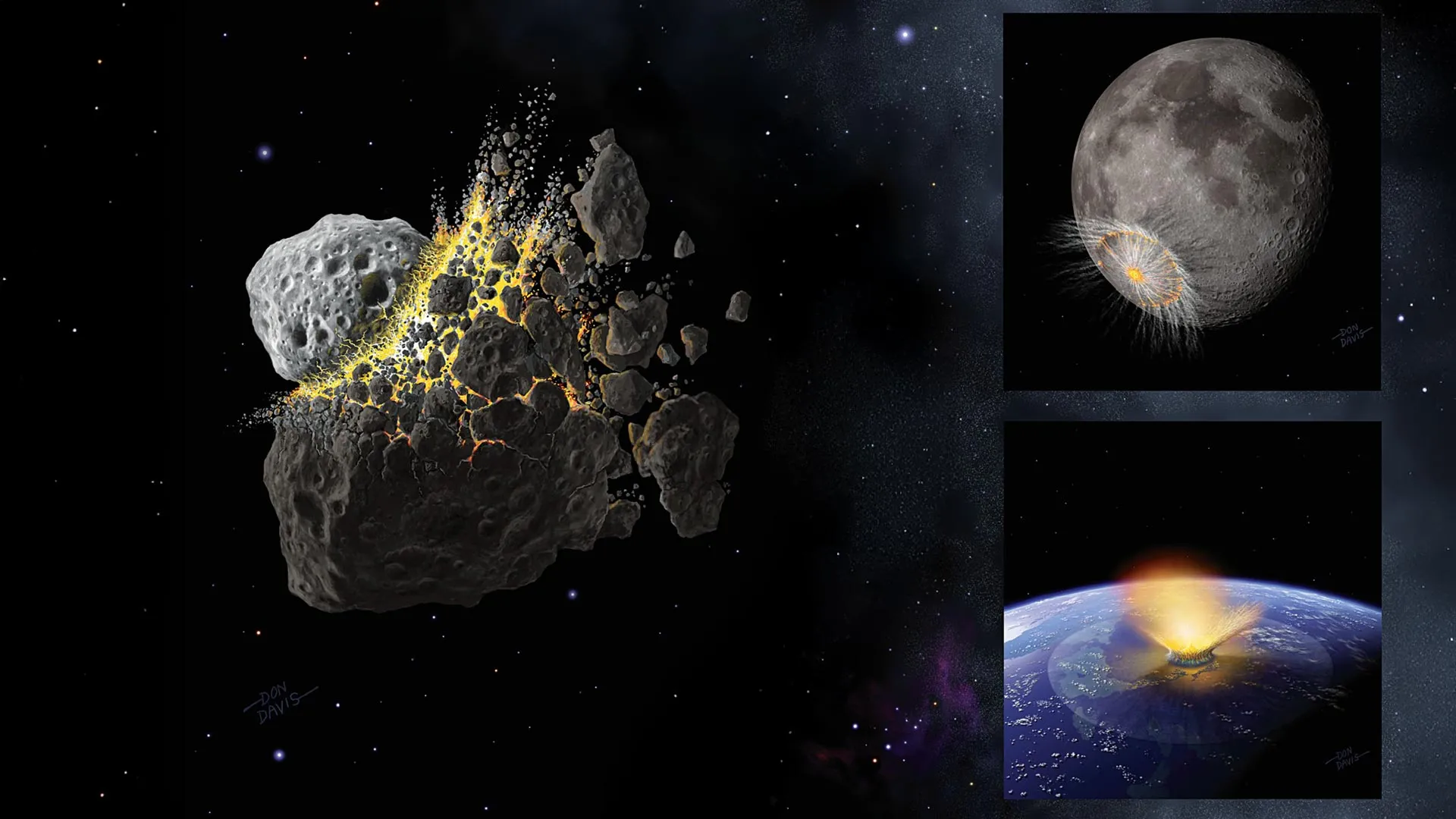
For eons, the inner solar system has been a theater of dramatic geological and biological evolution. While we often view Earth as a cradle of life protected by the steady rhythm of its orbit, the reality is far more volatile. A groundbreaking study led by the Southwest Research Institute (SwRI) has unveiled a cosmic "smoking gun" from 800 million years ago: a massive, violent collision in the main asteroid belt that likely triggered a sustained, multi-planet bombardment of the inner solar system.
This research, spearheaded by Dr. William Bottke, an executive director in SwRI’s Solar System Science and Exploration Division, suggests that the destruction of a singular, massive parent asteroid—the progenitor of the modern-day Eulalia asteroid family—sent a deluge of debris raining down upon Earth, the Moon, and Mars. This event was not merely a momentary flash of violence; it was a prolonged, epoch-defining barrage that may have fundamentally altered the climate and biological trajectory of our planet.
The Chronology of a Celestial Collision
The story begins roughly 800 million years ago, a time when Earth was in the midst of the Cryogenian period, an era characterized by profound climate fluctuations and the early evolution of complex life. According to the SwRI models, the main asteroid belt—the vast ring of debris residing between Mars and Jupiter—witnessed a catastrophic breakup.
The Eulalia Disruption
The parent body of the Eulalia family, a primitive carbonaceous chondrite-like object, was obliterated in a high-velocity impact. Unlike smaller, isolated collisions, this event was unique due to its location. The parent body was situated precariously close to the J3:1 mean motion resonance with Jupiter.
In the language of orbital mechanics, the J3:1 resonance is an "escape hatch." Any object falling into this gravitational pocket is subjected to rhythmic, intensifying nudges from the gas giant Jupiter. These gravitational pulses eventually destabilize the object’s orbit, pushing it out of the safety of the asteroid belt and into an elongated trajectory that crosses the paths of the terrestrial planets.
A Prolonged Siege
The impact did not release all its fury at once. The simulation data indicates a two-stage assault:
- The Initial Wave: Approximately 50% of the fragments from the Eulalia breakup were ejected into the J3:1 resonance almost immediately, creating a spike in impact frequency across the inner solar system.
- The Yarkovsky Tail: Over the subsequent 100 to 150 million years, an additional 25% of the debris was nudged into the resonance through the Yarkovsky effect. This phenomenon occurs as asteroids absorb sunlight and emit it as heat; the uneven thermal radiation acts as a tiny, persistent thruster that gradually alters an asteroid’s orbit over millions of years.
This mechanism transformed a single, discrete collision into a protracted, hundreds-of-millions-of-years bombardment, effectively turning the inner solar system into a celestial shooting gallery.
Supporting Data: The Moon as a Geological Archive
Reconstructing events that occurred hundreds of millions of years ago is a daunting task, particularly on Earth. Our planet is a dynamic, living machine; plate tectonics, persistent volcanism, and the relentless erosion of wind and water constantly recycle the crust. Consequently, the geological record of impact craters older than 650 million years has been largely scrubbed away.
The Lunar "Time Capsule"
To look back further, scientists turn to the Moon. Lacking an atmosphere, active tectonics, or liquid water, the Moon serves as a pristine, static archive of the solar system’s history. The craters that pockmark the lunar surface are not merely scars; they are chronological data points.
By analyzing the ages of large lunar craters and studying impact glass—molten rock formed during high-energy collisions that captures a snapshot of the event’s timing—researchers have identified a distinct surge in lunar impacts roughly 800 million years ago. These data points align perfectly with the orbital models of the Eulalia breakup, providing a rare cross-reference between asteroid belt dynamics and cratering statistics.
The Earth-Moon Disparity
The study emphasizes that the impacts on the Moon are only a fraction of the story. Because Earth possesses a significantly larger gravitational cross-section, it would have been a "magnet" for this debris. Researchers estimate that for every large fragment that struck the Moon, approximately 20 objects of similar or greater size collided with Earth.
Official Responses: Insights from the Experts
Dr. William Bottke, who also directs the Center for Lunar Origin and Evolution (CLOE) at NASA’s Solar System Exploration Research Virtual Institute, emphasizes the paradigm-shifting nature of these findings.
"The role impacts have played in shaping the origin and evolution of life in our solar system is poorly understood," Bottke stated. "The heavily cratered surface of the Moon serves as a reminder of the large impacts in Earth’s past, but so far, only the Chicxulub impact event 66 million years ago has been strongly linked to a specific effect on life, namely the mass extinction of the dinosaurs."
Bottke notes that while the Chicxulub event is the most famous, it represents only a single data point in a much larger, darker history. By linking the Eulalia breakup to a wider temporal window, the research team is moving toward a more holistic view of planetary evolution. "On Mars, these impacts would have triggered substantial episodes of seismic shaking and can be linked in time with a surge in volcanic activity. Together, this showcases how certain catastrophic collisions in the main belt could have had far-reaching consequences for the history of the terrestrial planets," Bottke added.
Implications: Impacts, Climate, and Biology
The most provocative aspect of this research lies in the potential connection between the Eulalia bombardment and the biological history of Earth. The 800-million-year-old impact spike coincides with a period of intense global cooling and significant shifts in the biosphere.
Environmental Catalysts
While the study does not definitively claim that the asteroid barrage caused these climatic shifts, the timing is strikingly coincidental. Large impacts introduce massive amounts of dust, sulfur, and debris into the atmosphere, potentially triggering sudden "impact winters" or altering planetary albedo. Furthermore, the seismic energy released by such a sustained bombardment could have triggered localized volcanic activity or destabilized gas hydrates, further impacting the climate.
A New Lens for Astrobiology
This research provides a new framework for astrobiologists. If major, long-duration asteroid showers are a predictable result of asteroid belt dynamics, then the evolution of life on rocky worlds may be as much a product of "cosmic weather" as it is of biological adaptation.
The Eulalia event serves as a reminder that Earth is not an isolated system. The terrestrial planets are tethered to the asteroid belt by gravity, and the history of our biosphere may be inextricably linked to the violent collisions occurring millions of miles away.
Conclusion: Future Directions
As we continue to map the asteroid belt and refine our models of the Yarkovsky effect and orbital resonances, we gain a clearer picture of the risks and histories of our cosmic neighborhood. The SwRI study represents a significant leap forward in "cosmic forensics," allowing us to bridge the gap between geological evidence on the Moon and the biological evolution of Earth.
Future research will likely focus on identifying more of these "collision families" and mapping their impacts to specific geological periods on Earth. By understanding these ancient barrages, we not only gain insight into our past but also develop a more sophisticated understanding of the hazards that could influence our future. The heavens, it seems, have a long memory, and we are only just beginning to decipher the secrets written in the craters of our neighbors.