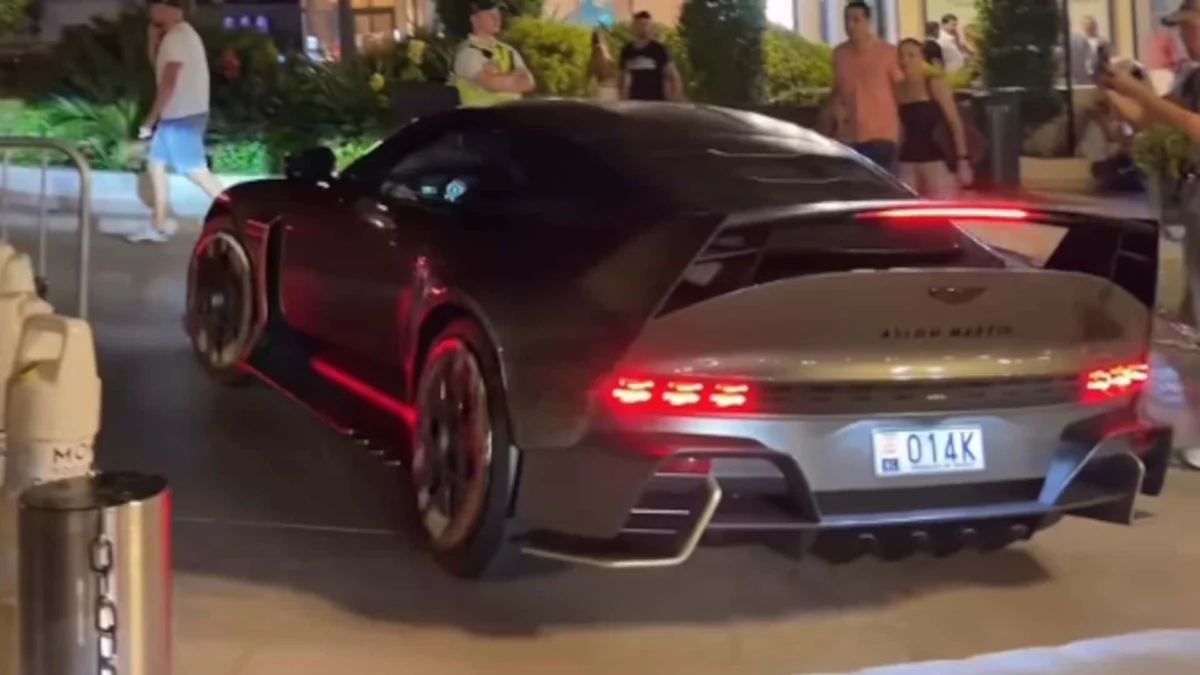
In the glittering, high-stakes ecosystem of Monaco, where the world’s most exclusive automobiles are merely background noise, one silhouette recently managed to stop traffic. Beneath the neon glow of the Casino de Monte-Carlo, a sleek, menacing black Aston Martin Valiant crept through the night, its round LED daytime running lights piercing the Mediterranean darkness. The driver behind the wheel was none other than two-time Formula 1 World Champion Fernando Alonso.
While the Aston Martin Valkyrie—a hypercar often spotted in the Principality—is a marvel of engineering, the Valiant is a different breed entirely. It is a rare, visceral, and strictly limited-production machine that represents a fundamental shift in how boutique manufacturers are engaging their most elite ambassadors.
The Genesis of an Analog Icon
To understand the significance of Alonso’s midnight cruise, one must look at what the Valiant represents in the current automotive landscape. In an era where the industry is rapidly pivoting toward electrification, hybrid assistance, and the digital mediation of the driving experience, the Valiant stands as a defiant monument to the analog era.
Under its aggressively sculpted, carbon-fiber hood lies a 5.2-liter twin-turbocharged V12 engine capable of producing 735 horsepower and a staggering 555 lb-ft of torque. However, the headline figure is not the power; it is the delivery. Aston Martin has paired this powerhouse with a six-speed manual transmission—a feature that has become functionally extinct in the supercar segment. There are no paddle shifters, no dual-clutch lightning-fast logic, and no electronic safety nets acting as intermediaries between the driver’s right foot and the rear wheels. It is a machine designed for the purist, by the purist.
A Chronology of Collaboration
The Valiant did not emerge in a vacuum. Its development represents a departure from the traditional "celebrity brand ambassador" model. Instead of simply signing his name to a marketing campaign, Fernando Alonso was embedded into the design and engineering process.
- Initial Concept (Late 2023): Aston Martin sought to create a "driver-focused" special that could bridge the gap between their heritage grand tourers and their high-performance track specials.
- The "Alonso Influence" Phase: Drawing upon his two decades of Formula 1 experience, Alonso provided direct feedback on chassis dynamics, weight distribution, and the tactile feel of the manual gearbox. His involvement was reportedly centered on stripping away unnecessary electronic weight and honing the car’s turn-in response.
- Public Debut and Validation: Following its reveal, the car was showcased to a select group of collectors. The sight of Alonso driving the production-spec vehicle through the tight, unforgiving streets of Monaco confirms that the car has moved from the drawing board to the real world—and that the F1 veteran is its primary champion.
Engineering the "Villain": Supporting Technical Data
The Valiant is visually and mechanically distinct from its sibling, the Aston Martin Valour. While the Valour was designed as a celebration of the brand’s history, the Valiant is designed for the apex.
Key technical specifications that highlight its track-focused nature include:
- Weight Reduction: Extensive use of 3D-printed components and lightweight carbon fiber panels significantly reduces the unsprung mass compared to the standard Vantage or Valour platforms.
- Aerodynamic Sculpting: The rear wing is not merely aesthetic; it provides critical downforce, while the unique taillamps and aero-discs on the alloy wheels reduce drag and improve cooling for the high-output V12.
- Suspension Geometry: The car features custom-tuned dampers designed to handle the visceral torque of the V12 while remaining compliant enough for road use, a balance that reflects Alonso’s preference for a "planted" yet communicative chassis.
Unlike the Valhalla—the company’s hybrid, mid-engine supercar—the Valiant retains a front-engine layout. This is a deliberate choice. By keeping the weight of the massive V12 up front, the car retains the traditional "long-hood" proportions of a classic sports car, offering a driving experience that is fundamentally different from the mid-engine, hybrid-heavy competitors currently flooding the market.
The Implications for Aston Martin
For a storied British brand that has undergone significant financial and corporate restructuring in recent years, the Valiant is a vital proof of concept.
1. Boutique Credibility
By positioning the Valiant as an ultra-limited production run, Aston Martin is signaling its intent to dominate the "bespoke" segment of the market. These cars are not intended to compete with mass-market luxury vehicles; they are intended to be instant collectibles. The involvement of a figure as respected as Fernando Alonso lends the brand a level of technical credibility that marketing budgets simply cannot buy.
2. The Manual Transmission Debate
Aston Martin is currently navigating a complex internal debate: Should they continue to offer manual gearboxes, or should they succumb to the industry trend of fully automatic, high-performance transmissions? The success and reception of the Valiant suggest that there is a massive, untapped market of enthusiasts who are willing to pay a premium for the "three-pedal" experience. The Valiant proves that the manual gearbox is not a relic—it is a selling point.
3. A Template for the Future
The collaboration with Alonso serves as a roadmap for future "Special Projects" at Aston Martin. By utilizing the feedback of their F1 drivers, the company can refine its production cars to feel more visceral and track-ready, allowing their consumer vehicles to benefit from the halo effect created by their racing endeavors.
Official Stance and Market Position
Aston Martin has remained relatively quiet regarding the specific financial arrangements of the project, focusing instead on the technical achievement. However, in a statement provided during the car’s announcement, design executives emphasized that the Valiant was "never meant to be a high-volume product."
The scarcity of the vehicle—fully allocated to a handful of elite clients—ensures that the Valiant will remain a rare, almost mythical sight. It sits in a unique niche alongside the likes of the Pagani Utopia or the Gordon Murray Automotive T.50, where the focus is entirely on the mechanical engagement between man and machine.
Conclusion: Why the Valiant Matters
The sight of Fernando Alonso maneuvering the Valiant through the narrow, historic tunnels of Monaco is a poignant reminder of what makes the automotive world special. In a future where autonomous driving and electrification are the inevitable default, the Valiant is a defiant "last stand" for the combustion engine and the manual transmission.
For the collector, the car represents an investment in history. For the enthusiast, it represents the pinnacle of modern engineering blended with old-school engagement. But for Aston Martin, it represents something even more significant: it is the proof that, even as the world changes, they can still build a car that makes a two-time World Champion smile. As long as there are drivers like Alonso who crave the connection of a manual shifter, there will be a place for the Valiant.
The Monaco streets may be filled with Ferraris, McLarens, and Porsches, but on this particular night, it was the black Valiant that commanded the room. It was not just a car; it was a statement of intent, and a reminder that in the world of high-performance automobiles, character is the one thing that can never be replicated by an algorithm.