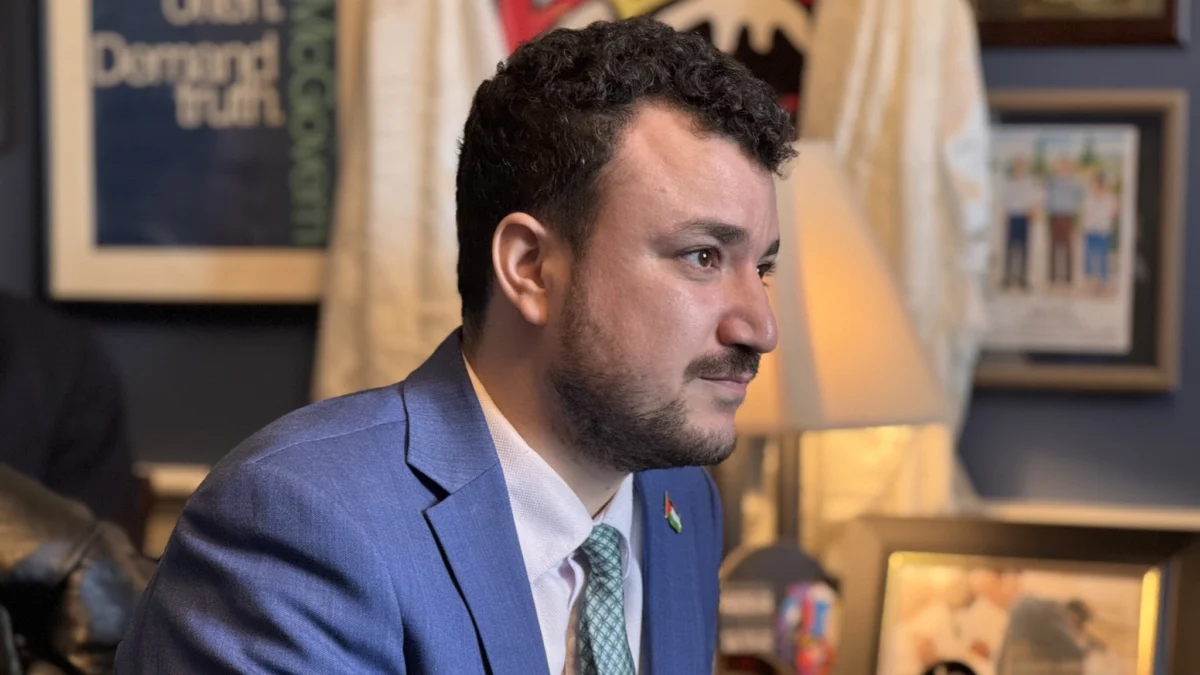
In a sweeping legal challenge that threatens to expose the mechanics of state-sanctioned political retaliation, Mahmoud Khalil, a prominent Palestinian rights advocate and former Columbia University graduate student, filed a landmark lawsuit in federal court this Tuesday. The 131-page complaint alleges a sophisticated, multi-pronged conspiracy between high-ranking Trump administration officials and influential private organizations to systematically identify, harass, and deport non-citizen activists based solely on their political speech.
The litigation, filed under the Ku Klux Klan Act of 1871—a Reconstruction-era statute designed to protect civil rights against conspiracies of intimidation—marks a significant escalation in the ongoing battle over the limits of free speech for non-citizens in the United States. Khalil, a lawful permanent resident married to a U.S. citizen, asserts that he was targeted as a "public face" of campus activism, ultimately leading to his detention and a near-successful effort to strip him of his residency status.
The Cast of Defendants: A High-Level Nexus of Power
The lawsuit is notable for its expansive list of defendants, which bridges the gap between official government policy and private ideological surveillance. The complaint names several heavyweights of the current administration, including Senior Presidential Advisor Stephen Miller, Secretary of State Marco Rubio, Secretary of Homeland Security Markwayne Mullin, Acting Attorney General Todd Blanche, former Secretary of Homeland Security Kristi Noem, and State Department official John Armstrong.
Beyond government actors, the suit targets the Heritage Foundation—a conservative think tank—and two online surveillance entities: Canary Mission and Betar. These private organizations are accused of acting as the "eyes and ears" for the federal government, providing the intelligence and "dossiers" that enabled immigration authorities to prioritize the removal of political dissidents.
Chronology of a Coordinated Campaign
To understand the scope of the alleged conspiracy, the complaint details a timeline that begins long before Khalil’s arrest.
The Genesis: Project Esther (October 2024)
The foundation of the alleged conspiracy, according to the legal filing, rests on the Heritage Foundation’s "Project Esther." Published in October 2024, the document outlined a blueprint for a "public-private partnership" designed to identify non-citizen students and scholars engaged in pro-Palestinian advocacy. The goal, the complaint argues, was to utilize the power of the federal government to arrest and deport these individuals, effectively chilling campus dissent.
The Surveillance Apparatus
The complaint alleges that the Heritage Foundation did not act alone. Canary Mission and Betar, groups known for cataloging the activities of student activists, allegedly curated lists of targets to be handed over to the Department of Homeland Security (DHS) and Immigration and Customs Enforcement (ICE). This pipeline was so streamlined that, as cited in the complaint, an ICE official testified in a separate federal proceeding that approximately 75 percent of the names investigated by his unit originated from Canary Mission data.
The Arrest and Detention (March 2025)
On March 8, 2025, the alleged conspiracy manifested in the life of Mahmoud Khalil. ICE agents arrested the graduate student, leading to his incarceration in an immigration detention center in Louisiana. Khalil remained in custody for 104 days, a period during which he missed the birth of his first child. His legal team argues that this detention was not a standard immigration enforcement action, but a targeted act of political intimidation designed to break his resolve and silence his advocacy.
Supporting Data and Evidence of Collusion
The 131-page complaint is bolstered by what the plaintiffs describe as a paper trail of collusion. The core of the legal argument is that the government effectively outsourced its investigative work to private groups that held an ideological vendetta against the activists.
The Outsourcing of Enforcement
Legal experts point to the "75 percent" figure as a potential smoking gun. If a federal agency is relying on private, non-governmental groups—which have no oversight, no requirement for due process, and a clear political agenda—to determine who should be subjected to state detention, it raises profound constitutional questions. The lawsuit argues that this constitutes a "deprivation of rights under color of law," a direct violation of the 14th Amendment and the KKK Act.
The "Willing Administration"
The complaint highlights internal communications and public-facing policy documents that show an eagerness within the executive branch to leverage these private databases. By framing the arrest of student activists as "national security" or "immigration enforcement," officials allegedly sought to bypass the legal protections normally afforded to activists engaged in protected speech.
Official Responses and Strategic Silence
As of the filing, the response from the named defendants has been limited. A spokesperson for the Heritage Foundation issued a brief statement describing the lawsuit as a "meritless attempt to distract from legitimate immigration enforcement efforts."
The Department of Justice and the Department of Homeland Security have not yet filed formal responses, though sources close to the administration suggest that the government will likely seek to dismiss the case by citing "prosecutorial discretion" in immigration matters. The administration’s legal strategy is expected to focus on the argument that the executive branch maintains broad authority to determine the suitability of non-citizens to remain in the country, regardless of the motivations behind those investigations.
However, civil rights advocates monitoring the case suggest that this defense will be difficult to maintain if discovery reveals that federal officials were actively coordinating with organizations like Canary Mission to target individuals based on their speech.
The Implications: A Chilling Effect on Democracy
The broader implications of the Khalil lawsuit are significant. If the courts allow this case to move forward, it could set a precedent for how the government interacts with private surveillance organizations.
The Erosion of Academic Freedom
University campuses have historically been hubs of political debate and dissent. By targeting student activists for deportation, the lawsuit suggests that the government is effectively creating a two-tiered system of speech: one for citizens, who are protected by the First Amendment, and one for non-citizens, who are now vulnerable to state-sponsored expulsion for expressing unpopular political views.
The Threat of "Private-Public" Surveillance
If the government can use private databases to track and deport political rivals, the barrier between state action and private malice dissolves. This could empower other interest groups to create "blacklist" databases that trigger government intervention against any number of groups, from environmental activists to labor organizers.
The Human Cost
In his press release following the filing, Khalil was clear about the personal toll:
"This case is about far more than what was done to me. It’s about a coordinated, ongoing campaign to punish, silence, and intimidate anyone who dares to speak out for Palestinian liberation."
Khalil’s pursuit of compensatory and punitive damages is not just a personal grievance; it is a request for the court to recognize the trauma inflicted by a government that views political speech as a deportable offense. Furthermore, the injunction he seeks—to bar the defendants from further pursuit of his removal—would provide a critical shield against future harassment.
Conclusion: A Test for the Courts
The lawsuit filed by Mahmoud Khalil stands as a defining moment for the judiciary. The court must now determine whether the executive branch and its private partners have overstepped their constitutional bounds.
As the legal proceedings unfold, the nation will be watching to see if the KKK Act of 1871—a law written in the shadow of the Civil War to combat domestic terrorism—can effectively be applied to the digital-age surveillance state. The outcome of this case will undoubtedly shape the future of activism, the role of private intelligence in government enforcement, and the fundamental right of all individuals residing in the United States to voice their dissent without the fear of state-mandated exile.
For now, Mahmoud Khalil remains at the center of this storm, waiting to see if the justice system will hold the architects of this alleged conspiracy accountable for their actions.