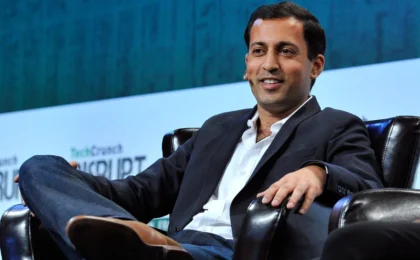
In the early months of 2025, Yoevan Khemlani was a rising star in Singapore’s burgeoning technology sector. As the founder of Interfaze, a specialized AI startup focused on high-level backend automation and web scraping, he had assembled a lean, elite team of four. On paper, Singapore was the perfect launchpad: it offered government grants, a stable regulatory environment, and a reputation as the "gateway to Asia."
However, as Interfaze began training its models and engaging with early adopters, a startling pattern emerged. "As we were training the model, a lot of our customers who were exploring or trying the product were moving to the U.S., already based in the U.S., or selling to the U.S.," Khemlani told Fortune. By May of that year, Khemlani reached a definitive conclusion: to build a global company, he had to leave the "gateway" and head straight to the source. He relocated to the San Francisco Bay Area, joining a growing exodus of Asian entrepreneurs who are increasingly viewing the United States not just as a market, but as a necessary survival hub.
This migration signals a significant shift in the global tech hierarchy. For a decade, cities like Singapore, Tokyo, and Kuala Lumpur marketed themselves as viable alternatives to Silicon Valley, citing lower operational costs and the untapped potential of the "Asian Century." Yet, the current AI gold rush and a tightening venture capital landscape have reaffirmed San Francisco’s dominance, creating a "push-pull" dynamic that is draining Asia of its most ambitious founders.
Main Facts: The Centralization of Global Innovation
The trend of Asian founders relocating to the U.S. is no longer anecdotal; it is a systemic movement facilitated by global venture firms. Antler, a prominent early-stage VC firm, reports that since 2025, it has assisted more than 30 founding teams from Asia in moving their operations to the United States.
The motivations behind this shift are rooted in three primary factors:
- Capital Concentration: The U.S. remains the undisputed heavyweight in startup funding, particularly for capital-intensive AI ventures.
- Market Homogeneity: Unlike the fragmented markets of Southeast Asia, the U.S. offers a massive, unified customer base with high purchasing power.
- The "Whisper Network": Silicon Valley’s dense ecosystem of talent and informal knowledge-sharing—often called "whisper networks"—provides a competitive edge that digital connectivity cannot replicate.
"Most of the founders we see in Asia these days want to build global businesses, and the attraction of being in the U.S. is unmistakable for that purpose," says Jussi Salovaara, Antler’s co-founder and managing partner for Asia. "Customers, talent, and capital are all found in abundance there."
Chronology: From Regional Optimism to the Silicon Valley Pivot
To understand why this migration is happening now, one must look at the trajectory of the Asian tech ecosystem over the last four years.
- 2022–2023: The Peak and the Pivot. During the post-pandemic tech boom, Southeast Asian venture funding hit record highs, reaching approximately $10.1 billion in 2022. During this period, Singapore and Malaysia were viewed as the next frontiers for "super-apps" and fintech.
- 2024: The Funding Winter. By late 2024, the landscape had soured. Venture funding to Southeast Asian tech firms plummeted by nearly 80%, dropping to just $2.2 billion. High interest rates and a lack of successful exits caused investors to retreat to safer, more established markets.
- 2025: The Year of the Exodus. As AI became the primary driver of tech valuations, founders realized that the specialized compute power and the specialized talent required for LLM (Large Language Model) development were concentrated in Northern California. This is when firms like Interfaze and Drift began their relocation processes.
- 2026: The Widening Gap. By the first quarter of 2026, the disparity reached a breaking point. While Asian markets remained stable in absolute terms, their share of global venture capital fell to single digits (9.6%), while the U.S. surged to capture 80% of all global startup funding.
Supporting Data: A Tale of Two Ecosystems
The data supporting this migration is stark. According to KPMG, the United States attracted roughly 68% of all startup funding globally last year. By the first quarter of 2026, that figure rose to 80%, largely driven by astronomical fundraising rounds for U.S.-based AI giants like OpenAI and Anthropic.
In contrast, Asia’s share has dwindled. Southeast Asia currently accounts for a mere 0.5% to 2% of global venture capital investment. The majority of what remains in the APAC region is concentrated in India and China, leaving "hub cities" like Singapore in a precarious position.
The Exit Problem
A primary reason for the "push" out of Asia is the lack of lucrative exit opportunities. For a venture ecosystem to thrive, early investors need to see a path to an Initial Public Offering (IPO) or a major acquisition.
- Southeast Asian IPOs: Raised $6.5 billion last year. While this was a 76% jump from previous lows, it remains a fraction of the $37 billion raised in Hong Kong alone.
- Performance Woes: Many high-profile Asian listings have struggled. JustCo, a Singaporean flexible workspace provider, saw its shares trade below the offer price within weeks of its June 2025 debut. Foundation Healthcare, a significant healthcare listing on the Singapore Exchange, closed 7.9% below its IPO price on its first day of trading in July 2026.
The Fragmentation Tax
Founders also cite the "fragmentation tax" of building in Asia. Yoevan Khemlani points out that a "Southeast Asia strategy" is a misnomer. "When you invest in the U.S., you’re investing in the whole country, which is a huge market," Khemlani explains. "But when you invest in Southeast Asia, you have to pick which country you want to invest in. The go-to-market strategy in each nation is very different."
Official Responses and Founder Perspectives
The voices of those on the ground paint a picture of a "cultural and strategic necessity" rather than a mere preference for the American lifestyle.
The Talent Magnet
Sanjil Jain, an Indian founder who moved to the U.S. in April 2025 to build Drift—an AI platform for robotics engineering—emphasizes the quality of the "crazy" talent in the Bay Area. Since moving, Jain has hired three Americans for his five-person team. "If we were to look for the same talent in India, it would have taken us a lot of time to sieve out the exact profile or the craziness in a person who would want to build with us," Jain says. "But here, pretty much everyone is crazy about building new technologies."
The Geopolitical Push
For Chinese founders, the move is often driven by geopolitical friction. Justin Li, an ex-Tesla engineer and founder of IndustrialMind.AI, moved to the U.S. because his B2B AI solution—which monitors production lines—targeted American and European automakers.
"B2B start-ups don’t have the best market access in China, as we’re mostly able to serve only Chinese customers and the local market," Li explains. Furthermore, Western firms are increasingly hesitant to share sensitive manufacturing data with companies headquartered in China due to tightening data-security regulations in both Washington and Beijing.
The Investor’s View
Jussi Salovaara of Antler notes that the U.S. investor mindset is fundamentally different. "In Asia, investors are very focused on revenue growth and profitability relatively early," he says. "In the U.S., they pay more attention to your vision and the problem you’re looking to solve." This "vision-first" approach is essential for AI startups that may require years of R&D before reaching profitability.
Implications: Is Asia Losing the Innovation Race?
The migration of founders to the U.S. has profound implications for the future of Asian tech hubs. If the best and brightest continue to leave as soon as they reach the scaling phase, Asian cities risk becoming "back-office" hubs—places where engineering is done cheaply, but where the intellectual property and wealth are centered elsewhere.
The Visa Barrier
However, the U.S. is not without its hurdles. Immigration remains the single largest bottleneck. In late 2025, the U.S. administration attempted to raise H-1B visa fees from $5,000 to a staggering $100,000. Although a federal court blocked this hike in June 2026, the political volatility remains a deterrent. Sanjil Jain notes that for Indian citizens, visa wait times can still stretch into years. "It’s not easy for us to get visas," he admits.
A New Division of Labor
Salovaara suggests that a new division of labor may emerge. While "global-first" software and AI companies are moving to the U.S., businesses focused on infrastructure, energy, and hardware may find better roots in Asia. He cites Alternō, a Vietnamese startup developing low-cost sand-based thermal batteries. "If you’re building in Vietnam, it’s obviously going to be a lot more cost-effective compared to the U.S.," Salovaara notes.
The Long-Term Outlook
Despite the current exodus, there is a hope that this is a cyclical rather than permanent trend. Antler’s CEO, Magnus Grimeland, maintains that "people can innovate from almost anywhere." The firm recently announced an expanded focus on "China-outbound" founders, helping them navigate the transition from Asian roots to global markets.
For now, the reality for founders like Yoevan Khemlani is clear: the road to a global AI empire still runs through San Francisco. "You can build from anywhere today, be it Singapore or the UK," Khemlani concludes. "But from a sales standpoint, it’s difficult to reach a global customer base from those countries. And from a venture perspective, it’s very hard to raise capital in San Francisco if you’re still in Singapore."
As the AI era matures, the challenge for Asian governments will be to create ecosystems that don’t just incubate talent, but provide the market depth and exit liquidity necessary to keep them at home. Until then, the "Great Migration" shows no signs of slowing down.