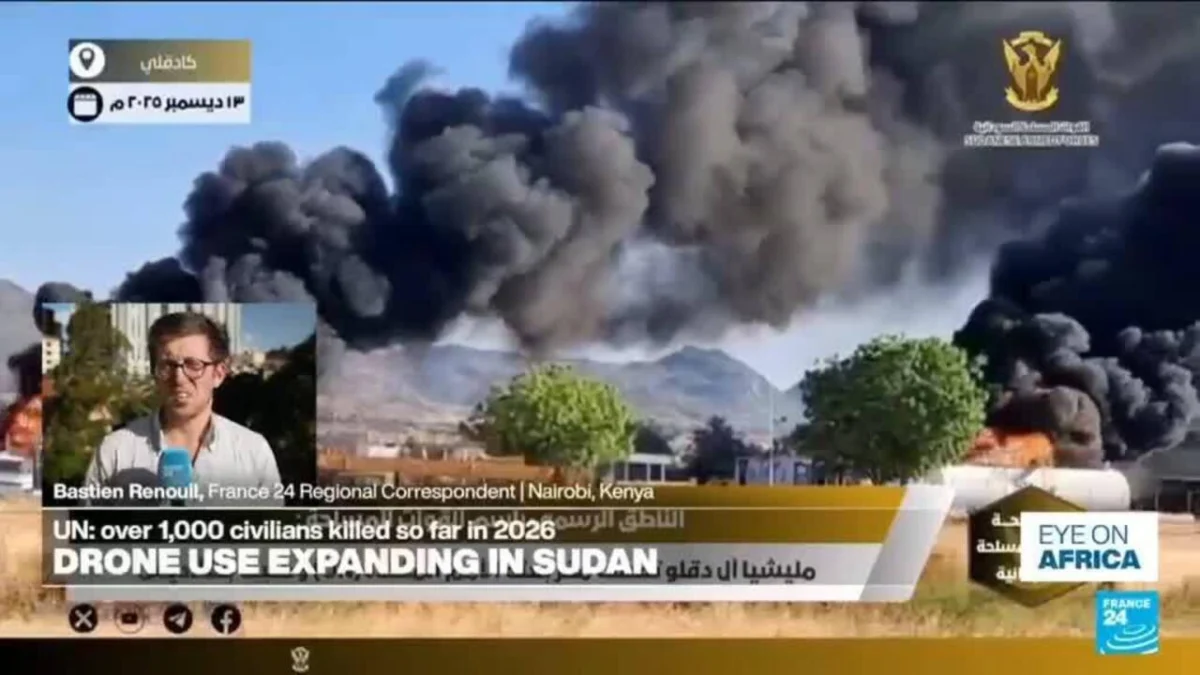
KHARTOUM/GENEVA — As the sun sets over the arid landscape of Khartoum and the surrounding states, the sound of a buzzing engine in the sky no longer signals a peaceful evening. For the millions of Sudanese caught in the crossfire of the ongoing civil war, the hum of an unmanned aerial vehicle (UAV) is now the herald of catastrophe.
In a grim milestone for the conflict that has ravaged the nation since April 2023, data released in mid-2026 confirms that drone-related strikes have claimed the lives of at least 1,000 civilians in the current year alone. This surge in precision-strike technology—once reserved for state actors—has become the primary instrument of terror in a war where the lines between military targets and residential blocks have been permanently erased.
Main Facts: The Democratization of Lethal Force
The Sudanese conflict, characterized by a brutal power struggle between the Sudanese Armed Forces (SAF) and the Rapid Support Forces (RSF), has undergone a terrifying technological evolution. While the early months of the war were defined by heavy artillery and street-level urban combat, the landscape of 2026 is defined by the “drone-ification” of the battlefield.
Military analysts tracking the conflict note that both the SAF and the RSF have diversified their procurement pipelines. Initially reliant on repurposed commercial drones for reconnaissance, the warring parties now possess advanced tactical UAVs capable of carrying significant explosive payloads. These devices are being utilized not just against frontline troop positions, but against bustling marketplaces, makeshift medical clinics, and densely populated displacement camps.
The 1,000-death toll serves as a conservative estimate. Given the collapse of local governance and the extreme danger facing journalists and humanitarian workers, the actual number of fatalities—and the thousands more maimed or displaced—is likely significantly higher. The lethality of these strikes lies in their anonymity; civilians are killed by operators situated miles away, often relying on faulty intelligence or intentionally targeting civilian infrastructure to instill fear.
Chronology: From Surveillance to Systematic Slaughter
The trajectory of drone warfare in Sudan can be categorized into three distinct phases:
1. The Reconnaissance Phase (April 2023 – December 2023)
At the onset of the war, drones were strictly tactical tools. They were used by the SAF to scout RSF movements in Khartoum and by the RSF to monitor army barracks. At this stage, the devices were primarily off-the-shelf hobbyist models. Casualties from drone strikes were incidental and statistically insignificant compared to the carnage caused by artillery and airstrikes.
2. The Weaponization Phase (January 2024 – December 2025)
By early 2024, the influx of foreign-sourced military-grade drones changed the game. Reports from UN monitors indicated that external state sponsors had begun supplying both sides with more sophisticated hardware. This period saw the first documented "kamikaze" or "loitering munition" attacks. The focus shifted from observation to disruption, with both sides targeting supply lines and communication hubs.
3. The Terror Phase (January 2026 – Present)
The first six months of 2026 have marked a tragic turning point. Drones are now being deployed in swarms to "clear" areas. The deliberate targeting of civilian gathering points has become a strategic choice, intended to prevent the other side from establishing administrative control over urban centers. The 1,000-civilian death count represents the normalization of these strikes as a standard operational procedure.
Supporting Data: The Anatomy of a Crisis
The data behind the 2026 figures paints a harrowing picture of how modern warfare impacts the most vulnerable:

- Geographic Concentration: Over 60% of recorded drone strikes occurred in the Khartoum Metropolitan area and the Darfur region.
- Targeting Patterns: Analysis of strike locations reveals that 45% of civilian casualties occurred in areas designated as "safe zones" for internally displaced persons (IDPs).
- Casualty Demographics: UNICEF reports that children account for approximately 28% of the casualties from drone strikes, often due to their presence in marketplaces and public squares during mid-day attacks.
- Economic Impact: The destruction of critical infrastructure—including power grids and water treatment plants—via drone-delivered munitions has exacerbated the ongoing famine, leaving over 15 million people on the brink of starvation.
Official Responses and Global Accountability
The international community has struggled to maintain a coherent response to the proliferation of these weapons.
The SAF Position
The Sudanese Armed Forces continue to justify their drone program as a "necessary defense of national sovereignty" against "foreign-backed mercenaries." Spokespeople for the SAF have repeatedly stated that they take "every precaution to avoid collateral damage," shifting the blame for civilian deaths onto the RSF for embedding themselves within civilian neighborhoods.
The RSF Position
Conversely, the Rapid Support Forces deny possessing a drone program of this magnitude, frequently claiming that the strikes are "false flag" operations conducted by the SAF to turn the local population against them. International investigators have largely dismissed these claims, citing photographic evidence of RSF-controlled drones in the skies over Darfur.
International Organizations
The United Nations Security Council has issued multiple condemnations, yet the lack of a unified stance among permanent members has paralyzed any meaningful action. The UN High Commissioner for Human Rights recently called for an immediate arms embargo, specifically targeting the sale of dual-use drone technology. "The sky over Sudan has become a source of terror," the Commissioner stated. "There is no excuse for the systematic targeting of the defenseless."
Implications: A Future Defined by Fear
The implications of this development reach far beyond the current death toll. The normalization of drone warfare in Sudan sets a dangerous precedent for future regional conflicts in Africa and the Middle East.
The Erosion of Humanitarian Space
Humanitarian aid groups, such as the Red Cross and Médecins Sans Frontières, have found it nearly impossible to operate. The constant threat of a drone strike makes the establishment of field hospitals or food distribution centers a death sentence. This has created "black holes" in the humanitarian response, where thousands of people are cut off from all aid.
The Psychological Toll
The psychological impact on the civilian population is profound. Unlike artillery, which is loud and visible, a drone is silent and omnipresent. This "perpetual dread" has led to a collapse in social cohesion, as people fear gathering in groups for any reason, including prayers, market shopping, or communal water collection.
Regional Destabilization
The proliferation of these weapons is not happening in a vacuum. Sudan has become a testing ground for various global drone manufacturers. By allowing these technologies to be used with impunity against civilian populations, the international community is signaling that the rules of war—specifically those intended to protect non-combatants—are effectively obsolete.
Conclusion
As the conflict in Sudan grinds into its fourth year, the shift toward drone-led violence marks a dark chapter in 21st-century warfare. The 1,000 civilians killed in 2026 are not merely numbers; they are a testament to the failure of the international system to curb the lethality of modern technology.
Unless significant pressure is applied to the state actors facilitating the flow of this technology into the hands of the SAF and the RSF, the "buzzing" in the Sudanese sky will continue to herald the end of lives, dreams, and futures. The war in Sudan is no longer just a fight for power; it is a fight for the very survival of the civilian population against an enemy that strikes from the clouds, invisible and unaccountable.