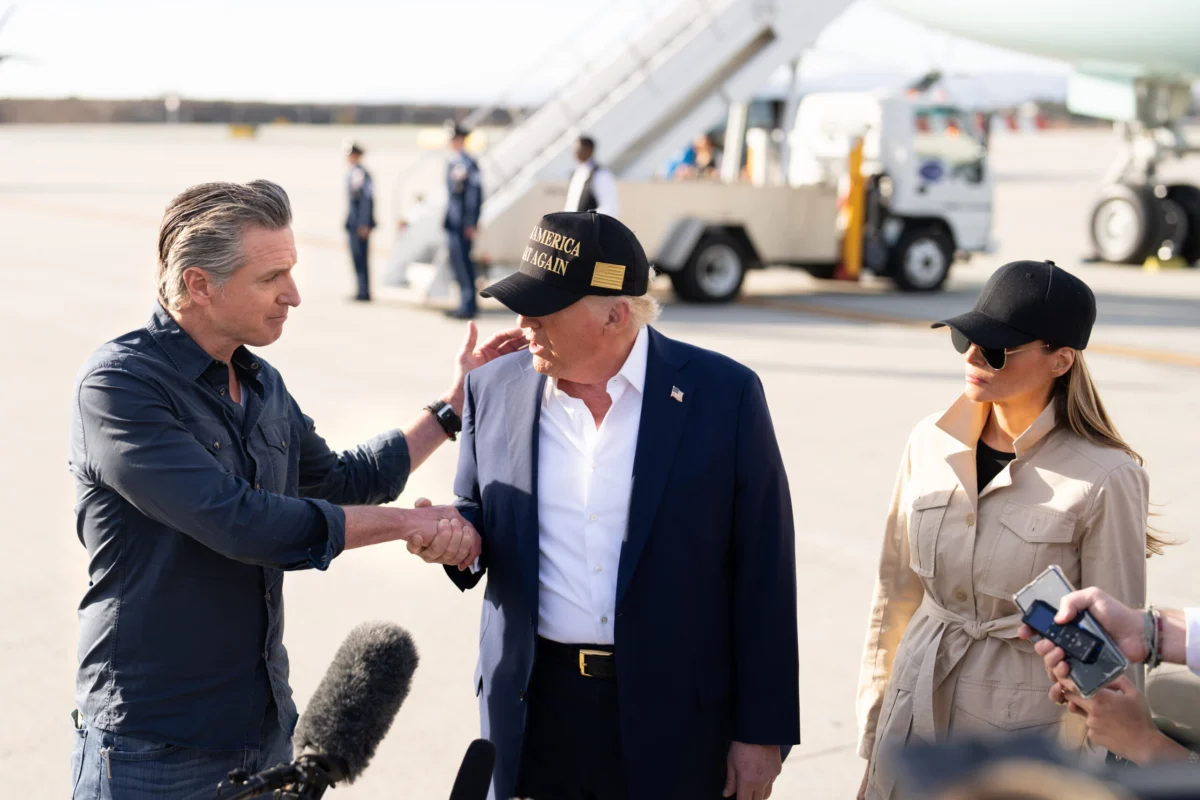
SACRAMENTO – The long-standing political cold war between California Governor Gavin Newsom and President Donald Trump has transitioned into a high-stakes legal confrontation. On Monday, Governor Newsom formally accused the Trump administration of weaponizing the United States Department of Justice (DOJ) to initiate a retaliatory investigation into him and his spouse, Jennifer Siebel Newsom.
In a pointed statement released from the state capitol, Newsom alleged that the federal government is engaged in a "fishing expedition," seeking to manufacture criminal charges against a political adversary rather than investigating legitimate wrongdoing. To combat what he describes as an abuse of executive authority, the Governor’s office has filed a comprehensive Freedom of Information Act (FOIA) request, demanding that the DOJ turn over all internal communications, memoranda, and documentation mentioning him or his wife since the President’s inauguration.
Main Facts: The Allegations of Executive Overreach
Governor Newsom’s core contention is that the current federal scrutiny is devoid of legal merit and motivated purely by political animus. According to the Governor, the investigation is a calculated attempt by the White House to undermine his potential candidacy for the presidency in future election cycles and to silence his vocal opposition to the President’s domestic policies.
"Donald Trump isn’t just coming after me because of my mean Tweets," Newsom declared during his address. "He’s coming after me because I am considering running for President. Because he hates that I’ve consistently called him out—over and over again—for his lies and deceit. Donald Trump is simply the most corrupt President in American history."
The investigation reportedly centers on two primary vectors:
- The Williamson Connection: Federal investigators have been probing the activities of Dana Williamson, the Governor’s former chief of staff, who recently pleaded guilty to federal fraud charges. The DOJ appears to be looking for a nexus between Williamson’s criminal conduct and the Governor’s inner circle.
- Nonprofit Financials: The DOJ has also initiated an inquiry into the California Partners Project, a nonprofit organization founded by Jennifer Siebel Newsom.
Newsom maintains that these investigations are "baseless" and represent a deviation from the post-Watergate norms that established the independence of the Department of Justice from the Oval Office.
A Chronology of Escalating Hostility
The current legal friction is the culmination of years of public antagonism between the two leaders, characterized by ideological clashes over immigration, environmental policy, and executive power.
- Mid-2025: Tensions reached a boiling point during the Los Angeles protests, where activists rallied against the administration’s mass deportation policies. Following these events, President Trump publicly called for the arrest of Governor Newsom, an unprecedented rhetorical escalation that signaled a shift toward direct confrontation.
- May 2026: The legal landscape shifted when Dana Williamson, a key architect of Newsom’s political operations, entered a guilty plea to federal fraud charges. This development provided the DOJ with a foothold to expand its investigative scope.
- June 15, 2026: Governor Newsom formally announced the filing of a FOIA request. The request mandates that the DOJ provide all records, including emails, text messages, and internal notes, dated between January 20, 2025—the date of President Trump’s inauguration—and the present day.
- Current Status: The DOJ is now under a 20-business-day clock to respond to the FOIA request, a deadline that is expected to be met with either transparency or a protracted legal battle over executive privilege.
Supporting Data and Precedent
The Brennan Center for Justice and various legal watchdog organizations have long warned that the politicization of the DOJ undermines the rule of law. By demanding that the department focus its resources on a specific political opponent, the administration is accused of violating the "independence doctrine."
Newsom is not the first high-profile Democrat to find himself in the crosshairs of the current administration. His case follows a pattern of retaliatory actions taken against other prominent figures who have challenged the President’s agenda:
- Letitia James: The New York Attorney General, who has been a frequent target of federal scrutiny regarding her state-level investigations into the President’s private business dealings.
- Jerome Powell: The former Federal Reserve Chair, who faced intense public pressure and threats of removal during his tenure.
- Tim Walz: The Governor of Minnesota, who has faced persistent federal pressure regarding his administration’s handling of civil unrest and state-federal funding disputes.
These instances suggest a broader pattern of "institutional weaponization," where the mechanisms of federal law enforcement are utilized to chill dissent and weaken the political infrastructure of the opposition party.
Official Responses and Legal Maneuvers
The Governor’s office has made it clear that they intend to challenge the DOJ’s tactics through every available legal channel. By filing the FOIA request, Newsom is attempting to force the DOJ to disclose whether the investigation was initiated through legitimate internal referrals or if it was directed by the White House.
"Presidents do not normally direct the DOJ to investigate specific individuals," legal experts noted in response to the filing. "Doing so breaks with a long-standing norm of Justice Department independence and is what critics call an abuse of executive power."
The White House has yet to provide a detailed response to the specific accusations leveled by the Governor on Monday. However, administration spokespeople have previously stated that the Department of Justice operates independently and that all investigations are conducted based on evidence rather than political affiliation.
Implications for the Future of American Governance
The conflict between Newsom and Trump carries significant implications for the 2028 election cycle and the stability of the American administrative state.
The Erosion of Norms
If the DOJ continues to pursue investigations that are perceived as politically motivated, it risks a permanent degradation of public trust in federal institutions. The "retaliatory action tracker" maintained by groups like Protect Democracy suggests that the current environment is unique in modern American history, with a shift toward utilizing the judiciary and the Department of Justice as tools of political warfare.
The 2028 Presidential Field
For Governor Newsom, the investigation serves as both a hurdle and a platform. While the threat of legal action against his family is a significant personal burden, the narrative of being a "victim of a corrupt administration" has the potential to consolidate support within the Democratic Party. As he noted in his concluding remarks, "Mr. President, come after me. I am not going anywhere. And the country is watching."
The Burden of Proof
The legal burden will now fall on the DOJ to prove that the investigations into the California Partners Project and the Williamson case are tethered to substantive evidence of wrongdoing. Failure to produce such evidence would likely validate Newsom’s claims of a political vendetta, potentially triggering a congressional inquiry into the administration’s handling of the Department of Justice.
As the 20-day FOIA window begins, the eyes of the nation remain fixed on the intersection of Sacramento and Washington. This is no longer merely a disagreement over policy; it is a fundamental test of whether the American legal system can maintain its neutrality in an era of hyper-partisan volatility.
The coming weeks will likely reveal whether this investigation will yield evidence of criminal activity or if it will go down in history as one of the most significant instances of executive overreach in the 21st century. For now, the Governor remains defiant, the President remains silent on the specifics, and the integrity of the nation’s highest law enforcement agency remains at the center of a deepening constitutional crisis.