For hundreds of millions of years, the narrative of vertebrate evolution has been characterized by a singular, heroic arc: the arduous transition from the primordial soup of the oceans to the terra firma of the continents. Yet, evolution is rarely a one-way street. Throughout deep time, numerous groups of mammals and reptiles—having already conquered the land—underwent a startling reversal, plunging back into the depths to reclaim the aquatic habitats of their ancestors.
A groundbreaking study recently published in the journal Current Biology provides the most comprehensive analysis to date of these evolutionary U-turns. By synthesizing fossil evidence with cutting-edge machine learning and a repurposed statistical method from the Second World War, researchers at Yale University have successfully mapped when and how these creatures transitioned back to the water, offering a definitive look at which animals became true ocean dwellers and which remained forever tethered to the shore.
The Mechanics of Re-entry: Convergent Evolution
The transition from land to water is not merely a matter of habit; it requires a radical biological transformation. Animals that returned to the sea were forced to develop flippers, streamlined bodies, and metabolic adaptations to handle the rigors of underwater life.
"These secondarily aquatic groups adapted in strikingly similar ways to their new aquatic home," explains lead author Caleb Gordon, who conducted the research during his doctoral studies at Yale’s Graduate School of Arts and Sciences before moving to the Florida Museum of Natural History. "As a result, they’ve become textbook examples of convergent evolution, which can tell us a lot about the processes driving and constraining adaptive change in response to similar environmental cues."
This phenomenon of convergent evolution—where unrelated species evolve similar traits to solve similar ecological problems—serves as the backbone of the Yale team’s study. By identifying these patterns, the researchers have created a rigorous framework to predict the lifestyles of extinct creatures based on their skeletal architecture.
A Chronology of Aquatic Adaptation
The study traverses a vast timeline, looking at diverse groups ranging from the Paleozoic era to the age of the dinosaurs.
The Paleozoic Ambiguity
The team first examined the mesosaurs, small marine reptiles that thrived between 290 and 274 million years ago in the regions that are now South Africa and South America. For years, paleontologists were divided on their lifestyle. Because mesosaurs were viviparous—giving birth to live young—some scientists argued they were fully aquatic. However, the Yale model suggests a more nuanced reality. Their limb proportions indicate that they were not built for constant immersion, but rather functioned more like modern-day alligators or platypuses, frequently oscillating between land and water. The study concludes that during the Paleozoic era, no reptile had yet evolved a truly, exclusively aquatic existence; they remained, in every sense, amphibious.
The Spinosaurus Enigma
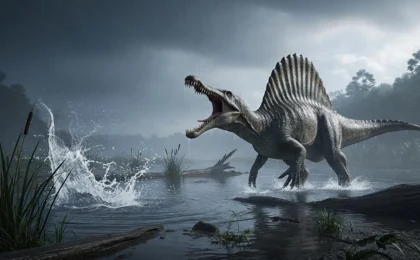
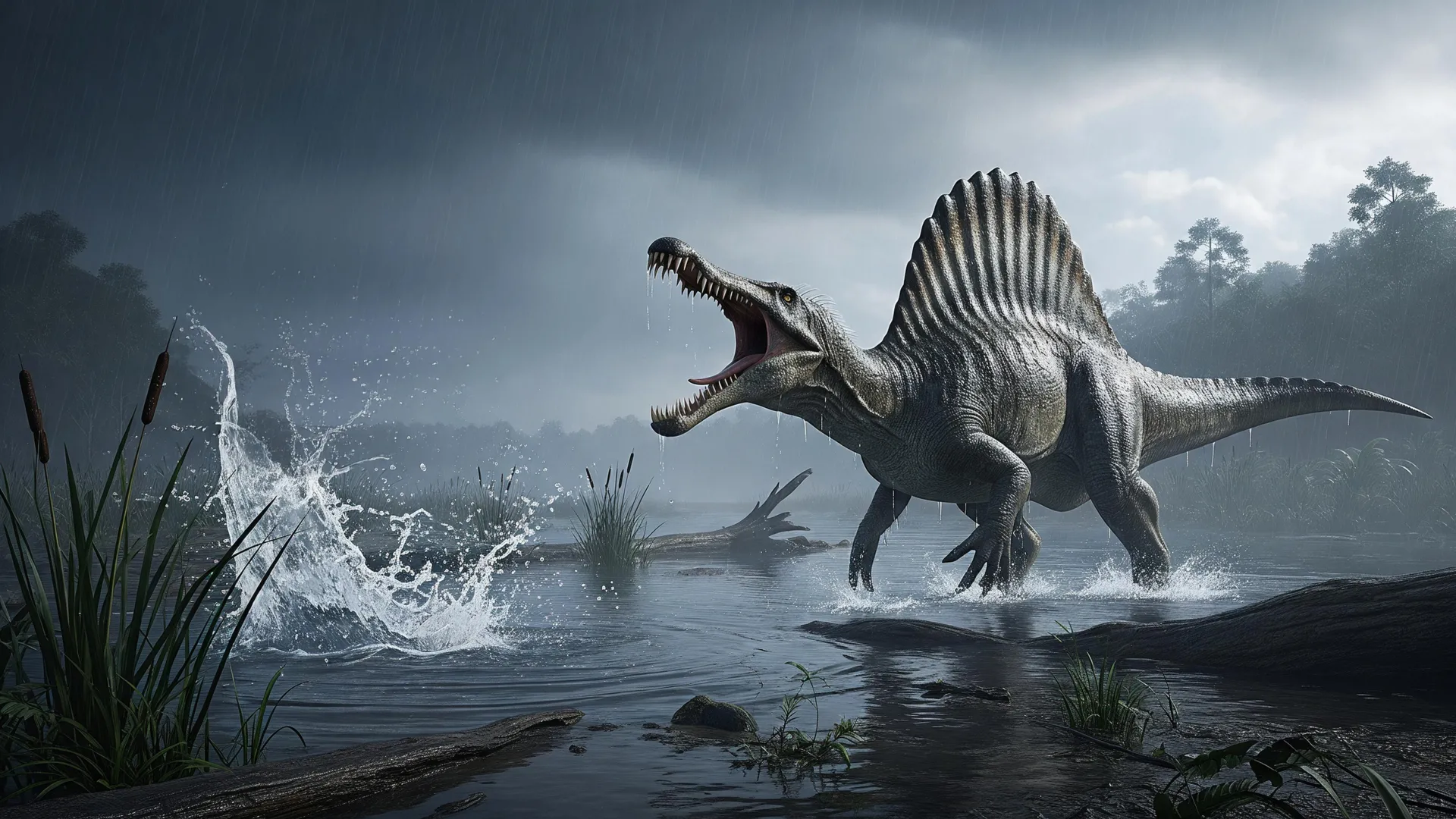
Perhaps the most famous subject of the study is Spinosaurus, the colossal, sail-backed predator of the Cretaceous period. Living between 113 and 94 million years ago in North Africa, its relationship with water has been a point of intense scientific friction.
Some researchers have posited that Spinosaurus was a "wading" predator, similar to a modern heron, searching for prey in the shallows. Others argued for a lifestyle closer to a seal or a penguin, with the animal spending most of its time submerged. The Yale team’s analysis—which relied on predictive modeling of skeletal proportions—adds significant weight to the latter. The data indicates that Spinosaurus possessed anatomical traits consistent with a highly aquatic lifestyle, spending the vast majority of its life beneath the surface.
Supporting Data: From Fossils to Algorithms
The scope of the research was massive. To build their predictive model, Gordon and his team analyzed hundreds of specimens, collecting over 11,000 individual measurements, high-resolution photographs, and CT scans from the Yale Peabody Museum and institutions across the globe.
The innovation lay in the methodology. The researchers trained machine learning models on living, modern-day vertebrates, identifying the precise correlations between skeletal proportions and specific ecological niches. By inputting the data from fossilized skeletons into these models, the team could "reconstruct" the soft tissue and behavior of creatures that have been extinct for millions of years.
The accuracy of this model is remarkable. The researchers found that by analyzing the proportions of the forelimbs alone, their AI could predict with over 90% accuracy whether an extinct animal possessed flippers or lived a fully aquatic life.
The WWII Connection: A Legacy of Surveillance
One of the most intriguing aspects of the study is the use of a statistical approach developed during the darkest days of the Second World War. As Jacques Gauthier, a professor of Earth and planetary sciences at Yale and curator-in-charge of vertebrate paleontology at the Peabody Museum, explains, the method was originally intended for military defense.
"Caleb resurrected a statistical technique from a bygone era," Gauthier says. "It was developed during WWII to estimate the probability that an approaching blip on the radar screen was an enemy plane. Caleb cleverly used it to get at whether or not an extinct animal had limbs modified for swimming."
By applying this probabilistic framework to evolutionary biology, the team was able to determine the likelihood of specialized swimming adaptations, even when the fossil record was incomplete. This bridges a critical gap in paleontology: the inability to see soft tissue or behavior directly.
Official Responses and Scientific Significance
The implications of this study extend far beyond Spinosaurus or mesosaurs. The research provides a blueprint for resolving the "subjectivity trap" that has long plagued the field of paleontology.
"Reconstructing the lives of extinct life forms in a scientifically rigorous way, as opposed to just telling stories, is a precise and delicate undertaking," says Bhart-Anjan Bhullar, senior author and associate professor of Earth and planetary sciences at Yale. "It requires a careful interweaving of data from modern organisms, of which our understanding is necessarily far deeper, and knowledge of these living organisms’ genealogy relative to fossil forms."
Bhullar emphasizes that the study finally allows the data to speak for itself, stripping away the biases of individual researchers who might favor one interpretation of a fossil over another. "Bones are all that is left to us of the vast majority of vertebrate animals that have lived on Earth," he notes. "We want to know so very much about these creatures, but we have so little on which to base our conclusions. Caleb’s method removes the subjectivity from this process."
Implications for Future Research
The success of this AI-driven approach signals a paradigm shift in evolutionary biology. The ability to predict behavior from skeletal remains with high statistical confidence opens doors to answering some of the most persistent questions in the history of life on Earth.
Potential future applications are vast. Researchers are already considering using these same models to study the transition of human ancestors to bipedalism—the moment our forebears began to walk on two legs—or to map the evolutionary mechanics that allowed the dinosaurian ancestors of birds to take flight.
By combining the physical legacy of the fossil record with the computational power of the modern era, the Yale team has provided more than just a history of swimming animals. They have provided a new, objective lens through which we can view the entirety of the vertebrate narrative. As the scientific community continues to refine these models, we may find that the "lost worlds" of the past are not as mysterious as they once seemed, provided we have the right tools to translate the language of their bones.
The study, supported by the Yale Institute for Biospheric Studies, the International Union for Conservation of Nature’s Crocodile Specialist Group, and the National Science Foundation, marks a vital step in transforming paleontology from a field of qualitative interpretation into a robust, predictive science.