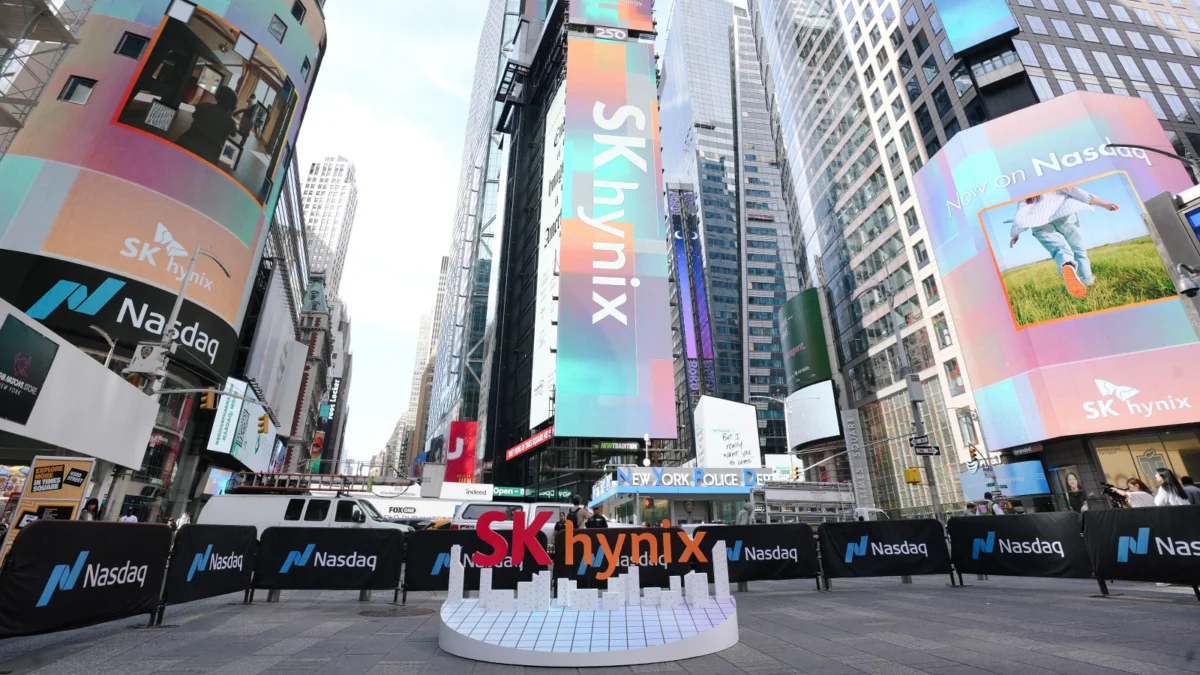
The global artificial intelligence revolution has reached a fever pitch, and its latest manifestation is a staggering $26.5 billion milestone on Wall Street. SK Hynix, the South Korean semiconductor juggernaut, officially made its U.S. market debut on Friday, July 10, 2026, marking the largest initial public offering (IPO) by a non-American company in history. By eclipsing the $25 billion record set by Alibaba in 2014, SK Hynix has signaled a seismic shift in how global capital perceives the semiconductor supply chain—a shift driven almost entirely by the insatiable demand for AI-ready memory.
The Main Facts: A Record-Breaking Entry
SK Hynix’s entry into the American equity market was structured with surgical precision. The company sold 177.9 million American Depositary Shares (ADS) at $149 per share. This strategic pricing allowed U.S. institutional and retail investors to gain exposure to the firm at approximately one-tenth the cost of a full share on the Korea Stock Exchange (KRX), effectively democratizing access to a company that has become the backbone of the generative AI boom.
The stock, trading temporarily under the ticker "SKHYV," saw an immediate surge, opening 14% above its IPO price and continuing its upward trajectory throughout the morning session. This performance is particularly striking given that the shares were priced at a 2.7% premium relative to the three-day average of the stock’s valuation in Seoul. Typically, foreign investors have been wary of the "Korea Discount"—a persistent phenomenon where South Korean firms are undervalued due to opaque governance, low shareholder return policies, and the ever-present geopolitical shadow of the Korean Peninsula. SK Hynix’s ability to shrug off this discount demonstrates that, in the era of AI, technological indispensability trumps traditional market skepticism.
A Chronology of the IPO
The path to this historic listing was characterized by overwhelming investor appetite. Reports indicate that the offering was oversubscribed by more than seven times, reflecting the urgency among global capital managers to secure a stake in the "picks and shovels" of the AI infrastructure.
- Pre-Launch (July 8, 2026): News surfaced that the offering was seeing massive demand, with subscription interest far outstripping the 177.9 million shares available.
- The Listing (July 10, 2026): SK Hynix officially began trading on the Nasdaq under the temporary ticker SKHYV. The 14% opening-day pop confirmed market confidence.
- The Transition (July 13, 2026): Regular trading commences, with the ticker shifting to the permanent symbol SKHY.
This timeline marks the culmination of a decade-long transformation for SK Hynix, which has evolved from a traditional memory manufacturer into a critical partner for firms like Nvidia. By positioning itself at the center of the High-Bandwidth Memory (HBM) supply chain, SK Hynix has secured its role as a fundamental pillar of the digital economy.
Supporting Data: Why Memory is the New Oil
To understand the gravity of this $26.5 billion influx, one must look at the technical necessity of the product. Modern AI GPUs, such as those produced by Nvidia, are functionally useless without high-performance memory to feed them data. HBM, or High-Bandwidth Memory, is the specialized component that prevents the "memory wall"—the bottleneck that occurs when processors are faster than the data delivery systems feeding them.
SK Hynix has spent years perfecting this technology, and the influx of capital is earmarked for further expansion. According to the company’s filing, the $26.5 billion will be deployed toward three specific, high-stakes infrastructure projects:
- A New Fabrication Plant: An expansive new facility in South Korea designed specifically to mitigate the global memory supply shortage currently threatening AI scalability.
- Advanced Packaging Facility: A new site dedicated to the complex process of stacking memory and logic chips, a critical bottleneck in modern hardware assembly.
- EUV Scanner Acquisition: Investment in extreme ultraviolet (EUV) lithography machines, the multi-million-dollar tools required to print the next generation of sub-nanometer chips.
These investments are not merely growth-oriented; they are defensive. With competitors like Micron and Samsung also vying for market share, SK Hynix is doubling down on its R&D and manufacturing capacity to maintain its technological lead.
Official Responses and the Geopolitical Chessboard
The success of the IPO has not gone unnoticed in Washington. On the eve of the listing, U.S. Commerce Secretary Howard Lutnick underscored the strategic importance of the memory sector. During an appearance at a Micron event, Lutnick signaled that the U.S. government is actively lobbying major foreign chipmakers to move their manufacturing centers stateside.
"We are in active discussions with Samsung and SK Hynix," sources reported Lutnick stating, emphasizing that the U.S. intends to reduce its reliance on foreign-produced, high-end memory. This is a clear directive to diversify the global supply chain, which is currently heavily concentrated in South Korea.
Micron, for its part, has already committed to a massive $250 billion investment in U.S.-based manufacturing, promising to generate over 90,000 jobs. However, the Korean giants face a difficult balancing act. Both Samsung and SK Hynix recently pledged a combined $550 billion in new manufacturing investment within South Korea. Balancing these domestic commitments with the political and economic pressure to build in the United States will be the defining management challenge for these firms over the next decade.
Implications: The End of the "Korea Discount"?
The success of the SK Hynix IPO suggests that the "Korea Discount" may be entering a period of obsolescence—at least for companies at the frontier of the semiconductor industry. When global institutional investors see a firm that is essential to the production of the next generation of AI, the typical concerns regarding governance and geopolitical risk are often sidelined in favor of pure growth potential.
However, the implications go deeper than just valuation. The success of this IPO marks a potential turning point for the Nasdaq as a global hub for the semiconductor industry. By bringing SK Hynix onto the exchange, U.S. regulators and markets have effectively linked the fortunes of the global AI boom directly to the U.S. equity markets.
For investors, the message is clear: the AI boom is not just about the companies designing the software or the chip designers like Nvidia; it is about the heavy, capital-intensive manufacturing processes required to make the hardware work. As SK Hynix moves forward under the ticker SKHY, it enters a new phase of its existence—not just as a Korean conglomerate, but as a global powerhouse directly accountable to the scrutiny and expectations of the American financial system.
The coming months will be a test of whether this massive capital injection can translate into a stable supply chain, or if the race for HBM supremacy will continue to outpace even the most aggressive manufacturing targets. One thing is certain: the era of memory-driven, AI-enabled global growth has officially claimed its biggest trophy yet.