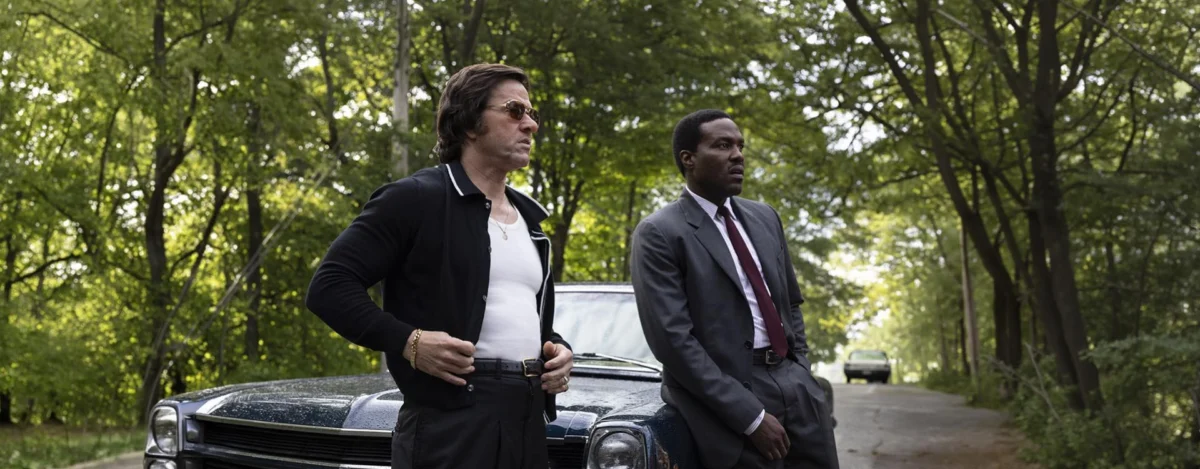
In 2018, Peter Farrelly’s Green Book offered a sanitized, comfort-food vision of racial reconciliation in the American South, famously pairing a Black concert pianist with his white driver in a narrative that sought to heal the nation’s wounds through fried chicken and mutual cultural exchange. Even at the time of its release, the film was criticized for its antiquated approach to race relations. Eight years later, By Any Means, the second feature film from director Elegance Bratton, feels not merely dated, but like a stylistic and thematic relic—a work that attempts to grapple with the horrors of 1960s Mississippi through a lens of brutal, performative violence that ultimately undermines the gravity of its subject matter.
The Chronology of a Misguided Narrative
The film begins with a somber, documentary-style montage. Set against the backdrop of 1960s Mississippi, the opening sequence meticulously establishes the disappearance of three civil rights workers—two Jewish men and one Black man—during the historic "Freedom Summer" of 1964. These archival clips serve to ground the audience in the grim reality of the era, where registering Black voters was an act of existential defiance against a violent white supremacist structure.
However, the tone shifts abruptly and violently as the film cuts to Mark Wahlberg. Portraying real-life mob enforcer Greg Scarpa, Wahlberg is introduced in a dingy basement, his character physically imposing and morally bankrupt, as he beats a man to the brink of death with a baseball bat. The question he poses—"Where are the bodies?"—sets the tone for a film that prioritizes visceral, "hard-boiled" action over historical nuance or character depth.
The central plot follows the uneasy alliance between Scarpa and FBI Agent Wayne Strider (Yahya Abdul-Mateen II). The two are tasked with investigating the murder of NAACP leader Vernon Dahmer, played by Giancarlo Esposito. While the film presents this as a "true story," the narrative foundation is built on sand. While Greg Scarpa was indeed a real mobster who allegedly provided information to the FBI, there is no historical record of him working alongside a Black handler. Agent Wayne Strider is a complete fabrication, a narrative convenience designed to facilitate a "buddy cop" dynamic that never existed.
Supporting Data and the Distortion of Rhetoric
The film’s title, By Any Means, is a transparent nod to the ethos popularized by Malcolm X. By repurposing a phrase synonymous with the Black liberation struggle and grafting it onto the violent, extrajudicial actions of a white mobster, the film engages in a crude and offensive revision of history.
The structural "lesson" of the movie is clear: the law-abiding, buttoned-up Black federal agent (Strider) is insufficient, and he must be "enlightened" by the savage, uninhibited wisdom of the white mobster (Scarpa). It is a reversal of the Green Book trope; where that film had the white man learn culture from the Black protagonist, By Any Means has the white man teach the Black protagonist the "art of violence."
In one particularly egregious moment, Scarpa tells Strider, "You’ve got your gun, you’ve got your badge, now you need to grow some balls." The film frames this directive as a moment of masculine awakening, implying that Strider’s adherence to the rule of law is a sign of weakness. This thematic choice ignores the very real danger Black civil rights workers faced when they dared to step outside the system in 1964, and it trivializes the strategic, often life-or-death decisions made by organizers who operated under the constant threat of state-sanctioned terror.
Official Perspectives and Behind-the-Scenes Realities
The production of By Any Means—written by Sascha Penn from a screenplay that appeared on the industry-vetted "Black List"—suggests that these narrative shortcomings were entrenched long before director Elegance Bratton signed on. Bratton, whose debut The Inspection was celebrated for its lyrical, personal, and sensitive portrayal of a young Marine, seems to be working against his own strengths here.
While the industry often touts "gritty realism" as a hallmark of quality, the script’s reliance on stereotypes is profound. Wayne Strider is depicted as a prim, somewhat repressed figure, defined largely by his frustration and his devotion to his wife, played by Nicole Beharie. Beharie is a formidable talent, but her character is relegated to the sidelines, serving only to offer silent, supportive glances or gentle neck rubs, reinforcing the film’s inability to write fully realized, three-dimensional women.
In contrast, Greg Scarpa is given the "cool" factor—chewing toothpicks, clad in a white tank top, and engaging in casual, unrepentant brutality. Even his domestic life is presented as a caricature; while he maintains a home life, he is also shown to be a womanizer, a trope that the film treats as an inevitable byproduct of his "tough guy" persona.
The Aesthetic Paradox: Beauty Amidst Brutality
If there is a redeeming quality to By Any Means, it lies entirely in the technical execution. Working with cinematographer Ante Cheng, Bratton manages to elevate the visual language of the film well beyond the limitations of its script. The lighting is frequently breathtaking: in one sequence, the early morning sun catches the wet pavement of a Mississippi road, turning a mundane travel shot into a moment of genuine visual poetry. In another, the villains are introduced through window shutters that cast harsh, sinister horizontal shadows across their faces.
This aesthetic sophistication creates a jarring dissonance. The film is undeniably beautiful to look at, yet that beauty serves to sanitize and "glamorize" the violence. It begs the question: why should such a talented visual storyteller be tethered to a narrative that is so fundamentally broken? The film is a masterclass in style over substance, where the camera treats the brutalization of human bodies with the same painterly reverence as a sunset over the Delta.
Implications for Historical Cinema
The broader implication of By Any Means is the continued reliance on the "white savior" or "white mentor" paradigm in stories about the American Civil Rights Movement. By focusing the narrative arc on the transformation of the Black agent through the influence of the white criminal, the film inadvertently centers the white experience in a struggle where he was, at best, a marginal, self-interested player.
Furthermore, the film’s choice to side with the "by any means necessary" approach as defined by a mobster—rather than the actual activists who risked their lives for voter registration—is a failure of moral imagination. The movie purports to examine the tension between nonviolent resistance and aggressive confrontation, yet it arrives at its conclusion with little genuine intellectual inquiry. It has already decided that the mobster is the hero, and the legal system is the obstacle.
In the final assessment, By Any Means is a film that refuses to engage with the complexity of the past, preferring instead to wrap its protagonists in the well-worn leather of an action thriller. It is a cautionary tale about what happens when historical trauma is treated as a narrative playground for stylized violence. Despite Bratton’s undeniable eye for light and form, the film remains a hollow exercise—an attempt to find "racial healing" in the blood-soaked basement of a mob enforcer, a location where no such healing has ever been found. The audience is left with a product that is technically polished but morally impoverished, leaving one to yearn for a more honest, more challenging, and more substantive exploration of the period—a story truly worthy of the blood and history it claims to honor.