As the global transition to renewable energy accelerates, the world is facing a paradoxical bottleneck. While capital for solar projects is abundant and demand for clean energy has never been higher, the physical reality of construction is hitting a hard wall: a critical shortage of skilled labor. In the race to meet climate targets and achieve energy independence, the construction industry is struggling to scale at the pace required.
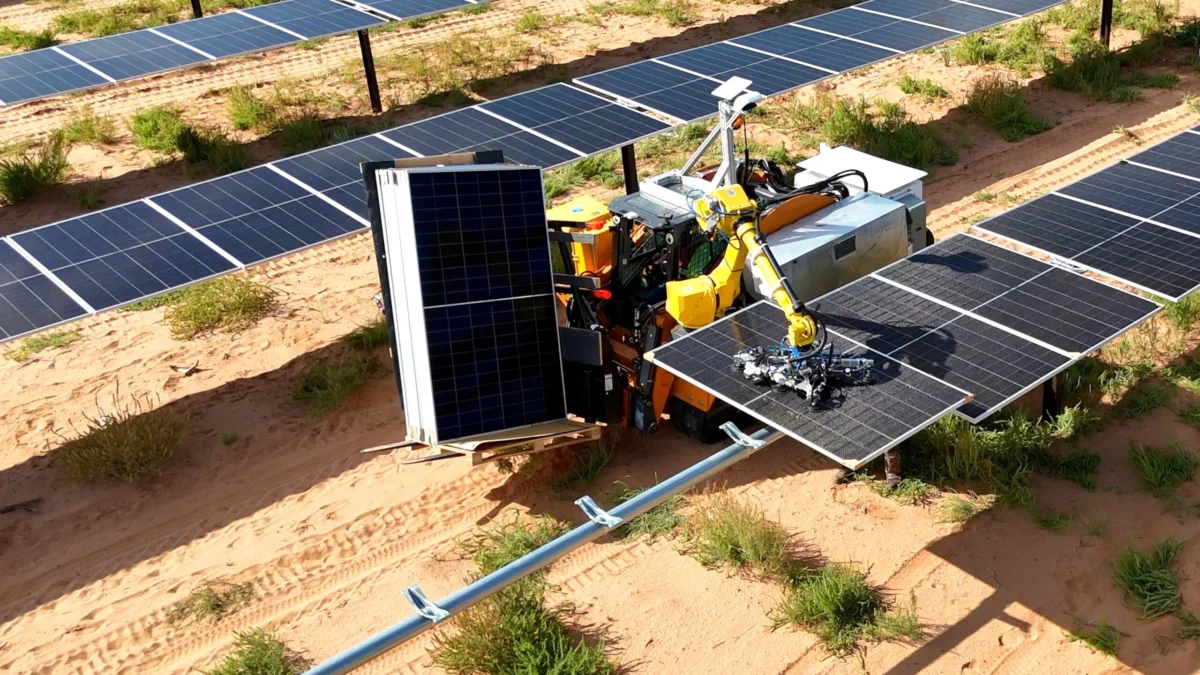
However, a new generation of "Physical AI"—the marriage of advanced machine learning models with heavy machinery—is poised to bridge this gap. Leading this charge is Gritt, a robotics startup that has emerged from stealth with $34 million in total funding, promising to transform chaotic, outdoor construction sites into highly efficient, automated workspaces.
The Core Problem: The Labor-Infrastructure Gap
The solar energy build-out is currently one of the most significant industrial endeavors on the planet. Yet, the work remains dangerously manual. Installing solar panels is a "dirty, dull, and dangerous" task that involves lifting heavy glass panels, maneuvering them into position, and fastening them with precision.
Historically, industrial robots have been confined to the sterile, predictable environments of automotive factories. They lack the "common sense" and spatial awareness required to handle the uneven terrain, shifting weather, and unpredictable variables of a construction site. This is where Gritt’s proprietary AI architecture changes the equation. By creating a software layer that can interpret and navigate unstructured environments, the company is turning standard off-the-shelf machinery into intelligent, multi-purpose construction workers.
A Chronology of Gritt’s Rise
Gritt’s journey began in the halls of Carnegie Mellon University, a global hub for robotics innovation. Founders Puneet Puri (CEO) and Vishal Dugar (CTO) identified that the future of construction wasn’t necessarily in inventing a new "robot" from the ground up, but in creating a "brain" that could operate existing heavy equipment.
- Early Seed Phase: The company secured initial backing from a consortium of forward-thinking venture firms, including First Round Capital, Climactic, Congruent Ventures, and VSC Ventures. This funding allowed the team to develop its foundational AI models and prove that its software could effectively control robotic arms and skidders.
- Refinement and Deployment: Unlike many competitors that spend years prototyping bespoke hardware, Gritt focused on integration. They began utilizing off-the-shelf hardware, such as robotic arms from industry giant Kawasaki, to handle the heavy lifting.
- Series A Breakthrough: On Tuesday, the company announced the successful closing of a $26 million Series A round led by Obvious Ventures, with participation from Union Square Ventures and Active Impact Investment. This brought their total funding to $34 million.
- Market Expansion: With two systems already deployed in the field, Gritt has moved from the laboratory to real-world industrial sites. They are currently contracted to assist in the installation of 2.8 gigawatts of solar capacity over the next 18 months, working with three of the top 10 power construction companies in the United States.
Supporting Data: Efficiency at Scale
The performance metrics provided by Gritt paint a compelling picture of why the industry is taking notice. In a standard setup, an eight-person crew typically installs roughly 800 solar panels in a single workday. When augmented with Gritt’s robotic systems, that same crew’s productivity skyrockets, hitting between 3,000 and 4,000 panels per day.
This represents a nearly five-fold increase in installation speed. Furthermore, the accuracy of these systems—positioning panels with sub-millimeter precision—ensures that the final installation meets rigorous quality standards, reducing the risk of structural failure or electrical complications. The company plans to scale its fleet to 48 active systems within the next six months to meet the surging demand from its power-sector partners.
Official Responses and Industry Perspective
The investment from Obvious Ventures highlights a shift in how VCs view robotics. Andrew Beebe, the partner who led the Series A round, noted the specific mindset required for this challenge. "There are people who used to build rockets that went into space and had an infinite budget for the smallest little part, and then there are people who know what it means to get into dirty, dull, and dangerous jobs and scale them like mad," Beebe said. "These guys are in the second camp."
For the customers on the ground, the benefits are both financial and human. One project manager, speaking on condition of anonymity, noted that the system is a game-changer for remote locations where recruiting a full manual labor crew is nearly impossible. Beyond efficiency, the system serves as a safety mechanism. By automating the repetitive, overhead lifting of 100-pound panels, the risk of workplace injuries—a significant cost and liability factor in construction—is dramatically reduced.
The Competitive Landscape: Hardware vs. Intelligence
Gritt is not alone in the race to automate solar installation. Competitors such as Luminous Robotics, Cosmic, and China’s Trinabot are also developing autonomous solutions. However, Gritt’s strategy diverges significantly from these players.
While competitors are largely focused on building specialized, bespoke hardware platforms, Gritt is focusing on the "intelligence layer." By keeping its hardware costs low through the use of off-the-shelf vehicles and arms, Gritt hopes to achieve a leaner cost structure that allows for faster deployment and easier maintenance. If a machine breaks, it is easier to replace a standard skidder than a proprietary, custom-built robot.
The Future: Beyond Solar Panels
The ultimate vision for Gritt extends far beyond the solar industry. The founders are already working on expanding their system’s capabilities to include fastening panels, drilling posts, and even constructing the racks that support the panels.
Looking further into the future, the company aims to tackle other labor-intensive, hazardous construction tasks, such as rebar tying. The recent rise of foundational AI models has made this transition possible. As CEO Puneet Puri explained, the "generalizability" of the software is the true secret sauce. Training the system to perform a new task—like rebar tying—now takes days rather than weeks because the underlying AI pipeline is reusable across different types of manual labor.
Implications for the Construction Industry
The implications of Gritt’s technology are profound. If successfully scaled, this could represent a fundamental shift in how humanity builds its critical infrastructure.
- Management and Decision-Making: Gritt aims to transform its robots into "site managers." The suite of sensors used for navigation can also detect operational inefficiencies. For example, the system could alert supervisors that a trench has been left open ahead of a predicted rainstorm, or it could autonomously flag missing inventory. This transforms the robot from a simple laborer into an active, intelligent participant in project management.
- Addressing the Labor Shortage: By handling the most physically demanding and repetitive aspects of construction, robots allow human workers to focus on higher-level tasks, such as oversight, system integration, and quality control. This may help attract a new generation of workers to the construction industry who are more comfortable working alongside technology.
- Speed and Climate Goals: The climate crisis demands an infrastructure build-out that is unprecedented in speed and scale. If Gritt can indeed help civilization build infrastructure "faster," as Puri puts it, the company could become an essential player in the global effort to hit net-zero targets.
As Gritt continues its rollout, the construction industry will be watching closely. If a start-up with a handful of robotic systems can successfully prove that "Physical AI" is the missing link in the renewable energy transition, it may well signal the end of the manual-labor era in heavy construction and the beginning of a more precise, efficient, and safer future.