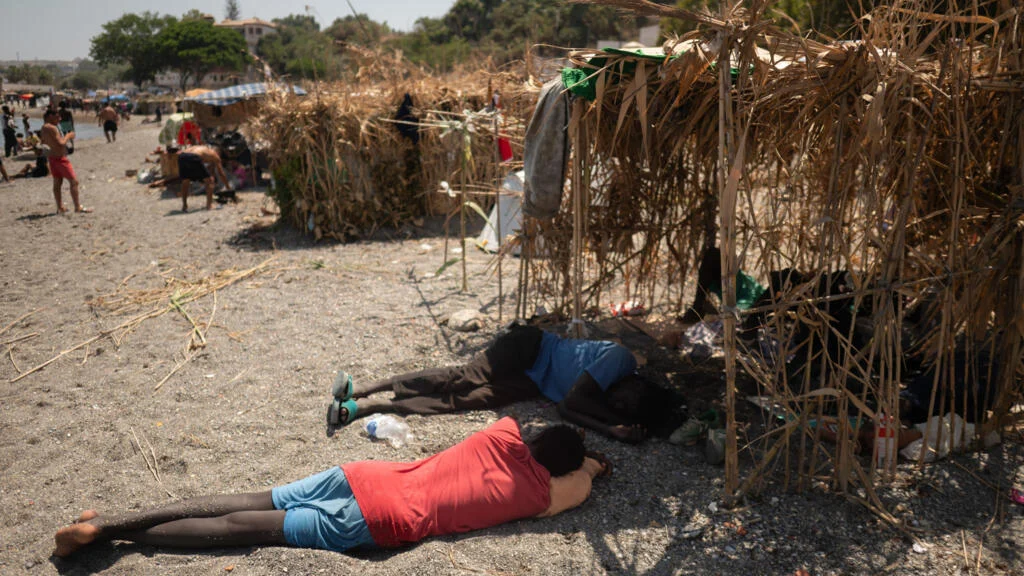
From a distance, the reed huts lining the sands of El Trampolin beach in Ceuta, a Spanish enclave on the North African coast, possess a deceptive, almost serene quality. During the balmy afternoons of August 2026, the soft murmur of the Mediterranean breeze and the thin plumes of smoke rising from makeshift campfires might easily be mistaken for a standard summer holiday scene. Yet, upon closer inspection, the facade of leisure dissolves entirely.
Here, there are no tourists. Instead, the beach is occupied by thousands of migrants, their bodies weary from arduous journeys, their clothes tattered by salt and wind, and their eyes fixed on the horizon—a horizon that promises safety but delivers only a legal and humanitarian stalemate. They are the remaining remnants of a staggering migration surge that saw over 70,000 individuals cross from Morocco into this small Spanish territory in late July. While the majority of those who crossed initially chose to return voluntarily, between 2,000 and 5,000 people remain on this strip of coastline, suspended in a state of indefinite waiting.
Main Facts: A Geopolitical Bottleneck
Ceuta, a tiny Spanish exclave nestled against the Moroccan border, serves as one of the most volatile friction points for international migration. Despite being European Union territory, it remains outside the Schengen Area’s open-travel zone, creating a unique, high-pressure legal cul-de-sac.

The current population on El Trampolin is a microcosm of global instability. The camp is not merely a collection of individuals from the Maghreb or sub-Saharan Africa; it is a tapestry of global displacement, featuring citizens from Iraq, Syria, Yemen, Palestine, India, and Bangladesh. These individuals have organized themselves into makeshift communities, often clustering by nationality or language. Their shelters, constructed from reeds, scavenged plastic, and discarded fabric, offer little protection against the elements. Life here is defined by extreme scarcity: water is rationed, food is shared when available, and the basic necessities of hygiene are managed in the same sea that represents their passage to a better life.
Chronology: The July Surge and the Aftermath
The crisis was triggered in late July 2026, when a massive, unprecedented wave of nearly 70,000 people crossed the border fence between Morocco and Ceuta. The sheer scale of the influx overwhelmed local resources in a matter of hours.
- July 27-29: Preliminary movements begin as tensions build along the border.
- July 30-31: The "Great Crossing." Tens of thousands of people surge into the enclave, overwhelming border security and local infrastructure.
- Early August: Faced with limited resources and the reality of the situation, the vast majority of the arrivals opt for voluntary repatriation back to Morocco.
- Mid-August: A core group of 2,000 to 5,000 individuals, many having arrived days before the peak or lacking any clear path back, establish the encampment at El Trampolin.
- August 15-Present: The site becomes a permanent fixture of the local landscape, monitored closely by police forces, while the legal status of the inhabitants remains in total paralysis.
The Human Cost: Stories from the Sand
For Kamara, a 35-year-old from Nigeria, the dream of Europe has been reduced to the struggle for his next meal. After spending years in Morocco, he finally reached Ceuta in late July, only to find that his arrival was not the end of his suffering, but the beginning of a new, more stagnant phase of it. "I’m tired of this whole situation," he says, eyes scanning the beach. "I don’t see returning to Morocco as a viable option. I’ll stay here until they decide our fate."

Similarly, Mamadou, a Senegalese national, expresses the profound psychological toll of the uncertainty. "I’m 35 now, but I feel like my life is going up in smoke," he reflects. "I see people my age who have jobs, travel freely, and live normal lives, while I’m living in the midst of suffering that grows by the day."
Abdelmajid, a Yemeni national who swam nearly eight kilometers to reach the enclave, illustrates the desperation driving these journeys. Fleeing a nation torn apart by war and systemic collapse, he arrived a day before the massive wave, only to be turned out of a city shelter when the system became overwhelmed. For men like Abdelmajid, and for the growing number of Egyptian migrants like Tarek and Ramadan—who survived horrific violence in Libya and Tunisia—the beach is the final line of defense against a return to the violence they fled.
Supporting Data and Medical Realities
The humanitarian statistics emerging from this crisis are grim. Local NGOs report that the recent surge resulted in at least 141 deaths, largely due to drowning during the frantic attempts to bypass border security. The Spanish Red Cross has been the primary provider of aid, with paramedics working under immense pressure to treat injuries ranging from dehydration and exhaustion to severe infections.

The demographic makeup of the beach, while predominantly male, includes a contingent of young women, such as 18-year-old Sabah from Morocco. Her situation highlights the vulnerability of the individual in a mass-migration event; she is isolated from her family, trapped in a bureaucratic limbo, and entirely dependent on daily food distributions.
Official Responses and Legal Complexity
The legal framework governing these individuals is labyrinthine. As legal experts point out, the mere act of reaching European soil does not grant an automatic right to stay. Mohamed Sano, a lawyer specializing in migration and asylum, notes that the situation requires "urgent intervention," yet warns that both the Spanish national government and the local Ceuta authorities appear paralyzed by the scale of the influx.
"Filing an asylum application does not mean it will be granted," Sano explains. "The decision rests with immigration authorities after each case is reviewed."

The process is further complicated by the EU’s designation of "safe countries of origin." If a migrant originates from a country the EU deems stable, their application for asylum is likely to be rejected, leading to deportation. However, for those from conflict-ridden nations like Yemen, the process involves lengthy background checks, medical examinations, and security screenings that, in a camp setting, are nearly impossible to facilitate effectively.
The Broader Implications: A Continent in Question
The situation at El Trampolin is not merely a local Spanish issue; it is a profound indictment of the current European approach to migration. Activists like Ramses Mohamed Azoumik of the Elin association argue that the authorities have failed to provide even the most basic standards of "dignified reception."
"These people’s rights and dignity must be respected," Azoumik asserts. "They need access to legal procedures, clean water, food, and a suitable place to stay."

The implications are far-reaching:
- Human Rights Erosion: The normalization of "living on the beach" as a standard response to migration crises risks eroding the fundamental human rights protections that the EU purports to uphold.
- Geopolitical Instability: The reliance on transit countries like Morocco to act as a gatekeeper creates a delicate, often fraught diplomatic balance, where migrants are used as pawns in larger political negotiations.
- Bureaucratic Inefficiency: The sheer volume of applications has created a bottleneck that leaves thousands in a state of psychological and legal suspension, wasting human potential and increasing the costs of management.
As the sun sets on El Trampolin, the contrast between the idyllic setting and the reality of the occupants becomes starker. For those on the sand, the European dream is not the promise of a job in Paris or a safe life in a stable democracy—it is currently just the hope that tomorrow will bring a definitive answer to the question: What will happen to us?
Until a sustainable, humane policy is implemented, these thousands of lives will remain anchored to the shore, watching the tide go in and out, while the distance between their current reality and their destination remains, for now, insurmountable.