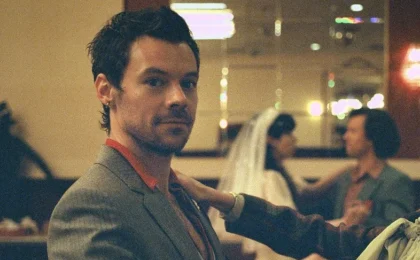
In the ever-evolving landscape of contemporary science fiction, the promise of a breakout star usually serves as a siren song for both financiers and audiences. However, the release of April X, the latest feature-length project from director Michel K. Parandi, serves as a sobering reminder that a rising star—in this case, Heated Rivalry standout Connor Storrie—is rarely enough to carry a film that lacks a foundational narrative identity. Despite securing a theatrical release that feels more like a strategic play on Storrie’s sudden fame than a reflection of the film’s quality, April X ultimately lands as a derivative, albeit visually competent, addition to the overcrowded genre of mid-budget dystopian thrillers.
Main Facts: A Star in Search of a Script
The film centers on Baxter (Storrie), a man navigating a crumbling, greige-hued future, and his twin sister, April (Lilly Krug). Set in an unspecified timeframe that relies heavily on the brutalist architecture of present-day Bucharest, the film attempts to weave a tale of human cloning, organ trafficking, and the commodification of human consciousness.
For Storrie, whose meteoric rise in the queer sports drama Heated Rivalry transformed him into a "hot property" in Hollywood, April X represents a career milestone: his first true lead in a feature vehicle. Yet, the performance feels restrained. Storrie adopts a stoic, Harrison Ford-esque frown—a stylistic choice that feels more like a nod to Blade Runner than an organic character development. He performs with the professional courtesy of an actor waiting for a better opportunity, which, in the context of his career trajectory, has arguably already arrived.
Chronology of a Narrative Lurch
The plot of April X is a fragmented affair that struggles to maintain its pacing. In the film’s initial act, we are introduced to the twins’ precarious existence: Baxter deals in black-market organs, while April possesses the unique, highly marketable ability to experience vivid, lucid dreams—a commodity in a world where the act of dreaming has become a relic of the past.
The inciting incident is as standard as the genre tropes it employs: Baxter crosses a dangerous local crime lord, Klein (played by Serban Pavlu), and the resulting debt leads to the disappearance of his sister. The film then takes a jarring, narrative-defying leap forward, jumping five years into the future. This transition is marked by little more than a change in hairstyle for Baxter and the introduction of a grim twist: April has been cloned into a series of "identikit" sex workers.
The remainder of the film concerns Baxter’s desperate, existential search to locate his sister’s soul among these duplicates, utilizing her recorded dreams as a potential conduit. It is a premise that teems with potential for philosophical exploration, yet the execution remains frustratingly surface-level, failing to ground the high-stakes science fiction in any tangible human emotion.
Supporting Data: Technical Merit vs. Creative Bankruptcy
Director Michel K. Parandi, making his feature-length debut, showcases a resourceful technical eye. Working on what appears to be a constrained budget, Parandi and his production team—led by cinematographer Nathan Haugaard and production designer Oana Novicov—have crafted a world that is visually coherent and occasionally striking.
The film utilizes the natural decay of Bucharest’s housing blocks to suggest a society in terminal decline. The integration of hi-tech drones against this backdrop of concrete rot provides a fleeting sense of aesthetic "pizzazz." However, the script, co-written by Parandi and Jack Coulter, acts as an anchor on these technical achievements.
The film relies on a collage of concepts borrowed from superior works of the genre. From the dream-market tropes reminiscent of Kathryn Bigelow’s Strange Days to the thematic echoes of Agnieszka Smoczynska’s Hot Spot, April X feels like a "greatest hits" compilation of sci-fi motifs without the imaginative eccentricity required to make them feel fresh. Where Hot Spot leaned into its own bizarre, patched-together identity, April X opts for a sterile, humorless tone that renders its dystopian world more tedious than terrifying.
Official Responses and Industry Context
While there has been no official "damage control" from the production studio, the industry response has been muted, signaling that the film’s theatrical rollout was likely a calculated effort to capitalize on the "Storrie Effect." By positioning April X in cinemas, the distributors successfully maneuvered the film out of the "straight-to-VOD" graveyard, even if the critical reception suggests that is where the film’s sensibilities truly lie.
For Parandi, April X will serve as his primary calling card in the industry. While the film demonstrates he has the technical capability to manage a complex shoot, it also reveals a significant deficiency in character writing. The lack of warmth or distinct personality in either Baxter or April prevents the audience from developing the emotional investment necessary to care about the existential stakes of the film’s conclusion.
Implications: The Dangers of the "Celebrity Vehicle"
The release of April X highlights a recurring trend in modern filmmaking: the temptation to greenlight projects primarily on the strength of a lead actor’s brand, rather than the strength of the screenplay. In this instance, the production seems to have bet that Storrie’s fans would be enough to sustain the film’s commercial life.
However, the reality is that such films often suffer under the weight of their own manufactured hype. Storrie is a capable actor, but he is not a miracle worker. When asked to carry a narrative that is fundamentally "muddy"—where the mechanics of his character’s life are obscure and his motivations are muted—even the most talented actor will struggle to create a compelling performance.
Ultimately, April X leaves us with a cautionary tale for both directors and talent agents. A successful career is built on the cumulative impact of deliberate, high-quality choices. While April X is not an "embarrassing blot" on Storrie’s résumé, it is a project that will be relegated to the margins of his filmography long before the next season of his hit series hits the airwaves.
For the genre of science fiction, the film serves as a reminder that visuals alone cannot sustain a narrative. A dystopian future should be haunting, provocative, or at the very least, interesting. By presenting a future that is merely "dull," April X misses its mark. Perhaps, as the film suggests, the most terrifying dystopia isn’t one defined by hyper-advanced technology or brutal collapse, but one defined by a lack of vision—an empty space where even the brightest stars are forced to wait for a better story to come along.