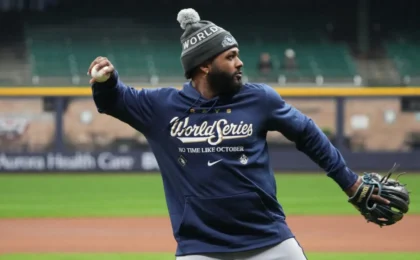
MILWAUKEE — For decades, the narrative surrounding the Major League Baseball postseason has been anchored by a singular, persistent anxiety: the "Rust vs. Rest" dilemma. Conventional wisdom—or perhaps, conventional superstition—suggests that teams forced to wait through long layoffs between series end up sluggish, losing the rhythmic edge that defines a 162-game campaign.
On Friday night at American Family Field, the Milwaukee Brewers didn’t just challenge that narrative; they systematically dismantled it. With a 3-2 victory over the Tampa Bay Rays in Game 1 of the World Series, the Brewers signaled that their week-long hiatus was not a handicap, but a tactical advantage. Having not played a game since their NLDS-clinching sweep of the Los Angeles Dodgers on October 15, the Brewers looked less like a team suffering from atrophy and more like a club hitting its stride.
A Blistering Start: Defying the Idle Clock
If there were any lingering concerns about the Brewers’ bats cooling off during their seven-day layoff, those doubts were vaporized within the first ten minutes of play. Facing Rays starter Nick Martinez—a seasoned All-Star who arrived in Milwaukee boasting a stellar performance against the Guardians in the ALCS—the Brewers’ offense was surgical.
Jackson Chourio set the tone immediately, leading off the bottom of the first with a crisp single. Christian Yelich followed with a booming triple to plate the game’s first run, and before the Rays could settle into their defensive set, William Contreras delivered an RBI single to extend the lead to 2-0. In the span of four batters, the Brewers had accomplished what "rusty" teams are purportedly incapable of: immediate, high-leverage execution against elite pitching.
The early offensive surge served as a statement of intent. By attacking a pitcher of Martinez’s caliber immediately, Milwaukee demonstrated that their preparation—which included intensive, simulated game-speed workouts—had successfully bridged the gap between inactivity and intensity.
Beyond the Box Score: Contreras’ Masterclass
While the offense grabbed the headlines, it was the performance of catcher William Contreras that truly highlighted the absurdity of the "rust" narrative. A catcher’s role is arguably the most demanding position on the field, requiring acute cognitive processing, defensive agility, and precise pitch framing.
After driving in a run in the first, Contreras proceeded to put on a defensive clinic. He successfully gunned down two Rays runners attempting to steal—a feat requiring elite pop times and arm strength—and demonstrated flawless judgment behind the plate by winning both of his ABS (Automated Ball-Strike System) challenges.
"Contreras was unbelievable," Brewers manager Pat Murphy said in his post-game press conference. "The two caught stealings, the ABS, the hits, calling the game—it was a complete performance. We weren’t perfect; we made a baserunning mistake and a defensive error, but after being off for some time, I am immensely pleased with how we came out in the first inning ready to go."
The "Rust" Myth: A Statistical Reckoning
To understand why the Brewers are so aggressively rejecting the "rust" label, one must look at the broader context of their postseason journey. Including their sweep of the Dodgers and their dominant run to the World Series, the Brewers have played a mere nine games over the last 26 days. Yet, they have secured victory in eight of those nine contests.
This success forces a difficult question for critics: If the rest is so detrimental, why is the most rested team in baseball also the most difficult to beat?
The answer lies in the evolution of modern baseball preparation. The days of simply taking batting practice against a coach tossing lobs are long gone. The Brewers utilized Trajekt technology—a sophisticated system that uses holograms of opposing pitchers to replicate specific spin rates, velocity, and movement patterns. This tech has become so precise that players are increasingly bypassing traditional minor-league rehab stints in favor of simulated high-velocity training.
Furthermore, the team prioritized internal "live" games. "We played baseball, that’s how we prepared," Murphy explained on the eve of the series. "You can’t recreate ‘real.’ It’s a long layoff, and if we want to use it as an excuse, then let people use it as an excuse, but I refuse to do that."
Challenging the "Excuse-Making" Culture
Murphy’s refusal to lean on the "rust" crutch speaks to a growing divide between traditional sports punditry and modern analytical reality. In the past, high-seeded teams that stumbled after a bye week were quick to point to their time off as a reason for their failure. However, as Murphy hinted, this is often a convenient narrative used to mask the reality of baseball’s inherent variance.
In a sport where even the best teams lose four out of every ten games, a small sample size—such as a five-game series—will always be susceptible to upsets. The "rust" narrative provides a comfortable psychological framework for fans and analysts to explain away those losses. Yet, when one examines the current playoff format, the numbers do not support the theory of disadvantage.
Since the current format was introduced in 2022, teams with five or more days of rest before Game 1 have posted a 14-10 record. While 10 losses might seem significant, it represents a winning percentage of .583—a pace that would equate to 95 wins over a 162-game season. These are not signs of a "rusty" team; these are signs of a rested, well-prepared team playing at a high level.
Historical Precedent and the Road Ahead
The Houston Astros’ 2022 championship run remains the definitive rebuttal to the anti-bye-week sentiment. After earning a first-round bye, they swept the Mariners, swept the Yankees, and eventually defeated the Phillies in the World Series, finishing with an 11-2 postseason record. The Brewers, currently sitting at 18-3 since September 13, are on a trajectory that could rival or even surpass that historic dominance.
Their path to this point was earned, not gifted. With 103 wins in the regular season, the Brewers secured their rest by being the best team in baseball. They earned their layoff by dispatching the Padres in four games and the Dodgers in a clean sweep. Rest is the byproduct of excellence, and the Brewers are currently reaping the rewards of that efficiency.
Implications for Game 2 and Beyond
The strategic advantage of their rest becomes even more pronounced when examining the bullpen. Milwaukee’s "three-headed monster"—Abner Uribe, Aaron Ashby, and Trevor Megill—has been devastatingly effective throughout the postseason. Because the team has not been pushed to their limit in recent weeks, these high-leverage arms remain fresh and fully available.
In Game 1, this trio combined for four innings of suffocating relief work. Given the current schedule, which includes a day off before Game 3, Murphy has the luxury of deploying this exact formula throughout the first three games of the series without fear of burnout.
For the Tampa Bay Rays, the mathematical reality is grim: they must now defeat a juggernaut four times in the next six games. The Brewers have not lost more than one game in a row since mid-September. They have cultivated a mindset where the "rest" is not a time to forget how to play, but a time to refine their approach.
As the series shifts to Game 2, the Brewers appear to be a team that has achieved the ultimate goal: they are physically recovered, mentally sharp, and statistically hungry. They didn’t forget how to play baseball during their layoff. They may just have forgotten how to lose.