For over three centuries, the bedrock of classical physics has rested upon a singular, elegant pillar: Sir Isaac Newton’s third law of motion. Often distilled into the aphorism "for every action, there is an equal and opposite reaction," this principle dictates the mechanics of our universe. When a runner’s foot strikes the pavement, the ground pushes back with identical force. It governs the propulsion of cars, the stroke of an oar, and the trajectory of a rocket.
However, the natural world is replete with systems that seem to flagrantly violate this Newtonian mandate. From the mesmerizing, fluidic shifts of a starling murmuration to the chaotic swarming of bacteria and the complex dynamics of human crowds, many collective systems operate on "non-reciprocal" interactions. In these groups, individuals respond only to a subset of their neighbors—usually those ahead or beside them—while remaining oblivious to those behind. Because the influence flows in one direction, the action and reaction are fundamentally unbalanced.
Now, a team of researchers in Dresden, led by physicist Roderich Moessner and collaborators at the Würzburg-Dresden Cluster of Excellence ctd.qmat, has unveiled a theoretical framework that reconciles these "rebellious" systems with the traditional laws of physics. By introducing the clever mathematical concept of "fictitious partners," the team has bridged the gap between non-reciprocal complexity and classical predictability.
The Newtonian Paradox in Nature
The Mechanics of Non-Reciprocity
To understand the significance of this discovery, one must first appreciate why non-reciprocal systems have long been a "black box" for physicists. Traditional theoretical mechanics are built entirely upon the assumption of symmetry. If Particle A exerts a force on Particle B, Particle B must exert an equal force on Particle A.
In biological systems, this symmetry rarely holds. Consider a school of fish or a flock of birds. A bird in flight tracks the position and velocity of its neighbors to maintain formation and avoid collisions. However, its visual field is selective; it reacts to the birds ahead, but the birds behind have no reciprocal influence on its flight path. Because the interaction is one-way, the system does not satisfy the requirements of a reciprocal, energy-conserving model.
For decades, this has forced scientists to rely on approximations that often failed to capture the emergent phenomena—the "intelligence" of the swarm—accurately. "Whatever we normally teach our students in theoretical mechanics, it ultimately rests on the action-reaction principle," notes research group leader Marin Bukov. When that principle is stripped away, the standard mathematical toolkit becomes largely ineffective.
Chronology: From Theoretical Frustration to Breakthrough
The road to this discovery began with the persistent inability of computational models to simulate complex living systems.
- Pre-2020s: Scientists observed that while simulations of simple, reciprocal particles were highly accurate, attempts to model biological swarms or active matter resulted in errors that compounded over time. The "non-reciprocal" nature of these systems was recognized as the culprit, but no unified framework existed to correct it.
- The Dresden Initiative: Working under the umbrella of the ctd.qmat cluster, the team sought a way to preserve the existing, well-tested machinery of many-body physics while accommodating non-reciprocal interactions.
- The "Imaginary Partner" Insight: The breakthrough occurred when the team moved away from trying to "fix" the physics of the birds themselves and instead focused on the mathematical structure of the interactions. They hypothesized that by adding "fictitious" variables to the equations, they could balance the ledger.
- Formalization: The team, including biophysicist Ricard Alert, developed a rigorous proof that these auxiliary variables could mathematically replicate the behavior of non-reciprocal systems, allowing them to be treated as if they were reciprocal.
- Recent Publication: The results of this study were finalized and subsequently published in the journal Nature Physics, marking a potential paradigm shift in how we model complex collective motion.
Supporting Data: The Artifice of Mathematical Symmetry
The brilliance of the Dresden team’s approach lies in its simplicity. They did not attempt to rewrite the laws of motion; rather, they expanded the environment in which those laws operate.
The Case of the Imaginary Bird
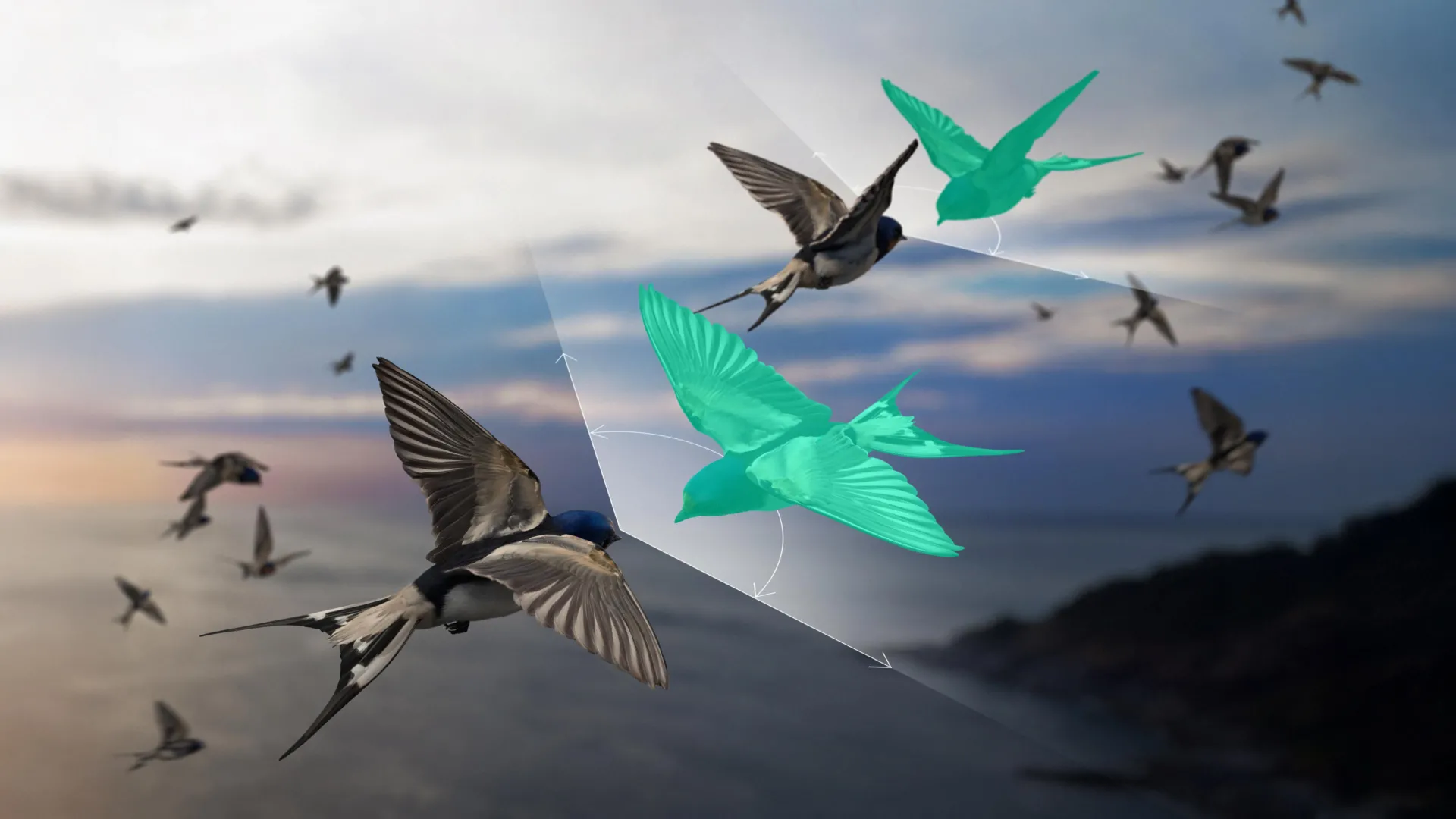
To simulate a flock of birds, the researchers create a mathematical mirror. For every real bird in the simulation, they introduce a "fictitious partner." This partner exists only as a mathematical variable—a set of coordinates and vectors—that moves in exact opposition to the real bird.
"The elegant solution is to artificially place a fictitious bird in front of each real bird, aligned in exactly the opposite direction," explains Ricard Alert. By doing so, the one-way interaction between the real bird and its neighbors is transformed into a system of reciprocal interactions between real and fictitious components.
Why This Works
In the language of physics, this is known as using "auxiliary degrees of freedom." While these fictitious partners do not exist in the physical world, they satisfy the mathematical requirements of Newton’s third law. Because the auxiliary variables are balanced against the real ones, the entire system can be solved using the standard, high-precision methods physicists have spent 300 years refining. This effectively "tricks" the simulation into reaching the correct answer without requiring the development of entirely new, unproven mathematical languages.
Official Responses and Expert Perspectives
The academic community has reacted with significant interest to the publication, noting that the utility of this model extends far beyond simple bird-watching.
"The research team has developed and proven a theory that makes much of what we teach our students applicable to non-reciprocal systems as well," says Marin Bukov. "These systems, where Newton’s third law does not apply, can now finally be described exactly and simulated precisely—even using established methods. This is exactly the kind of tool that has been missing in recent years."
The implications are particularly profound for researchers studying the intersection of quantum matter and collective motion. Roderich Moessner, who serves as the director of the Max Planck Institute for the Physics of Complex Systems, emphasizes that this is not merely an exercise in biology or ecology, but a fundamental inquiry into matter itself.
"In Würzburg and Dresden, we study quantum matter whose particles interact under certain conditions in ways that give rise to new phenomena such as magnetism or lossless current transport," Moessner explains. "The exciting question now is whether these exceptions to Newton’s law lead to entirely new forms of collective quantum behavior. We still know very little about this—and that is precisely what makes this so fascinating."
Implications: The Future of Collective Intelligence
The ability to accurately simulate non-reciprocal systems opens doors across a vast spectrum of scientific disciplines.
Biological and Medical Applications
In biology, understanding how cells communicate and move within living tissue is critical for cancer research. Cancer cells often exhibit non-reciprocal behavior, moving in ways that defy standard physical models. With this new framework, researchers can better simulate the migration of cells, potentially leading to new insights into how tumors metastasize and how they might be contained.
Crowd Dynamics and Urban Planning
Beyond biology, the model offers a more robust way to simulate human behavior in dense environments. From evacuation protocols in burning buildings to the flow of traffic in autonomous vehicle networks, the ability to model "one-way" human interactions—where individuals react to what they see ahead but not to the crowd behind—could save lives and improve urban efficiency.
Quantum Matter and Beyond
Perhaps most ambitiously, the team’s work suggests that our understanding of "non-reciprocal" quantum matter is still in its infancy. By applying these new theoretical tools, physicists hope to identify new states of matter that have been overlooked precisely because they didn’t conform to traditional Newtonian models.
The publication in Nature Physics is likely to become a foundational citation for future studies in active matter physics. By turning the "problem" of non-reciprocity into a solvable, balanced equation, the Dresden team has ensured that Newton’s legacy continues to serve as a bridge to the future, rather than a barrier to understanding the complex, asymmetric, and beautiful chaos of the natural world.