In the landscape of modern higher education, the ivory tower is increasingly becoming a question of square footage. As colleges and universities grapple with a confluence of existential pressures—declining enrollment, volatile public perception, regulatory shifts, and the relentless march of technological disruption—a foundational asset has moved to the center of the debate: the campus itself. For decades, the collegiate growth model was simple: more students necessitated more buildings. Today, that equation is fracturing, forcing administrators to confront a surplus of space that is as much a fiscal burden as it is a physical one.
The Reality of Underutilization
The latest Inside Higher Ed/Hanover Research Survey of College and University Chief Business Officers (CBOs) paints a stark picture of the current state of campus infrastructure. According to the data, a mere 43 percent of institutions report that they regularly utilize more than three-quarters of their physical space. The numbers are even more sobering for public master’s and baccalaureate institutions, where only 19 percent of facilities reach that threshold of regular utilization.
Despite this evidence of widespread vacancy, the instinct to build remains deeply ingrained. Nearly half of CBOs (44 percent) indicated that their institutions are maintaining their current physical footprints while pouring capital into renovations, and 31 percent are actively pursuing targeted expansion. Only 13 percent of institutions reported engaging in strategic downsizing.
This inertia occurs against the backdrop of a long-simmering deferred maintenance crisis. Facilities now rank as the fourth most significant area of cost-revenue misalignment, cited by 29 percent of CBOs, trailing only academic programming (48 percent), athletics (39 percent), and financial aid discounting (30 percent).
A Chronology of Expansion and Adjustment
The current predicament is the result of a two-decade trend wherein colleges added space at a rate far outpacing enrollment growth.
- The Era of Unchecked Growth (2000–2015): During this period, higher education institutions aggressively expanded, fueled by easy access to debt and a cultural mandate to build “amenity-rich” campuses to lure students.
- The Pandemic Pivot (2020–2022): The rapid shift to remote learning exposed the fragility of the "brick-and-mortar" necessity. As hybrid work and online instruction became permanent fixtures, the traditional reliance on physical attendance began to erode.
- The Recognition of Surplus (2023–2025): Data from firms like Occuspace revealed that average utilization of campus building space plummeted from 53 percent in 2024 to 45 percent by the fall of 2025.
- The Current Correction (2026–Present): Institutions are now beginning to pivot from expansion toward "rightsizing." While peak utilization has seen a marginal recovery—increasing six to eight percentage points in spring 2026—it remains far below the industry-standard target of 70 percent, leaving a vast, costly gap in operational efficiency.
The Financial and Operational Toll
The cost of maintaining this underused infrastructure is staggering. Occuspace estimates that unused space—which nonetheless demands utilities, custodial care, and ongoing maintenance—drains roughly $79 billion from the higher education sector annually.
Nic Halverson, CEO of Occuspace, argues that this is an overlooked crisis. "Underutilized campus space is very much a real thing, and I don’t think it gets enough attention relative to how much it costs institutions every year," he notes. The problem is exacerbated by siloed budgeting, where facilities management, academic affairs, and student services operate as independent fiefdoms, preventing a holistic approach to real estate.
Beyond the balance sheet, there is a cultural element to the waste. Many employees view assigned office space as a "political status," resisting efforts to convert underused rooms into shared collaboration spaces even when they only visit campus intermittently. This psychological attachment to fixed space often prevents administrators from maximizing the utility of existing buildings.
Official Responses and Strategic Shifts
Administrators are beginning to acknowledge that "stewardship" must replace "ownership" as the primary philosophy for space management. Terry Brown, vice president for academic innovation and transformation at the American Association of State Colleges and Universities (AASCU), emphasizes that universities are distinct from commercial entities.
"Universities are not like hotels and airlines—there’s some inefficiency built in," Brown says, noting that highly specialized laboratories serve a critical academic mission even if they are not occupied 24/7. However, she argues that space must be treated with the same fiscal scrutiny as faculty salaries or research funding.

AASCU’s own student-centered course-scheduling initiative serves as a blueprint for this shift. By using data to reduce bottlenecks during peak hours (such as the traditional Tuesday/Thursday mid-morning surge), the program has seen measurable success. The pilot program, which included 11 regional universities, led to a 12 percent increase in student completion rates for core English and math courses, while Texas A&M University-Corpus Christi managed to boost classroom utilization by 5 percent.
Adaptive Reuse: Converting Liabilities into Assets
The most innovative institutions are moving away from new construction in favor of "adaptive reuse." This strategy involves repurposing aging or underutilized buildings for modern needs, a concept that aligns with the philosophy of Elliot Felix, author of The Connected College. Felix argues that the "most sustainable building is the one you don’t build," advocating for a "grow in place and online" mindset.
Recent examples of this trend include:
- Truman State University: Transformed a landmark, neglected building into a comprehensive Student Success Center, centralizing services to foster community.
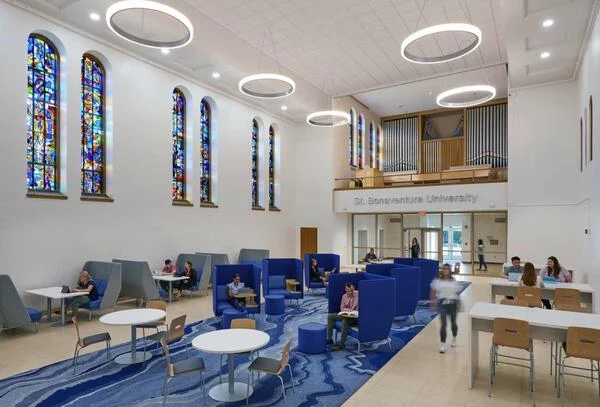
- St. Bonaventure University: Converted a de-consecrated historic chapel into a vibrant student common area as part of a larger renovation project for its health professions school.
- University of Michigan: The renovation of the Dennison Building into "Weiser Hall" serves as a model for interdisciplinary collaboration, proving that old structures can be modernized to house cutting-edge research and interdisciplinary units.
The Risks of Public-Private Partnerships (P3s)
Not all efforts to monetize campus space have been met with success. Partnerships with private developers are increasingly common, but they carry significant political and financial risk.
George Washington University recently faced backlash for selling its Virginia science campus to a data center operator. Similarly, the University of Maine at Orono has encountered scrutiny regarding a hotel development on campus that has underperformed, leading to reports that the university may be forced to utilize the facility for student housing to cover costs.
Experts like Ruth Johnston of the NACUBO consulting arm warn that while renting space for childcare, banking, or recreational services like pickleball can diversify revenue, these decisions must be mission-aligned. "You just have to assess: Is this central to our mission and to our core?" Brown adds.
Implications for the Future
The implications for higher education are profound. The era of the "building-first" growth strategy is over. Instead, the future of the campus lies in:
- Utilization Studies: Moving beyond anecdotal evidence to hard data, schools must conduct granular studies of how every square foot is being used.
- Sustainability: With the built environment accounting for 40 percent of carbon emissions, rightsizing is not just a fiscal necessity—it is an environmental imperative.
- Flexible Design: Moving toward "third places"—spaces designed for community and collaboration rather than static, single-purpose classrooms—is essential for retaining students who are increasingly drawn to hybrid and flexible learning environments.
- Operational Integration: Breaking down the silos between academic planning and facilities management is the only way to treat occupancy as an "operating input" comparable to research grants or tuition revenue.
As Cecilia M. Orphan of the University of Denver notes, regional public universities have historically been "original adaptive reusers," often making do with unconventional buildings. This spirit of innovation will be required across the sector as institutions move away from the unsustainable habit of expansion.
The path forward is not necessarily to shrink, but to optimize. By viewing the campus not as a static collection of monuments, but as a dynamic portfolio of assets, higher education can ensure that its physical environment supports, rather than stifles, its academic mission. The goal is no longer to be the institution with the most buildings, but the one that makes the most meaningful use of the space it already calls home.