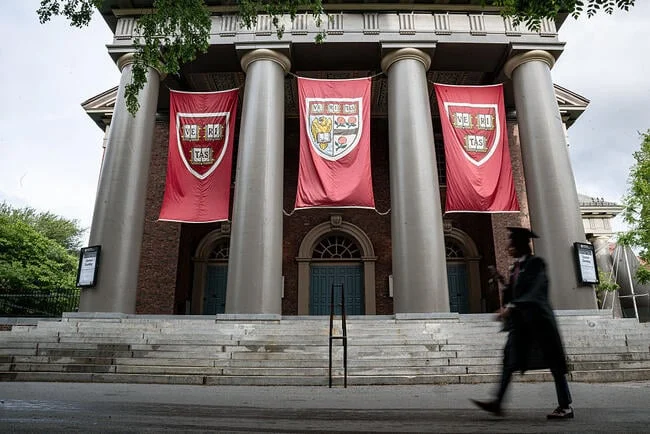
The hallowed halls of Harvard University, once defined by the rhythmic scratching of fountain pens and the meticulous curation of research libraries, are currently the site of a high-stakes pedagogical experiment. As generative artificial intelligence (AI) evolves from a novelty into an inescapable utility, the faculty of the Faculty of Arts and Sciences (FAS) find themselves caught in a profound conflict between academic integrity and the inexorable march of technological progress.
A comprehensive new survey conducted by The Harvard Crimson—the university’s venerable student newspaper—reveals a stark divide: while university leadership champions the integration of AI as a vital research and pedagogical tool, the professoriate is growing increasingly wary, with nearly two-thirds of surveyed faculty characterizing the impact of AI on their courses as “somewhat” or “very” negative.
The Shifting Landscape: A Chronology of Conflict
The trajectory of AI adoption at Harvard has been nothing short of volatile. In the immediate wake of the public release of large language models (LLMs) like ChatGPT, the university’s initial stance was one of cautious observation.
By the 2025 academic year, roughly 10 percent of faculty reported having no specific policy regarding the use of AI in their classrooms. However, as of the latest survey, that number has plummeted to a mere 3.5 percent. This shift signifies a rapid move toward formalization, as professors scramble to define the boundaries of acceptable AI assistance.
The timeline of this transition reflects a broader national anxiety:
- Late 2024–Early 2025: Initial faculty experimentation with AI tools. Policies remained loose, and institutional guidance was limited to general academic honesty statements.
- Academic Year 2025–2026: A period of "Great Retrenchment." Faculty began noticing significant shifts in student output, leading to the 42 percent dissatisfaction rate noted in the previous cycle.
- Autumn 2026: The current "Policy Hardening" phase. As indicated by the Crimson’s data, professors are increasingly moving toward restrictive stances, with 25 percent now instituting blanket prohibitions on AI use—a significant increase from the 20 percent recorded just one year prior.
The Data Divide: Analyzing Faculty Sentiment
The Crimson’s survey of more than 460 professors provides a granular look at how different disciplines are adapting to the AI reality. The data suggests that the "soft" sciences are far more amenable to AI integration than their counterparts in the humanities.
Disciplinary Trends
- Social Sciences: 84 percent of faculty in this sector permit at least some level of AI usage. The nature of social science research—often involving data synthesis and trend analysis—may lend itself more readily to the capabilities of current LLMs.
- Science and Engineering: 79 percent of faculty in these departments allow for AI, though often with strict caveats regarding the verification of code or laboratory results.
- Arts and Humanities: Trailing behind, only 63 percent of humanities professors permit AI. This reluctance is likely rooted in the foundational importance of original writing and critical thought, which many believe is being eroded by automated tools.
The Problem of Detection
Perhaps the most alarming statistic for the university administration is the disconnect between perception and reality regarding student work. Nearly 90 percent of faculty report having received work they suspected—or knew—was generated by AI. Yet, there is a profound lack of confidence in the available tools for proof. Only 64 percent of professors feel "somewhat or very confident" in their ability to distinguish between student-authored work and AI-generated text.

This uncertainty has created a "chilling effect" in the classroom. When a professor cannot definitively prove AI use, they are less likely to pursue formal disciplinary action. Consequently, despite the near-universal perception of widespread AI use, only 12 percent of faculty respondents referred cases to the honor council this past year—a marginal increase from 10 percent the year prior.
Official Responses: A Leadership Out of Sync?
While the faculty is clearly leaning toward restriction, the university’s executive leadership is pushing for acceleration. The administration appears to view AI as an essential component of the future workforce, urging faculty to meet students where they are rather than policing their tools.
The Dean’s Perspective
Harvard College Dean David Deming has been at the forefront of the pro-AI advocacy. In a recent directive, he suggested that professors should not only accept but actively encourage the use of AI in writing and project-heavy courses. The argument is that literacy in the age of AI—"AI fluency"—is now a foundational skill as critical as reading and basic arithmetic.
The Presidential Stance
President Alan Garber has echoed these sentiments, framing AI as an engine for research and innovation. During his address on the first day of the 2026 academic year, Garber praised the potential of AI to unlock new frontiers in scientific inquiry. For the administration, the goal is to position Harvard as a global leader in AI-enhanced education, rather than a bastion of traditionalist resistance.
The Pedagogical and Ethical Implications
The friction between the administration’s "AI-first" mandate and the faculty’s cautionary approach raises fundamental questions about the nature of a Harvard education.
The Erosion of Critical Thinking?
Critics among the faculty argue that by allowing AI to handle the "heavy lifting" of research and drafting, students lose the struggle that leads to true intellectual development. The process of organizing a chaotic set of ideas into a coherent argument is where the learning happens; if an AI performs that synthesis, the student effectively skips the cognitive exercise that the course was designed to provide.
The Integrity Crisis
The current environment has forced an evolution in the university’s honor code. If students are using AI to generate outlines, conduct preliminary research, or even refine prose, where does "assistance" end and "plagiarism" begin? The fact that most professors now have explicit policies is a testament to the fact that the old definitions of academic honesty are no longer sufficient.

Equity and Access
There is also a socioeconomic dimension to this debate. If professors begin to mandate the use of paid, high-end AI tools, will students who cannot afford these subscriptions be disadvantaged? Conversely, if AI is banned, will students who lack the time to produce massive, high-quality papers be at a disadvantage compared to those who have the resources to outsource work to AI tools?
Looking Ahead: The Future of the Harvard Classroom
The tension between the ivory tower’s traditions and the silicon reality of the 21st century is not unique to Harvard, but the university’s response will undoubtedly set a precedent for higher education globally.
As the survey demonstrates, the faculty is not merely reacting to a trend; they are grappling with an existential shift in the relationship between student and subject. The increase in restrictive policies suggests that for now, the "human touch"—the emphasis on original thought, physical presence, and manual synthesis—is being guarded fiercely by the teaching staff.
However, the administration’s continued push for integration suggests that the current restrictive phase may be a temporary defensive posture. The likely outcome is a "hybrid model," where AI is not treated as a forbidden fruit but as a regulated utility—similar to how the calculator was once resisted in mathematics departments before becoming an essential, and eventually mundane, tool.
For the students of Harvard, the classroom experience is becoming increasingly bifurcated. They are being told by their Dean to master the tools of the future, while being told by their professors to keep those same tools at arm’s length. This pedagogical whiplash is the defining feature of the 2026–2027 academic year. As the university continues to navigate this transition, the success of its mission will depend on whether it can reconcile these two competing visions: one that views AI as an existential threat to the mind, and one that views it as the next great instrument of human achievement.