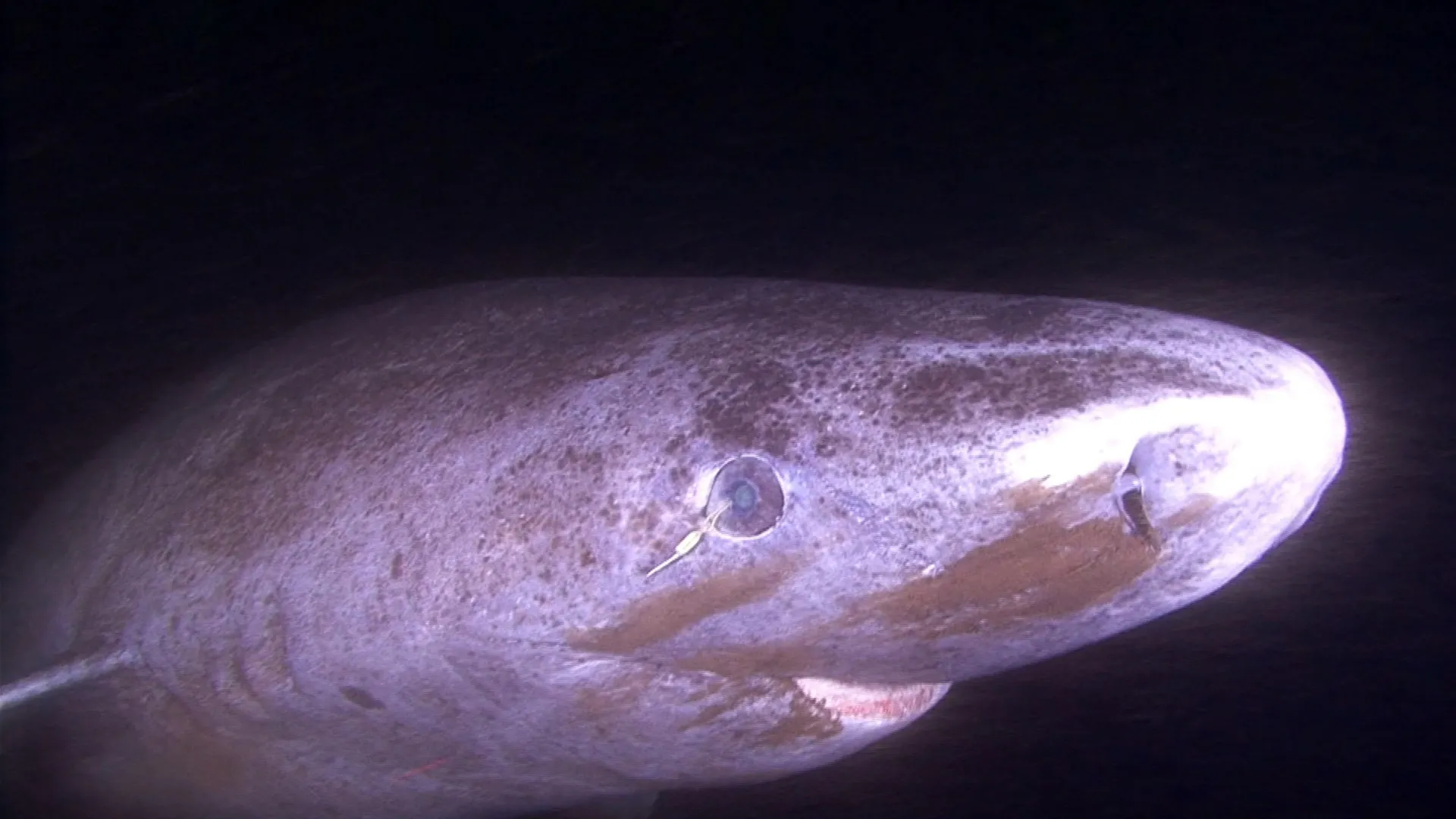
In the freezing, obsidian depths of the Arctic Ocean, a creature glides through the silence—a Greenland shark, an animal so ancient that some individuals alive today were swimming through these same waters when the American Revolution was fought. These enigmatic predators, which can reach ages of up to 400 years, have long been the subjects of biological wonder. Yet, for all their fame as the world’s longest-living vertebrates, a persistent myth has shadowed them: the belief that they are functionally blind.
New research, led by Dr. Dorota Skowronska-Krawczyk, an associate professor of physiology and biophysics at the University of California, Irvine, is now shattering that assumption. By peering into the ocular biology of these centuries-old giants, scientists have discovered that the Greenland shark’s vision is not a vestigial relic of the deep, but a sophisticated, resilient system that defies the traditional laws of biological aging.
The Myth of the Blind Titan
The Greenland shark (Somniosus microcephalus) is an imposing figure. With thick, slate-gray bodies, small heads, and rounded snouts, they appear almost prehistoric. Their most striking feature, however, is their eyes. They are often cloudy, milky, and frequently host parasitic copepods that attach directly to the cornea. Given these visual obstructions and the pitch-black, high-pressure environment in which they reside, marine biologists long hypothesized that the sharks relied exclusively on smell and vibration, effectively ignoring their eyes as useless organs.
"Evolutionarily speaking, you don’t keep the organ that you don’t need," explains Dr. Skowronska-Krawczyk. While reviewing footage of the sharks in their natural habitat, she noticed something the scientific community had largely overlooked: the sharks were physically tracking light. Their eyes were not merely sitting in their sockets; they were actively responding to the visual cues of their environment. This observation sparked a multi-year investigation into whether these animals were seeing, or perhaps even thriving, in the dark.
Chronology of an Arctic Discovery
The journey to understand the Greenland shark began in earnest following a landmark 2016 study published in Science by marine biologist John Fleng Steffensen. That study established the shark’s incredible longevity, but it also highlighted the pervasive presence of eye-dwelling parasites.
The subsequent investigation into their vision followed a rigorous timeline:
- 2020–2024: Researchers led by Steffensen, alongside collaborators Peter G. Bushnell and Richard W. Brill, utilized scientific long lines near the University of Copenhagen’s Arctic Station on Disko Island, Greenland, to obtain samples. The eyes were carefully dissected and preserved in fixative solutions to maintain cellular integrity for laboratory study.
- The Laboratory Phase: The specimens were transported to the University of California, Irvine. For Emily Tom, a Ph.D. student in the Skowronska-Krawczyk lab, the arrival of the samples was a surreal experience. "I opened the package, and there was a giant, 200-year-old eyeball sitting on dry ice just staring back at me," Tom recalls.
- The Analysis: The team had to scale up standard protocols, moving from the microscopic work of mouse eyeballs—roughly the size of a papaya seed—to a baseball-sized organ. The team performed histological and vision-specific analyses, focusing on the retinal structure and protein expression.
- Publication: In late 2024, the findings were published in the journal Nature Communications, co-authored by researchers from the University of Basel, Switzerland, including Walter Salzburger and Lily G. Fogg, who provided critical insights into the evolutionary biology of the findings.
Data and Biological Resilience
The findings from the UC Irvine team were nothing short of revelatory. Contrary to the expectation of advanced degradation in a 200-to-400-year-old animal, the histological examinations revealed no signs of retinal cell death.
The Rhodopsin Advantage
The researchers focused heavily on rhodopsin, a specialized protein essential for detecting light in low-visibility environments. They discovered that this protein remained remarkably active in the Greenland shark’s retina. Crucially, the rhodopsin was tuned to detect blue light—the specific wavelength that penetrates most effectively into the deep, dark Arctic waters. This adaptation suggests that the shark is not just "seeing," but is highly specialized to detect the faint bioluminescence or filtered surface light available at extreme depths.
DNA Repair Mechanisms
Perhaps the most significant discovery is the evidence of robust DNA repair mechanisms within the eye tissue. In most vertebrates, the accumulation of DNA damage over decades leads to cataracts, macular degeneration, and eventual blindness. The Greenland shark appears to have evolved a molecular "maintenance crew" that preserves the integrity of its visual system across centuries, effectively insulating the retina from the wear and tear of time.
Official Perspectives and Expert Insight
Dr. Skowronska-Krawczyk emphasizes that this research is not merely a niche study of a remote predator; it is a fundamental inquiry into the mechanics of aging. "What I love about my work is that we are the first in the world to see these results—finding new mechanisms and rules of biology," she says.
Her mentor-style approach, which involves hands-on laboratory work with her students, has been vital to the success of the project. Emily Tom notes that the intensity of the work required both technical precision and a deep respect for the specimen. "Handling the tissue required precision," Tom explains. "If it warmed too much and reached room temperature, the samples could begin to deteriorate. It was a race against the clock, even for an eye that had survived two centuries."
The collaboration between the University of Copenhagen and UC Irvine highlights the importance of international scientific cooperation. By combining the fieldwork expertise of marine biologists who understand the shark’s habitat with the molecular expertise of researchers who study age-related diseases, the team was able to bridge the gap between ecology and medicine.
Implications for Human Medicine
The potential implications of these findings for human health are profound. As the global population ages, age-related vision loss—such as macular degeneration and glaucoma—has become a significant public health challenge. Understanding the molecular pathways that allow the Greenland shark to maintain perfect vision for centuries could provide a roadmap for new therapeutic interventions.
"We can learn so much about vision and longevity from long-lived species like the Greenland shark," says Tom. If scientists can isolate the specific genes or repair mechanisms that protect the shark’s retina, it may be possible to develop treatments that slow or even reverse the onset of similar conditions in humans.
Beyond ophthalmology, the study raises broader questions about tissue longevity. How do some organisms manage to prevent the systemic degradation that defines the aging process in other mammals? The Greenland shark serves as a living laboratory for the study of extreme biological resilience.
The Future of Arctic Research
Despite the success of the study, Dr. Skowronska-Krawczyk acknowledges the challenges ahead. Uncertainty regarding federal research funding and the logistical difficulties of Arctic fieldwork remain persistent hurdles. However, she remains optimistic about the future of this work.
"We will prevail," she asserts. The team is already planning future studies to further map the genome of the Greenland shark and compare its DNA repair mechanisms to those of shorter-lived species.
As the world continues to grapple with the complexities of aging, the humble Greenland shark, drifting through the dark, cold waters of the north, provides an unlikely beacon of hope. It reminds us that nature often holds the solutions to our most pressing medical mysteries, hidden in the most unexpected places. For the scientists at UC Irvine, the giant, baseball-sized eye that once stared back at them from a cooler of dry ice was not just an anatomical specimen; it was a window into a future where age-related disease might finally be conquered.
In the quiet, dark corners of the Earth, the Greenland shark continues to see, watching the light—and in doing so, it is finally teaching us how to see more clearly ourselves.