Main Facts: A Solemn Return to the Historic House Steps
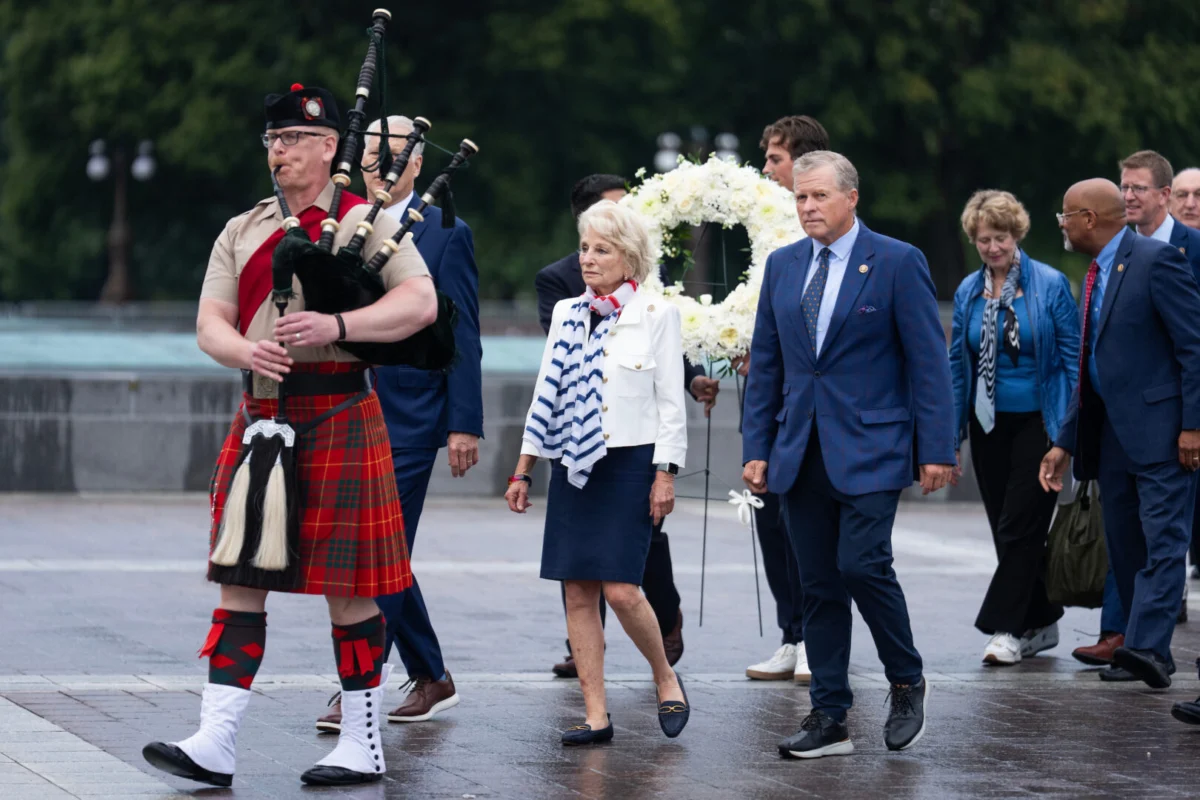
WASHINGTON — To the solemn cadence of a ceremonial bagpipe, a bipartisan delegation of former and current members of the United States Congress walked in procession to the House steps of the U.S. Capitol on Friday afternoon, marking a quarter-century since the terrorist attacks of September 11, 2001.
Organized by the Association of Former Members of Congress (FMC), the commemorative ceremony brought together leaders who shaped—and were shaped by—the legislative, national security, and humanitarian responses to the deadliest foreign attack on American soil. As bagpipe notes echoed across the East Front of the Capitol complex, lawmakers walked side by side in a visual echo of September 11, 2001, when members of the House and Senate spontaneously gathered on those very steps to sing "God Bless America" in a moment of historic unity.
Prominent former lawmakers leading the procession included former Rep. Tim Roemer (D-Ind.), who later served on the bipartisan 9/11 Commission; former Rep. Jane Harman (D-Calif.), a long-time leader on the House Intelligence Committee; and former Rep. Charlie Dent (R-Pa.), a key voice in post-9/11 domestic security oversight. They were joined by former Rep. Susan W. Brooks (R-Ind.), former Rep. Derek Kilmer (D-Wash.), and current Rep. Glenn Ivey (D-Md.), among others.
The 25th-anniversary observance served not only as a moment to honor the nearly 3,000 victims who died in New York, at the Pentagon, and in the fields of Shanksville, Pennsylvania, but also as a retrospective on twenty-five years of altered national priorities, legislative overhauls, and evolving global threats.
Chronology: From Crisis on Capitol Hill to a Quarter-Century of Policy Evolution
The path to the 25th anniversary began in confusion and peril on the morning of September 11, 2001. The timeline of legislative action and institutional adaptation spans two and a half decades of American history:
The Day of the Attacks (September 11, 2001)
- 8:46 AM – 9:03 AM: American Airlines Flight 11 and United Airlines Flight 175 strike the North and South Towers of the World Trade Center in New York City.
- 9:37 AM: American Airlines Flight 77 strikes the Pentagon.
- 9:45 AM: The U.S. Capitol and the White House are evacuated amid intelligence reports of additional hijacked airliners.
- 10:03 AM: United Airlines Flight 93 crashes in Shanksville, Pennsylvania, after passengers and crew fought back against hijackers. Historical evidence later confirmed the aircraft was targeted toward Washington, D.C., with the Capitol as its probable intended destination.
- 7:00 PM: Members of the Senate and House assemble on the Capitol steps, holding hands across party lines to demonstrate national solidarity and resilience.
Legislative Transformation (2001–2004)
- October 2001: Congress passes the USA PATRIOT Act, radically reshaping federal surveillance, law enforcement authority, and financial tracking of terror networks.
- November 2001: The Aviation and Transportation Security Act creates the Transportation Security Administration (TSA), federalizing airport security.
- November 2002: President George W. Bush signs the Homeland Security Act of 2002, establishing the Department of Homeland Security (DHS)—the largest reorganization of the U.S. federal government since the National Security Act of 1947. Simultaneously, Congress creates the National Commission on Terrorist Attacks Upon the United States (the 9/11 Commission).
- December 2004: Following the publication of the 9/11 Commission Report, Congress passes the Intelligence Reform and Terrorism Prevention Act, establishing the Office of the Director of National Intelligence (ODNI) to integrate federal intelligence agencies.
Institutionalization and Health Care Support (2006–2019)
- December 2010: Congress passes the James Zadroga 9/11 Health and Compensation Act, creating the World Trade Center Health Program and reopening the September 11th Victim Compensation Fund (VCF) for first responders and survivors suffering from toxic exposure.
- July 2019: Congress passes the Never Forget the Heroes Act, permanently funding the September 11th Victim Compensation Fund through fiscal year 2090.
The Quarter-Century Commemoration (September 11, 2026)
- 5:00 PM: Former and current members of Congress assemble at the House steps, holding a public procession, moment of silence, and wreath-laying ceremony organized by the FMC to honor the 25-year milestone.
Supporting Data: The Quantitative Impact of Post-9/11 America
The 25th anniversary offers a stark metric-based overview of how the events of September 11, 2001, reshaped the structural, financial, and human landscape of the United States.
       POST-9/11 HISTORICAL & FISCAL METRICS (2001–2026)
+-------------------------------------------------------------+
| Fatalities on Sept 11, 2001          | 2,977 individuals    |
| First Responder / Survivor Deaths    | 5,500+ (post-2001)   |
| WTC Health Program Enrollees        | 125,000+ active      |
| Federal Homeland Security Budget     | $100B+ annually      |
| DHS Workforce Expansion             | ~260,000 personnel   |
| Global War on Terror Direct Costs    | $8 Trillion+         |
+-------------------------------------------------------------+
Human Impact and First Responder Health
While 2,977 people lost their lives on the day of the attacks, the health registry tracking toxic exposure in New York, Washington, and Pennsylvania shows a continuing casualty toll. More than 125,000 responders and survivors are currently enrolled in federal monitoring programs, with toxic-exposure-related deaths among New York Police Department officers and Fire Department of New York (FDNY) personnel now exceeding the number of first responders killed on the day of the attacks.
Governmental Restructuring and Fiscal Investment
Prior to 2001, federal spending on domestic defense and border protection was fragmented across dozens of agencies. Today:
- The Department of Homeland Security manages an annual budget exceeding $100 billion and employs over 260,000 public servants.
- Total U.S. federal expenditures related to post-9/11 counterterrorism, homeland security, and foreign military actions over the past 25 years exceed $8 trillion, according to fiscal research data.
- Infrastructure changes to the U.S. Capitol complex itself—including the construction of the 580,000-square-foot Capitol Visitor Center, completed in 2008—were largely redesigned to incorporate subterranean security screening facilities post-9/11.
Official Responses: Lawmakers Reflect on Unity, Security, and Governance
Speaking following Friday’s ceremony, leaders from both political parties reflected on the lessons of the past quarter-century, contrasting the unity of 2001 with the modern political landscape.
Perspectives from Key Participants
Tim Roemer, who served as a Democratic Congressman from Indiana before joining the 9/11 Commission and later serving as U.S. Ambassador to India, stressed the enduring necessity of national unity:
"Twenty-five years ago, the Capitol was targeted, but our national resolve was strengthened. The 9/11 Commission showed that when leaders put aside partisanship to analyze hard truths, we can reform our institutions to protect the American public. Returning to these steps today is a reminder that national security is not a partisan issue—it is the foundational obligation of the United States government."
Jane Harman, former ranking member of the House Intelligence Committee, emphasized the evolving nature of national security threats:
"In the immediate aftermath of 9/11, we had to invent a new security paradigm to counter non-state terrorist networks. Over the past 25 years, our intelligence community has matured exponentially. However, as we look to the future, the lessons of 9/11 must be applied to emerging digital threats, artificial intelligence, and domestic security challenges. Vigilance requires adaptation."
Charlie Dent, a former Republican Representative from Pennsylvania who served as a senior member of the House Appropriations Subcommittee on Homeland Security, reflected on the spirit of 2001:
"On September 11th, nobody asked if you were a Democrat or a Republican. On these very steps 25 years ago, Congress spoke with one voice. As we commemorate this solemn milestone, our country desperately needs to recapture that sense of shared purpose and civility in public governance."
Glenn Ivey, currently representing Maryland’s 4th Congressional District, highlighted the generational transition occurring within public service:
"We now have an entire generation of young Americans, including members of our military and diplomatic corps, who have no living memory of September 11, 2001. It is our duty to pass down the historical memory of that day—not just the horror of the attack, but the extraordinary courage displayed by first responders, civilian heroes, and the public servants who rebuilt our national defense."
Implications: The Legacy of 9/11 in Modern Governance and Security
The 25th anniversary of September 11 comes at a strategic pivot point for American foreign policy, domestic security, and democratic institutions.
                   EVOLUTION OF THREAT MATRIX

    1990s - Early 2000s                   2020s - Future
  +----------------------+            +----------------------+
  | State Actors &       |            | Cyber & AI Warfare   |
  | Conventional Terror  |    ===>    | Hybrid/Asymmetric    |
  | Border Controls      |            | Domestic Extremism   |
  +----------------------+            +----------------------+
The Transitioning Threat Matrix
Over the past 25 years, federal security priorities have shifted from counterterrorism operations in the Middle East toward strategic competition with near-peer nation-states, counter-cyber operations, and securing critical national infrastructure against digital intrusion. The robust intelligence-sharing infrastructure built in the wake of 9/11—specifically through the National Counterterrorism Center (NCTC)—now serves as the structural model for federal responses to emerging threats in artificial intelligence and supply-chain security.
Civil Liberties vs. State Oversight
The quarter-century mark also prompts continued evaluation of the balance between national security authorities and constitutional privacy rights. FISA (Foreign Intelligence Surveillance Act) reform, mass data handling, and domestic surveillance boundaries remain central to legislative debates in the House and Senate, demonstrating that the statutory framework erected immediately after 9/11 remains subject to ongoing judicial and legislative recalibration.
Preserving Institutional Openness
For the U.S. Capitol complex, the 25th anniversary highlights the delicate equilibrium between physical security and public access. While post-9/11 security protocols permanently changed how tourists, journalists, and citizens access the halls of Congress, Friday’s gathering on the House steps underscored a collective commitment to maintaining the Capitol as an open symbol of democratic governance.
As the bagpipes faded across Capitol Hill on Friday evening, the 25th anniversary ceremony concluded with a silent wreath-laying at the base of the Capitol steps—a quiet testament to a day that permanently altered the nation’s trajectory, and a solemn reminder of the legislative responsibilities born from its wake.