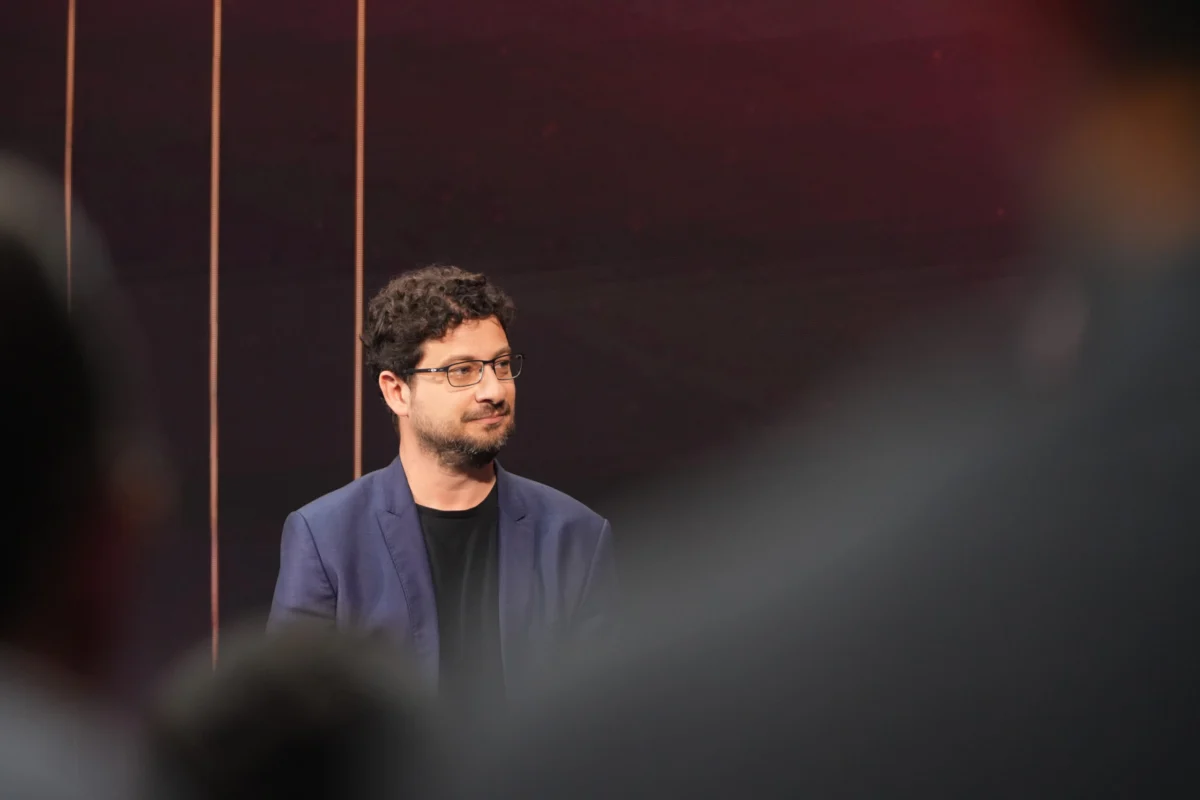
If you have ever opened a video file on a computer, you have likely encountered the orange traffic-cone icon. VLC Media Player, the ubiquitous open-source software, has been downloaded more than 6 billion times, serving as the universal language for digital video. Now, its lead developer, Jean-Baptiste Kempf, is looking to standardize a far more complex frontier: the real-time control of the physical world.
Kempf, a seasoned French entrepreneur and a luminary in the open-source community, believes we are on the precipice of a seismic shift. He predicts that within a few years, hundreds of millions of robots and drones will be navigating our streets, factories, and skies. To manage this mechanical explosion, he has founded Kyber, a startup building the essential infrastructure layer required to operate remote devices with near-zero latency. With a fresh $5 million in funding led by Lightspeed Venture Partners—a firm known for backing AI titans like Anthropic and Mistral—Kyber is positioning itself as the foundational “nervous system” for the next generation of physical AI.
The Core Technology: Bridging the Physical-Digital Gap
At its heart, Kyber is an SDK (Software Development Kit) designed to synchronize video, audio, sensor telemetry, and control inputs across distributed networks. The platform is engineered to solve a fundamental problem of modern robotics: the geographic disconnect between the operator (or the AI brain), the compute resources, and the physical action.
“Physical AI is only as good as the underlying systems running it,” Lightspeed noted in a recent announcement. That sentiment underscores why Kyber’s architecture is so critical. Whether a robot is being piloted by a human in a remote office or by an AI agent thousands of miles away from its hardware, the challenge remains the same: the speed of data transmission.
Kyber takes its name from the lightsaber crystals of the Star Wars universe—a nod to the precision and energy efficiency the company aims to provide. In the world of robotics, where a delay of even a few milliseconds can result in a collision or a mechanical failure, speed is the ultimate currency. By leveraging high-performance video streaming technologies—a direct technological lineage from Kempf’s work on VLC and his tenure as CTO at the cloud gaming startup Shadow—Kyber optimizes data flow to ensure that command-and-control signals arrive instantaneously.
Chronology: From VLC to the Robotics Frontier
The journey toward Kyber began long before the company was formally incorporated. Kempf’s career has been defined by his mastery of open-source video streaming and high-performance computing.
- The VLC Foundation (2000s–Present): As the lead developer of VideoLAN, Kempf gained unparalleled insight into how to deliver high-quality, low-latency video across diverse hardware and network conditions.
- The Shadow Era (2020): While serving as CTO of the cloud gaming pioneer Shadow, Kempf grappled with the massive technical hurdle of streaming complex, interactive game environments to users with minimal lag. It was here that the initial seeds for Kyber were sown as a side project.
- Founding Kyber: Recognizing that the infrastructure for gaming could be repurposed for the nascent robotics and IoT (Internet of Things) sector, Kempf transitioned to full-time development of the Kyber platform.
- The Lightspeed Infusion (2024/2025): The company secured a $5 million seed round, signaling venture capital’s growing appetite for "Physical AI" infrastructure rather than just the software models themselves.
- Global Expansion: Today, with 25 full-time employees, Kyber operates out of Paris, with strategic footholds in San Francisco and Singapore, positioning itself to support a global fleet of autonomous and remote-controlled hardware.
Supporting Data and Scaling Challenges
The robotics market is currently fragmented, with companies building proprietary, siloed solutions to manage their fleets. Kempf notes that while large-scale operators exist, they are currently limited. "The largest fleets today have maybe 2,000 or 3,000 vehicles," Kempf explains. "Imagine you need to manage millions of them; that’s not the same thing."
As the industry shifts from controlled, small-scale deployments to mass-market autonomy, the requirements for "observability"—the ability to monitor and troubleshoot systems in real time—become exponentially harder.
The Scale Paradox:
- Small Scale: A developer can manually troubleshoot a single drone or robotic arm.
- Large Scale: When managing 10,000+ units, human intervention is impossible. AI agents must take over the management of the fleet.
- The Kyber Advantage: By providing a unified software layer, Kyber allows for remote updates, health monitoring, and control without requiring a technician to physically touch the hardware. This significantly reduces the Total Cost of Ownership (TCO) for companies in the logistics, defense, and telecommunications sectors.
Official Perspectives: The Philosophy of Open Source
Kempf’s approach to business mirrors the philosophy that made VLC successful. The core Kyber project remains open source, fostering a community of developers and ensuring interoperability. However, the company offers a commercial, productized version of the platform for enterprise clients who require robust support, security, and integration.
This hybrid model is increasingly popular among "deep tech" startups. By offering an enterprise-grade layer on top of a common open-source standard, Kyber avoids the "walled garden" trap that often stifles the growth of proprietary robotics platforms.
Furthermore, Kyber distinguishes itself by providing "Forward-Deployed Engineers" (FDEs). These are not just salespeople; they are technical experts who work alongside clients in the field to ensure custom deployments function in real-world, often unpredictable environments. This model, popularized by firms like Palantir, ensures that the software is not merely sold as a "black box" but is integrated deeply into the client’s operational workflow.
Implications: The Future of Remote Operations
The potential applications for Kyber extend well beyond the obvious robotics sector. Kempf has identified three primary pillars of growth:
- Robotics and Drones: This is the most immediate market, covering everything from warehouse automation bots to long-range delivery drones.
- Remote IT Access: Often overlooked, this segment represents a massive opportunity. Kyber aspires to provide a more modern, secure, and performant alternative to legacy players like Citrix.
- Autonomous Systems: As AI models move from chat interfaces to physical bodies, Kyber serves as the necessary bridge between the digital "brain" and the physical "limbs."
A New Era of Remote Work
Perhaps the most intriguing implication of Kyber’s technology is the changing nature of human labor. If an operator can manage a robot in a remote facility with the same responsiveness as sitting in the room with it, the geographical barriers to employment vanish. A technician in Paris could repair a piece of critical infrastructure in a mine in Australia, or a pilot in San Francisco could navigate a drone in a Singaporean shipping port.
"The companies that tried to solve it spent years and tens of millions building custom solutions they’ll never share," the Kyber team noted on their recruitment page. "We’re building the version everyone else can use."
The Road Ahead
As we look toward a future defined by AI-driven physical automation, the bottleneck will not be the intelligence of the models themselves, but the reliability of the pipes through which that intelligence flows. By focusing on the "boring" but vital infrastructure of latency, sync, and remote connectivity, Kempf is betting that the most valuable company in the robotics revolution won’t be the one building the robots, but the one ensuring they can be controlled, monitored, and scaled across the entire planet.
With its roots in the legendary VLC project and its eyes on the future of physical AI, Kyber appears to be on a trajectory that mirrors the ubiquity of its founder’s previous work. If Kempf succeeds, his traffic-cone icon might one day be replaced by a Kyber-enabled drone or robot, silently working in the background of our everyday lives.