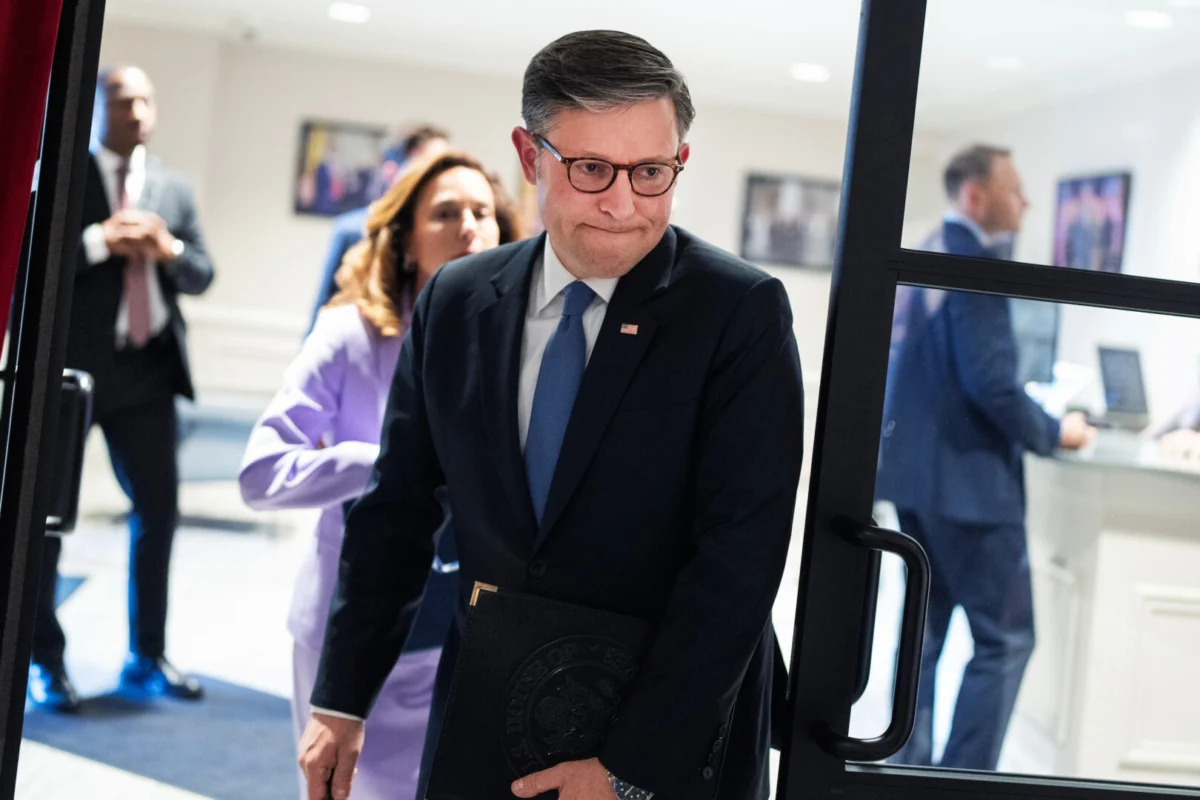
WASHINGTON D.C. – In a significant development that could reshape the legislative landscape and test the boundaries of presidential influence, House Speaker Mike Johnson (R-La.) on Monday formally transmitted a broadly supported bipartisan housing package to the White House. This move ignites a critical 10-day countdown, excluding Sundays, for President Donald Trump to either affix his signature, issue a veto, or allow the legislation to lapse into law without his direct approval by July 10.
The transmission comes after a week of high-stakes political drama, during which Trump, despite earlier endorsement, abruptly rescinded his commitment to sign the bill. His refusal stemmed from a demand for separate, contentious election security legislation requiring proof of citizenship for voter registration and photo identification at the polls – a measure currently lacking the necessary support for Senate passage. The housing bill, designed to address the nation’s pressing affordability crisis, had previously cleared both chambers of Congress with overwhelming, veto-proof majorities, setting the stage for a potential override showdown should the former president choose to obstruct its passage.
Speaker Johnson’s decision to send the bill forward, solidified after a crucial meeting with Trump and subsequent public statements, aims to push the popular legislation across the finish line while navigating the complex interplay between congressional prerogative and presidential demands. The episode highlights the delicate balance of power in Washington and the potential for a single issue to hold vital bipartisan efforts hostage.
Main Facts: A Legislative Standoff Unfolds
The core of the current political imbroglio centers on H.R. 4763, the "Affordable Housing and Homeownership Act," a bipartisan initiative aimed at tackling the burgeoning housing crisis impacting millions of American families. This legislation, championed by both Republicans and Democrats, represents a rare moment of consensus in an otherwise deeply divided Congress. Its passage through the Senate with an 85-5 vote and the House with a 358-32 margin underscores its broad appeal and perceived necessity.
However, the path to enactment became unexpectedly fraught last week when former President Donald Trump, who had initially given the bill his "ringing endorsement" and was expected to participate in a high-profile signing ceremony, abruptly canceled the event. Trump’s reversal was contingent on Congress first passing an election security measure – a demand that injects a highly partisan and currently stalled issue into the legislative process of a popular, bipartisan bill.
Speaker Mike Johnson, faced with a potential legislative logjam and pressure from within his own conference, ultimately decided to transmit the housing bill to the White House. This formal act triggers the constitutional process, placing the onus directly on President Trump. Should Trump opt for a veto, the bill’s strong bipartisan support suggests that Congress possesses the numbers to override it, a move that would represent a significant legislative rebuke to the former president. The situation creates a political tightrope walk for congressional Republicans, who must weigh loyalty to Trump against the overwhelming will of both chambers and the perceived needs of their constituents.
Chronology: From Bipartisan Triumph to Political Turmoil
The journey of the Affordable Housing and Homeownership Act to the President’s desk has been marked by a series of dramatic turns, transforming what was anticipated to be a smooth legislative victory into a high-stakes political chess match.
Initial Passage and Anticipation
The housing package enjoyed robust support throughout its legislative journey. On Monday, June 24th, the Senate overwhelmingly approved the measure with an 85-5 vote, reflecting strong bipartisan backing for its provisions. The following day, Tuesday, June 25th, the House of Representatives solidified this support, passing the bill by an impressive 358-32 margin. These margins were far beyond the two-thirds majority required to override a presidential veto, signaling a broad congressional mandate.
With such widespread approval, congressional leaders, including Speaker Johnson, anticipated a swift and celebratory signing. A high-profile ceremony was scheduled for Wednesday, June 26th, in Statuary Hall, a traditional venue for presidential bill signings, signaling the importance attributed to the legislation. This event was expected to highlight a rare instance of bipartisan cooperation delivering tangible results for the American people.
Trump’s Abrupt Reversal and New Demands
However, the planned celebration dissolved just 90 minutes before it was set to begin. Former President Trump abruptly canceled the signing ceremony, sending shockwaves through Washington. His explanation was unequivocal: he would not sign the housing legislation until the Senate passed a separate election security measure. This measure, a long-standing priority for Trump, would mandate proof of citizenship for voter registration and require photo identification at the polls – proposals that are highly contentious and have faced significant Democratic opposition.
Trump’s demand immediately linked the fate of the broadly popular housing bill to a stalled and deeply partisan issue, effectively holding the former hostage to the latter. The election bill, due to Democratic objections and the Senate’s 60-vote filibuster threshold, currently lacks the necessary support to advance in the upper chamber. This created an immediate legislative impasse, threatening to derail a significant bipartisan achievement.
Speaker Johnson’s Intervention and Commitment
In the wake of Trump’s unexpected move, Speaker Johnson found himself in a precarious position. The House floor, already under strain from internal Republican divisions, saw some members block key votes in solidarity with Trump’s voter ID demands. To break this logjam and ensure the functioning of Congress, Johnson held a crucial meeting with Trump on Thursday afternoon, June 27th.
During this meeting, Johnson reportedly persuaded Trump to urge his supporters to end their House floor blockade, allowing critical bills like the National Defense Authorization Act (NDAA) and appropriations measures to move forward. Following the discussion, Johnson publicly committed to sending the housing bill to Trump, alleviating some of the immediate uncertainty surrounding its fate.
Weekend Confirmation and Formal Transmission
Johnson further cemented his commitment during an appearance on Fox’s "Sunday Morning Futures" program. "I’m sending it to him on Monday and it will become law," he declared, emphasizing his preference for a presidential signature. "I certainly want him to take the biggest, boldest marker that he has and do that big Trump signature proudly on that legislation, because we’re delivering for the people and that’s what he wants to do," Johnson added, signaling his hope for a positive outcome despite the prior week’s drama.
True to his word, Speaker Johnson formally transmitted the housing package to the White House on Monday, July 1st. This action formally initiated the 10-day review period, placing the ultimate decision squarely on President Trump’s desk. The move sets the stage for a tense week, culminating in the July 10th deadline.
Supporting Data: The Substance and the Stakes
Beyond the political maneuvering, the underlying issues – housing affordability and election security – represent significant policy challenges with profound implications for American citizens. Understanding the details of both the housing bill and Trump’s desired election reforms is crucial to grasping the full scope of the current standoff.
The Housing Affordability Crisis
The bipartisan housing package directly addresses what many consider a national crisis: the escalating cost of housing. According to the Bureau of Labor Statistics, housing is the single largest expense families face, accounting for approximately one-third of household budgets. This burden has intensified in recent years due to factors such as insufficient housing supply, rising interest rates, and inflationary pressures. The median home price in the U.S. has surged, and rental costs have similarly climbed, pushing homeownership out of reach for many and straining the budgets of renters.
The legislation seeks to mitigate these pressures through several targeted provisions:
- Streamlining Regulations: The bill aims to cut through bureaucratic red tape that often slows down and increases the cost of housing construction. By simplifying the regulatory environment, proponents hope to accelerate the development of new housing units.
- Boosting Bank Investments: It includes provisions to increase the cap on banks’ investments in affordable housing projects, encouraging greater private sector participation in financing new developments. This infusion of capital is expected to stimulate construction.
- Promoting Manufactured Housing: The package supports the expansion of manufactured housing, a more affordable alternative to traditional stick-built homes, by adjusting rules to make these options more accessible and viable.
- Encouraging Zoning Reform: The bill incentivizes local governments to ease restrictive zoning rules that often limit housing density and drive up costs. By encouraging more flexible land-use policies, it seeks to allow for a greater variety and quantity of housing types.
- Curbing Large Investors: Importantly, it also includes a modified version of a Trump priority to curb the ability of large institutional investors to buy up single-family homes. This measure aims to reduce competition for individual homebuyers and keep more starter homes accessible to families.
While proponents acknowledge that these are "modest steps," they represent a concerted effort to increase supply and lower costs, directly responding to a top concern for voters across the political spectrum.
The Election Security Debate
The election security measure demanded by Trump is a familiar flashpoint in American politics. Specifically, he seeks legislation that would require voters to prove citizenship to register to vote and bring photo identification to the polls. These proposals are framed by their supporters as essential for ensuring the integrity of elections and preventing voter fraud. Trump has repeatedly called alleged election misconduct a "national emergency," arguing it is more important than the housing issue itself. He posits that lower interest rates, rather than this specific housing package, would be more effective in reducing housing costs.
However, these measures are highly controversial. Opponents, primarily Democrats and civil rights groups, argue that such requirements disproportionately burden minority voters, the elderly, students, and low-income individuals who may have difficulty obtaining or affording the necessary documentation. They contend that the measures are a form of voter suppression, designed to make it harder for eligible citizens to cast their ballots, and that instances of in-person voter fraud are exceedingly rare.
Legislatively, the path for such an election bill is arduous. In the Senate, the 60-vote threshold required to overcome a filibuster means that any partisan election reform bill, lacking bipartisan consensus, is unlikely to pass. While "other options are under consideration," such as attaching the measure to a must-pass bill like the annual defense authorization (NDAA) or appropriations legislation, this tactic would likely face fierce resistance and could paralyze the legislative process on those critical bills. The deep partisan divide on election integrity reforms makes any immediate legislative victory for Trump on this front highly improbable.
The Collateral Damage of Legislative Standoffs
The holdup on the housing bill has already threatened to cause "collateral damage" to other legislative priorities. For instance, the House overwhelmingly passed a bill (414-2) on Thursday, June 27th, aimed at protecting seniors from financial scams. Its fate was temporarily jeopardized by Sen. Ruben Gallego (D-Ariz.), who pledged to block House-GOP led bills from Senate passage by unanimous consent until Speaker Johnson sent the housing bill to Trump.
Gallego, a lead Democratic co-sponsor of his chamber’s version of the senior protection bill, found himself in a tough spot. While his threat underscored the interconnectedness of legislative action and the leverage individual senators can wield, Johnson’s transmission of the housing bill to the White House has likely defused this specific point of tension, at least temporarily. However, the incident serves as a stark reminder of how political impasses can ripple through the entire legislative agenda, impacting unrelated but important bills.
Official Responses: Navigating the Political Divide
The current situation has elicited varied responses from key political figures, each attempting to frame the narrative and advance their respective agendas.
Speaker Mike Johnson’s Stance
Speaker Johnson has consistently maintained a position of strategic resolve. Following his meeting with Trump, he made clear his intent to send the housing bill forward, emphasizing his commitment to the legislation’s ultimate enactment. His public statements, particularly on Fox News, conveyed a clear preference for Trump’s signature but also a pragmatic acceptance that the bill "will become law" even without it, underscoring the veto-proof majorities it garnered.
Johnson’s approach reflects a delicate balancing act: demonstrating loyalty to the de facto leader of his party while also fulfilling his duties as Speaker to advance popular legislation. He framed the housing bill as "delivering for the people," aligning it with what he believes Trump ultimately desires, even if the former president’s immediate focus is elsewhere. His actions signal a determination to see the bipartisan effort succeed, minimizing the political fallout for House Republicans.
President Trump’s Ambiguous Position
President Trump’s public comments have been less definitive, maintaining a degree of ambiguity regarding his final decision. In remarks to reporters on Monday, he did not commit to signing the measure but also did not rule it out. He famously referred to the housing package as a "big yawn" when compared with the voter ID legislation he champions, underscoring his prioritization of election security.
Trump articulated his reservations, stating, "The housing bill is a bill that can get through. They worked on it long and hard. It’s very bipartisan. That means the Democrats like it." He added, "I think, it’s maybe, probably more that way they’re getting things I wouldn’t necessarily agree to.” This statement reveals his concern about the bipartisan nature of the bill potentially benefiting Democrats or including provisions he might find objectionable, despite his earlier endorsement. His stance is largely driven by a desire to avoid "giving Democratic supporters like Massachusetts Sen. Elizabeth Warren a win" and to leverage his influence to push his election security agenda.
Democratic Perspectives
Democratic proponents of the housing bill, including Senator Elizabeth Warren (D-Mass.), who was mentioned by Trump, view the legislation as a vital step towards addressing a critical national need. They are likely to emphasize the bill’s bipartisan origins and its potential to deliver tangible relief to families struggling with housing costs. Trump’s initial refusal to sign, and his linkage of the bill to the election security debate, has been characterized by some Democrats as cynical political maneuvering that obstructs progress on a non-partisan issue.
Senator Ruben Gallego’s (D-Ariz.) threat to block House-GOP led bills highlighted the frustration among Democrats with Trump’s tactics. While Gallego’s specific threat may be mitigated by Johnson’s transmission of the bill, the broader sentiment of Democrats is likely to be one of condemnation for any attempts to hold essential legislation hostage for unrelated, partisan demands. They will likely push for the bill to become law, with or without Trump’s signature, and highlight any veto as an obstruction of bipartisan progress.
Implications: A Test of Power and Principle
The ongoing saga of the bipartisan housing bill carries significant implications for the legislative process, the political landscape, and the relationship between congressional leadership and a powerful former president.
Legislative Precedent and Future Bipartisan Efforts
This episode sets a challenging precedent for future bipartisan legislative efforts. If a broadly supported bill, passed with veto-proof majorities, can be held hostage to unrelated and highly contentious demands, it could chill future attempts at cross-party cooperation. Lawmakers might become more hesitant to invest time and political capital in bipartisan initiatives if their ultimate success is contingent on external, non-germane conditions imposed by a powerful political figure. It raises questions about the efficacy of compromise in a hyper-partisan environment.
The Strength of a Veto Override
Should President Trump decide to veto the housing bill, the strong bipartisan margins by which it passed (85-5 in the Senate and 358-32 in the House) suggest that an override is highly likely. However, any newfound opposition from Trump could put immense pressure on Republican lawmakers to flip their positions and vote to sustain a veto. Such a move would force Republicans to choose between supporting a popular bill that addresses a critical constituent need and demonstrating loyalty to the former president. The outcome of a potential override vote would be a significant indicator of Trump’s enduring influence over the Republican Party in Congress.
Impact on the Congressional Agenda
The standoff has already demonstrated its capacity to cause "collateral damage" to other legislative priorities. The threat to other bills, such as the senior financial scams protection act, illustrates how a single point of contention can create ripple effects throughout the legislative calendar. Crucial bills like the NDAA and annual appropriations measures, which must pass to fund the government and authorize defense spending, could face delays or become vehicles for contentious riders if the election security debate remains unresolved. This could lead to further government shutdowns or protracted legislative battles, disrupting the regular functioning of Congress.
Political Ramifications for Key Players
- For Donald Trump: This episode reinforces Trump’s image as a disruptor willing to challenge established norms to achieve his goals. It allows him to highlight his commitment to election integrity, a core tenet of his political brand, and position himself as an uncompromising fighter for his base. However, it also risks alienating swing voters and independent-minded Republicans who prioritize tangible solutions to economic issues like housing affordability. His refusal to sign a popular bill could be framed as obstruction, potentially undermining his appeal to a broader electorate in a future presidential campaign.
- For Speaker Mike Johnson: Johnson’s handling of this situation is a significant test of his leadership. By sending the bill to the White House, he asserts congressional prerogative while attempting to manage his relationship with Trump. Successfully seeing the bill become law, ideally with a Trump signature, would be a win for Johnson, demonstrating his ability to navigate complex political currents. A veto and override would still be a legislative victory for Congress but could be interpreted as a slight against the former president, potentially complicating Johnson’s leadership within his conference.
- For Republicans: The situation puts congressional Republicans in a difficult position. They are caught between their party’s de facto leader and the legislative will of both chambers, which includes a significant number of their own colleagues. How they respond to a potential veto will reveal the extent to which they prioritize party unity and presidential loyalty over bipartisan legislative achievements that benefit their constituents.
- For Democrats: Democrats can leverage this situation to highlight bipartisan consensus on critical issues like housing and to criticize what they view as partisan obstruction. They will likely underscore Trump’s demands for election security as an attempt to undermine democratic processes, while championing the housing bill as a necessary measure for working families.
Ultimately, the fate of the bipartisan housing package will be a telling indicator of the current political climate in Washington. It will reveal the true extent of presidential influence over congressional action, the resilience of bipartisan cooperation, and the willingness of lawmakers to prioritize substantive policy over political brinkmanship. The coming days will determine whether a widely supported solution to a pressing national problem can overcome the deep divisions that continue to define American politics.