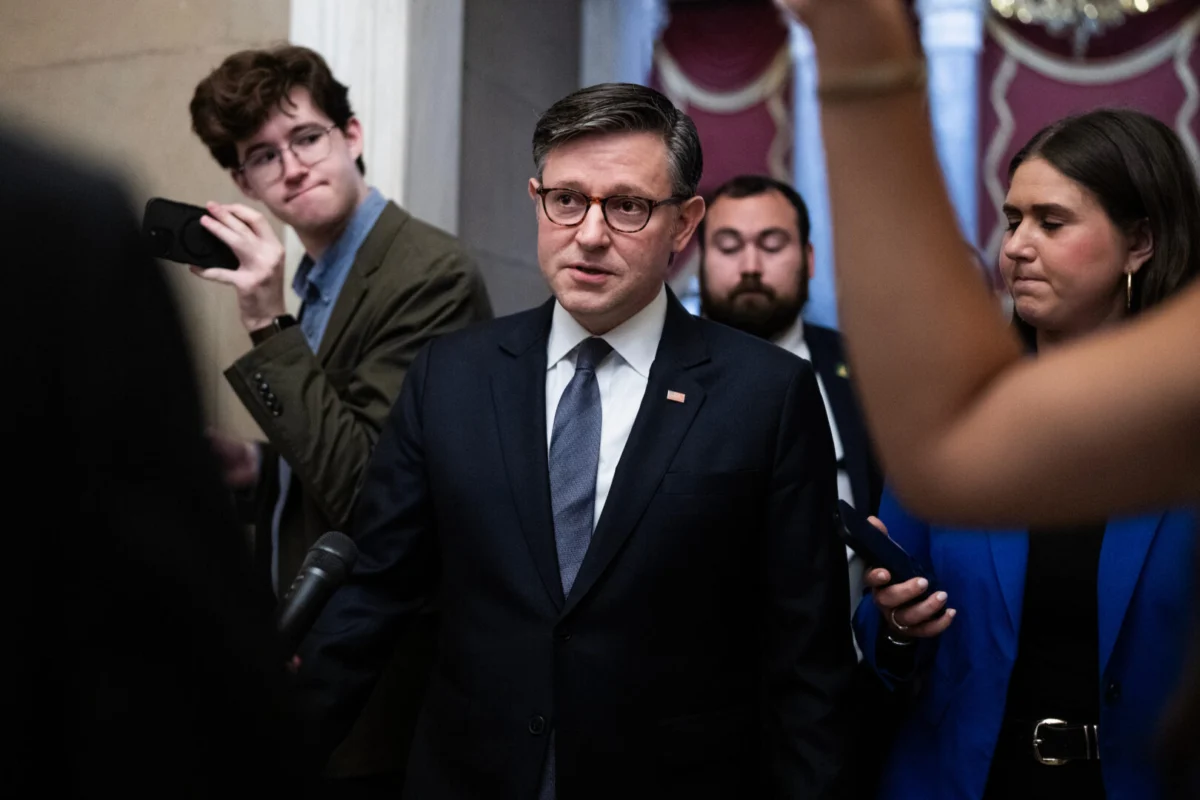
Washington, D.C. – In a display of unexpected unity, Speaker Mike Johnson (R-La.) successfully navigated his often-fractured Republican conference through a critical legislative sprint this past week, securing passage for several key priority items before House members departed for a five-week recess. The legislative victories, however, immediately ran headlong into the stark reality of a deeply divided Congress, with significant doubt cast on their prospects in the Senate and escalating tensions within the Republican Party itself, particularly between Senate leadership and the White House.
The ambitious legislative agenda spearheaded by Johnson in the House underscored a determined effort to demonstrate the GOP’s capacity to govern, even as the clock ticks down to the crucial midterm elections. Yet, the celebratory mood on the House side was quickly tempered by the skepticism emanating from the Senate, where Majority Leader John Thune (R-S.D.) has signaled a cautious, if not outright resistant, approach to many of the House-passed measures. This inter-chamber friction, compounded by public spats between Thune and President Donald Trump’s administration, paints a vivid picture of a Republican trifecta struggling to find common ground, even on its most cherished policy goals.
The House’s Legislative Blitz
The week saw the House advance a series of bills designed to fulfill key Republican promises, particularly those related to fiscal policy and election integrity.
A Budget Battleground: The $95 Billion Reconciliation Package
On Wednesday, the House adopted a GOP-backed budget resolution, a significant procedural step taken along strict party lines. This resolution is the precursor to a proposed $95 billion reconciliation package, primarily earmarked for the ongoing Iran war. Reconciliation, a legislative tool allowing certain budget-related bills to bypass the Senate’s filibuster, is often seen as a pathway for major policy changes when bipartisan consensus is elusive.
However, the House’s reconciliation blueprint is not without its controversial elements. Crucially, it incorporates aspects of the so-called SAVE America Act, a legislative initiative strongly advocated by President Trump. These provisions are designed to tighten voter registration and identification requirements, specifically mandating proof of citizenship to register to vote and photo identification at the polls for federal elections. This inclusion immediately set the stage for a clash with the Senate.
Averted Shutdown, for Now: The Funding Extension
In another strategic move, the House passed a bill to extend current government funding until December. This preemptive measure aims to defuse the perennial end-of-September budget crisis, allowing lawmakers to focus on the upcoming midterm elections without the specter of a government shutdown looming over their heads. By pushing the funding deadline past the elections, the House leadership hoped to create a more stable legislative environment, at least temporarily.
Senate Roadblocks and Internal GOP Strife
While the House celebrated its legislative output, the Senate remained largely unimpressed, with Majority Leader Thune articulating significant reservations that highlight the profound policy and procedural divides within the Republican Party.
Senator Thune’s Lukewarm Stance on Reconciliation
Senate Majority Leader John Thune has adopted a distinctly lukewarm posture regarding the House’s reconciliation package. His skepticism stems from both the overall scope of the package and, more pointedly, the inclusion of the SAVE America Act’s voter ID provisions. Speaking to reporters on Thursday, Thune candidly admitted, "I can’t count 50 right now on a budget resolution." This statement underscores the formidable challenge of securing the simple majority required for reconciliation in the Senate, even with the GOP holding the White House and both chambers.
The Byrd Rule Hurdle: A Technical Challenge
Thune further highlighted the procedural gauntlet the reconciliation bill would face, specifically mentioning the "Byrd bath." The Byrd Rule, named after former Senator Robert Byrd, is a Senate rule that prevents "extraneous" (non-budgetary) matter from being included in reconciliation bills. Policies that do not primarily impact federal spending or revenue are typically struck down during this process.
"The path to clearing the chamber’s so-called Byrd bath is still an open question," Thune stated, emphasizing the technical difficulties posed by the voter ID provisions. He reiterated that for such measures to survive reconciliation, they would need to be "incentive-based and principally budgetary, not policy." This distinction is critical, as broad policy mandates like requiring proof of citizenship or photo ID for voting are often deemed non-budgetary and thus vulnerable to being stripped from a reconciliation bill. The "math on that hasn’t changed," Thune insisted, signaling that the current form of the SAVE America Act provisions would struggle to meet the strictures of the Byrd Rule.
The Highly Contentious SAVE America Act
The SAVE America Act, with its focus on voter identification and citizenship verification, has become a lightning rod for partisan debate. Proponents argue these measures are essential for ensuring election integrity and preventing voter fraud, particularly in the wake of recent elections. Critics, however, contend that such requirements disproportionately impact minority groups, the elderly, and low-income individuals who may face challenges in obtaining required documentation, effectively suppressing legitimate votes. The inclusion of these measures in a reconciliation package, a process designed for fiscal matters, further complicates its passage and fuels the political firestorm.
The Oval Office vs. The Senate: A Test of Loyalty
The internal Republican divisions have been exacerbated by a public and increasingly acrimonious standoff between Senator Thune and President Trump, primarily over the SAVE America Act.
Trump’s "Patience Running Out"
Tensions between the White House and Thune publicly escalated this week. President Trump, a vocal proponent of stricter voter ID laws, and White House Press Secretary Karoline Leavitt both lobbed public criticisms at Thune. Leavitt’s blunt assessment that the president’s "patience is running out" with Thune over his perceived foot-dragging on the SAVE America Act underscores the depth of the rift. The White House appears to view the Senate Majority Leader’s caution as a lack of commitment to a key presidential priority, despite the formidable legislative hurdles.
Thune, however, did not back down. On Thursday, he offered a pointed retort to the White House’s public pressure, suggesting that Leavitt or "somebody else" should "get on the phone and get the votes." This defiant stance highlights Thune’s insistence on the practical realities of Senate procedure and vote counting, rather than simply yielding to presidential demands. His response suggests a growing exasperation with what he perceives as unrealistic expectations from the White House regarding the legislative process.
Senate Republicans Voice Frustration
The White House’s "hyperfixation" on the voter ID legislation and the public finger-pointing at Thune has not been well-received by many in the Senate Republican conference. As they eye what could be the last legislative weeks of their "GOP trifecta" – controlling the presidency, House, and Senate – many senators are increasingly frustrated by what they see as an unhelpful and counterproductive internal squabble.
Senator John Cornyn (R-Texas), who recently faced a Trump-backed challenger in his primary, voiced strong concerns about the strategic misstep. "I don’t know who it was that sold the president on this idea that this was attainable, but it’s creating a circular firing squad for Republicans," Cornyn lamented. He added, "And here we are, what? One-hundred and three days before the midterm elections? This is not a great place for us." Cornyn’s remarks reflect a broader sentiment among some Senate Republicans that the focus on a politically challenging and procedurally fraught voter ID bill is distracting from other legislative priorities and creating unnecessary internal conflict at a critical juncture. "We just don’t have the votes," Cornyn stated unequivocally, referring to the sweeping election bill. "There’s nothing that Sen. Thune can do to change that." This assessment underscores the belief that the issue is not Thune’s willingness, but the fundamental lack of Senate support.
Seeking Bipartisan Ground: The Funding Dilemma
Amidst the internal GOP struggles, Thune has clearly articulated his primary legislative focus: securing a bipartisan solution for government funding. While he acknowledges the House’s budget resolution and keeps it "in his back pocket," his immediate priority is to find a stopgap measure that can garner support from both sides of the aisle.
"The House will send us something, and then hopefully we’ll be able to modify it so that we can get Democrat votes on it," Senator Mike Rounds (R-S.D.) said earlier in the week, outlining a potential path forward. "And if we can get Democrat votes on it, send it back to the House." This strategy suggests a recognition that passing any significant funding legislation in the Senate will almost certainly require overcoming the 60-vote filibuster threshold, necessitating Democratic cooperation. Thune has affirmed his intent to bring a bill to the floor "before the August break," signaling his commitment to addressing the funding issue head-on.
Beyond the Fiscal Fights: War Powers and Congressional Ethics
The week’s legislative activity extended beyond fiscal matters, touching on issues of foreign policy and governmental ethics, though with similarly divided outcomes.
Divided Chambers on Iran War Powers
In a significant win for Democrats, the House, for a second time, voted to formally call on President Trump to end the war in Iran. The nonbinding concurrent resolution, led by Rep. Pramila Jayapal (D-Wash.), passed 214-208, indicating persistent congressional pressure on the White House regarding its military engagements abroad. This vote reflects a growing bipartisan concern, particularly among Democrats, about the scope and duration of the Iran conflict.
However, a similar push in the Senate fell just a few votes short on Thursday. The chamber voted down a procedural motion to discharge a joint resolution, led by Sen. Chris Van Hollen (D-Md.), from the Senate Foreign Relations Committee. While the chambers split on the immediate success of these efforts, the votes collectively indicated a mounting political pressure on the White House to re-evaluate and potentially de-escalate its involvement in the Iran war. The votes serve as a legislative warning, signaling that continued military action without clear congressional authorization could face increasing resistance.
The Congressional Stock Trading Debate
The House also approved a bill aimed at reining in members of Congress’s ability to trade stocks, an idea that enjoys broad public support. However, this widely popular concept ultimately fell victim to a party-line vote, highlighting the deep partisan chasm even on issues of ethics reform.
The GOP-backed bill proposed banning members of Congress, their spouses, and dependent children from buying new stocks. Controversially, Republicans appended unrelated language to the bill that would require voters in federal elections to show photo ID at the polls – a clear nod to President Trump’s broader election bill ambitions and the contentious SAVE America Act.
This strategic inclusion alienated many Democrats. Only 13 Democrats voted in favor of the GOP bill, with others arguing that the proposal did not go far enough. Many Democrats contended that a truly effective stock trading ban needs to bar stock ownership entirely, rather than just new purchases, or extend its prohibitions beyond Congress to include the president and other high-ranking officials. The addition of the voter ID provisions was seen by some as a poisoned pill, designed to make a bipartisan consensus impossible on an otherwise popular measure.
Implications: A Fractured Trifecta Nears Midterms
The legislative activities of the past week paint a complex and often contradictory picture of the Republican-controlled government. While Speaker Johnson demonstrated an ability to rally his House conference around priority items, the subsequent reception in the Senate and the escalating internal disputes reveal deep fissures within the GOP trifecta.
The Fissures Within the GOP Trifecta
The public spat between President Trump and Senator Thune, coupled with the frustration voiced by other Senate Republicans, underscores a significant challenge to party unity. The White House’s insistence on the SAVE America Act, despite Senate leadership’s practical concerns about its viability, creates an unnecessary distraction and saps energy from other potential legislative achievements. This "circular firing squad," as Senator Cornyn termed it, threatens to undermine the GOP’s image as a cohesive governing force heading into the midterms. The disconnect between the House’s aggressive legislative output and the Senate’s cautious, procedurally-minded approach further highlights the internal disharmony.
Looming Midterms and Legislative Paralysis
With the midterm elections just over a hundred days away, the inability of the Republican-controlled Congress and White House to coalesce around key legislative priorities could have profound political consequences. Voters often expect a unified government to deliver on its promises. The current landscape, marked by intra-party feuds and legislative gridlock, particularly on issues like voter ID and reconciliation, risks disappointing the Republican base and alienating swing voters. The focus on a bipartisan funding deal by Senator Thune, while pragmatic, implicitly acknowledges the difficulty of passing purely partisan legislation in the Senate.
A Challenging Path Ahead
As House members head home for recess, the legislative landscape remains fraught with uncertainty. The fate of the House-passed budget resolution, the $95 billion reconciliation package with its controversial voter ID elements, and even the government funding extension, all hang in the balance. The ongoing tensions between the White House and Senate leadership suggest that the path to enacting significant Republican agenda items will remain challenging, requiring either unprecedented unity or a dramatic shift in strategy. The coming weeks, leading up to the August break and beyond, will be a critical test of the Republican Party’s ability to reconcile its internal differences and deliver on its promises before the electorate renders its judgment in the midterms.
Rebecca Kheel, John Donnelly, John T. Bennett, Aris Folley, and Jacob Fulton contributed to this report.