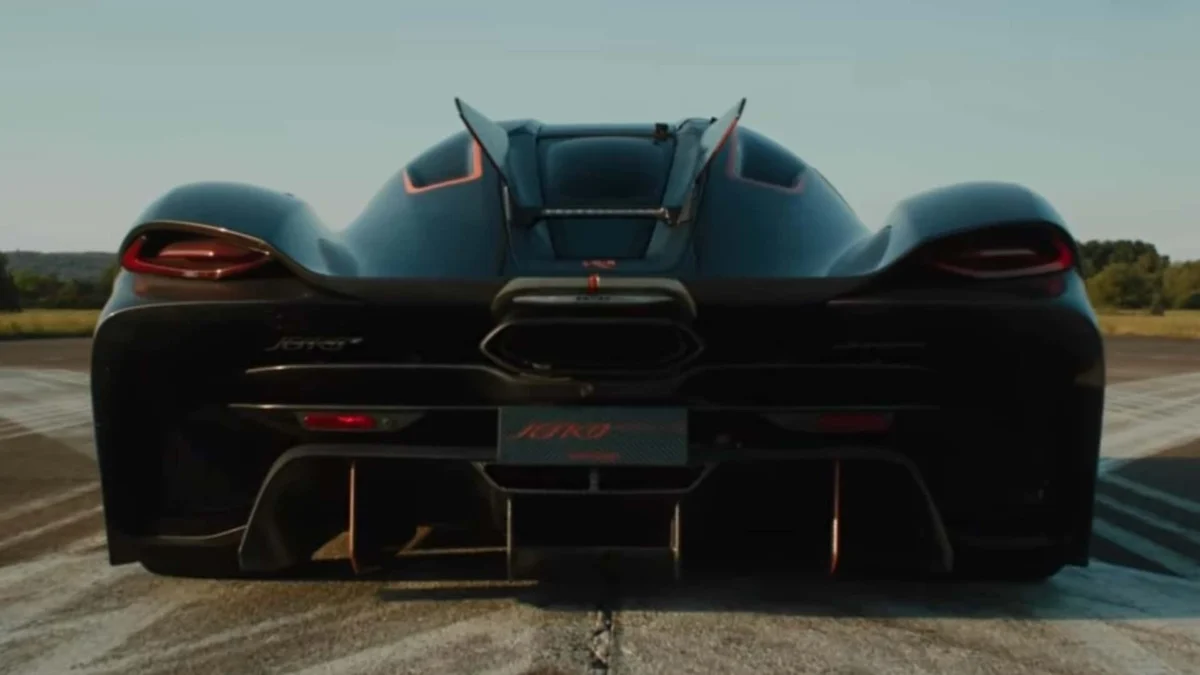
There are few constants in the volatile world of automotive engineering, but the relentless pursuit of velocity by Koenigsegg Automotive AB has become a reliable certainty. In the rarefied air of hypercar manufacturing, where manufacturers often trade in hyperbole and rendered prototypes, the Swedish marque continues to deliver tangible, physics-defying results. On June 6, coinciding with Sweden’s National Day, the Koenigsegg Jesko Absolut descended upon the company’s private proving grounds at an airfield in Ängelholm, systematically dismantling long-standing assumptions about what a production-spec vehicle is capable of achieving.
The Record-Breaking Run: A New Benchmark
Under the watchful eyes of independent verifiers from Racelogic, the Jesko Absolut became the first production-series vehicle to surpass the 300 km/h (186 mph) threshold within a quarter-mile distance. Factory test driver Markus Lundh, operating with a level of composure that borders on the surreal—as evidenced by footage showing him maintaining steering control while operating a handheld device—clocked 305.39 km/h (189.76 mph) at the 402-meter mark.
The demonstration did not cease there. As the vehicle continued its acceleration phase toward the half-mile marker, it reached a staggering 373.87 km/h (232.31 mph). These figures are not merely impressive; they represent a significant leap in longitudinal performance for a street-legal car, particularly when one considers that the run was performed on an unprepped surface using standard production tires.
Engineering the Impossible: Chronology of a Masterpiece
The journey of the Jesko Absolut began with the premise of creating the ultimate "megacar"—a term coined by Christian von Koenigsegg to describe vehicles with a power-to-weight ratio exceeding one megawatt. The development of the Jesko Absolut was centered on the principles of minimal drag and maximum powertrain efficiency.
The Powerplant
At the heart of the Jesko Absolut lies a 5.0-liter twin-turbocharged V8 engine. Unlike its competitors, which frequently rely on complex hybrid architectures and front-axle electric motors to boost launch traction, the Jesko remains a pure-bred, rear-wheel-drive machine. Producing 1,280 horsepower on standard gasoline, or an earth-shattering 1,600 horsepower when fueled with E85, the internal combustion engine stands as a testament to the viability of traditional engineering in an electrified era.
Transmission Innovation
The secret to the Jesko’s instantaneous power delivery is the proprietary Light Speed Transmission (LST). This nine-speed, multi-clutch gearbox allows for virtually seamless shifts, ensuring that the engine remains in its optimal power band throughout the entire acceleration curve. The data captured during the recent record run highlights this capability: the vehicle accelerated from 100 to 200 km/h (62 to 124 mph) in just 2.53 seconds, a feat that would be impossible without the near-instantaneous gear changes facilitated by the LST.
Supporting Data: A Statistical Breakdown
To understand the magnitude of the Jesko Absolut’s performance, one must examine the raw telemetry recorded during the Ängelholm session. The following table illustrates the car’s progression from a standing start to the half-mile mark:
| Test Metric | Performance Time / Speed |
|---|---|
| 0-62 mph (0-100 km/h) | 2.35 Seconds |
| 0-124 mph (0-200 km/h) | 4.88 Seconds |
| 0-186 mph (0-300 km/h) | 8.30 Seconds |
| 62-124 mph (100-200 km/h) | 2.53 Seconds |
| 124-186 mph (200-300 km/h) | 3.43 Seconds |
| Quarter-mile | 8.54 Seconds |
| Half-mile | 12.76 Seconds |
The data confirms that the Jesko Absolut is not just a high-speed cruiser; it is a violent accelerator that maintains its momentum well past the speeds where most vehicles begin to experience significant aerodynamic drag.
The "Over-the-Air" Evolution
Perhaps the most consumer-friendly aspect of this achievement is that it is not exclusive to a bespoke, one-off prototype. Koenigsegg has confirmed that the software optimizations and calibration tweaks that facilitated this record-breaking performance will be pushed to existing customer vehicles via an over-the-air (OTA) update.
This move reflects a shift in the automotive industry where hardware, while paramount, is increasingly supported by digital refinement. For the "one-percenters" who own a Jesko Absolut, this means their investment remains future-proofed, receiving performance upgrades long after the vehicle has left the factory floor in Ängelholm.
Implications for the Hypercar Hierarchy
The success of the Jesko Absolut has sent ripples through the upper echelons of the automotive industry. Christian von Koenigsegg, ever the visionary, has already hinted that the company’s next internal target is even more ambitious. He specifically identified the Koenigsegg Gemera—the company’s four-seat, all-wheel-drive hybrid "Mega-GT"—as a potential candidate for future straight-line records.
With a combined output of 2,300 horsepower from its electrified V8 powertrain, the Gemera possesses the necessary traction and brute force to challenge the records set by its stablemate. The irony of a heavier, four-seat hybrid potentially outperforming a dedicated aerodynamic speed-machine like the Jesko Absolut underscores the rapid evolution of hybrid technology.
The Competition Landscape
The automotive world is waiting to see how the traditional titans respond. Bugatti, having recently unveiled the V16-powered Tourbillon, remains the primary rival in the battle for absolute top speed. Meanwhile, Rimac continues to push the boundaries of what electric propulsion can achieve with the Nevera R, challenging the notion that internal combustion is the only path to record-breaking performance.
In the United States, manufacturers like Hennessey (with the Venom F5) and SSC (with the Tuatara) continue their development programs, though progress has been less visible in the public sphere recently. Even the mainstream performance segment is entering the fray, with Chevrolet’s Corvette ZR1X aiming to establish itself as the final word in American performance, bridging the gap between mass-produced sports cars and limited-run hypercars.
Conclusion: The Horizon of Speed
Koenigsegg’s recent performance at Ängelholm serves as a poignant reminder of the passion inherent in automotive engineering. While the global market pivots toward mass-market electrification and autonomous transportation, companies like Koenigsegg provide a vital service by pushing the envelope of what is physically possible.
The Jesko Absolut is not merely a car; it is a manifestation of the belief that speed is an art form. By achieving these records on an unprepped surface without hybrid assistance, Koenigsegg has proven that there is still significant untapped potential in the internal combustion engine and mechanical drivetrain. As the company prepares for the next phase of its evolution—likely involving the hybrid might of the Gemera—the rest of the automotive world must take note: the bar has been raised, and the chase for the ultimate speed record has never been more competitive.
Whether the limit of human-controlled velocity will eventually be dictated by tire technology or sheer human nerve remains to be seen. However, one thing is certain: as long as Koenigsegg is in the game, the record books will continue to be rewritten.