The transition of life from the primordial oceans to the terra firma of the continents represents one of the most significant biological leaps in Earth’s history. Among the most successful of these pioneers were the insects—creatures that today constitute the most species-rich animal group on our planet. Yet, despite their ubiquity, the early chapters of their evolutionary saga have remained shrouded in mystery, hidden behind an 80-million-year void in the fossil record.
New research published in Nature on August 26 has finally begun to pierce this veil. An international team of paleontologists, led by Professor Chenyang Cai of the Nanjing Institute of Geology and Paleontology (NIGPAS) and University of Cambridge Ph.D. candidate Erik Tihelka, has unveiled a remarkable discovery: a 324-million-year-old "stem group" insect that challenges our fundamental understanding of how the first insects walked, swam, and colonized the land.
The Discovery: Reclassifying a "Crustacean"
The centerpiece of this study is a species dubbed Chosha praecursor, recovered from the Tesnus Formation in the Marathon Uplift of western Texas. For years, these fossils sat in collections, misidentified by researchers who assumed they were merely the larvae of ancient crustaceans.
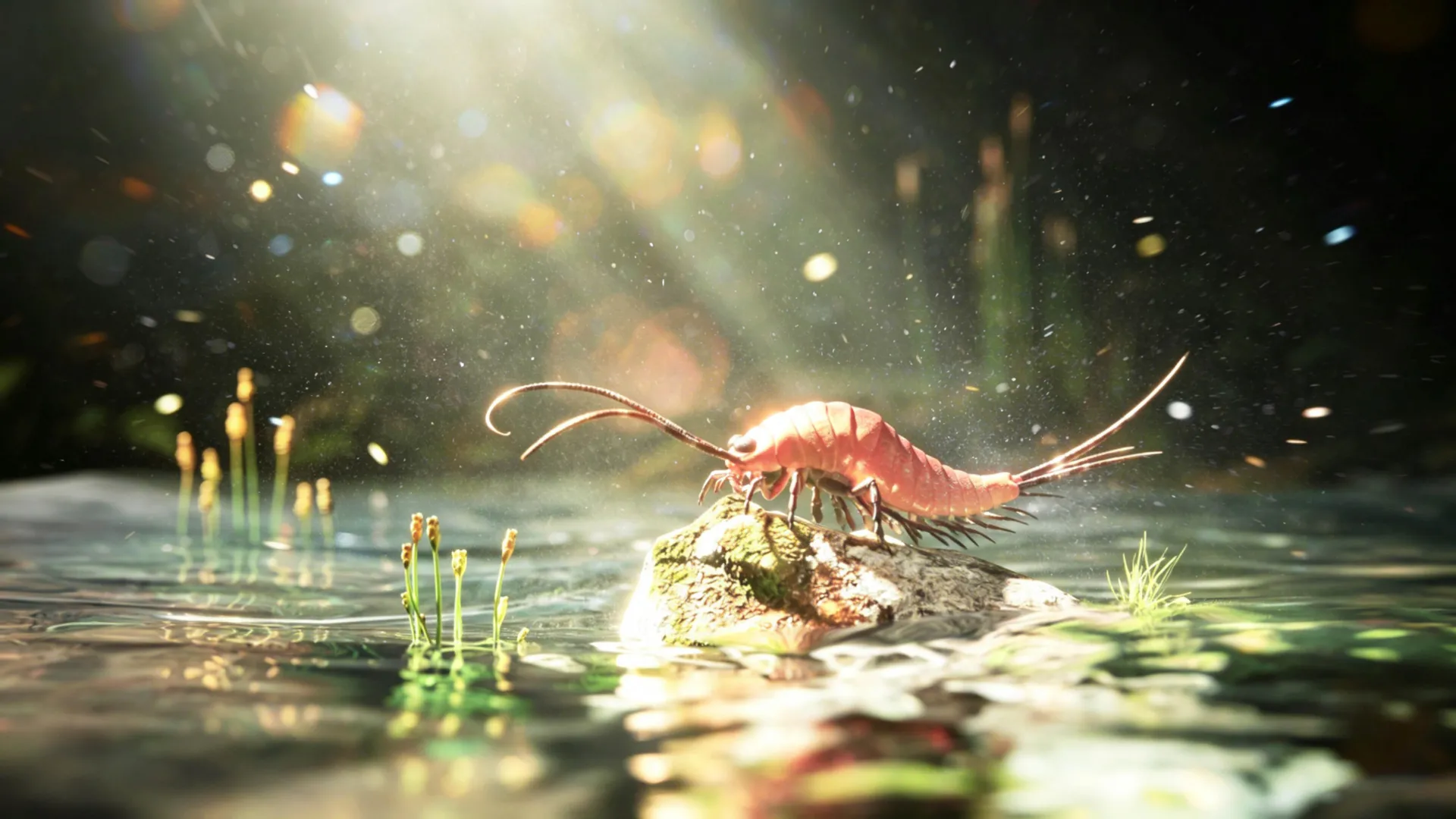
However, through the application of advanced cross-polarized light imaging, the team was able to peer through the mineralized matrix of the calcareous claystone concretions. What they found was not a crustacean, but an adult female insect. Measuring approximately 32 millimeters in body length—reaching nearly 50 millimeters when including its terminal filaments—C. praecursor revealed a anatomy that bridged the gap between aquatic ancestors and the terrestrial insects we recognize today.
The specimen possessed a classic hexapod (six-legged) body plan, including a segmented trunk and a distinct ovipositor—an organ used for laying eggs. Yet, it also displayed a striking, archaic feature: segments one through nine of its abdomen carried segmented appendages, with the rear limbs modified into specialized, paddle-like structures. This hybrid anatomy suggests that C. praecursor was a denizen of the water’s edge, navigating the shallow-water delta environments of the Late Mississippian period with an amphibious grace.
A Chronological Reconstruction of Insect Evolution
To place C. praecursor into context, the researchers performed a systematic reevaluation of "enigmatic" Paleozoic fossils, including the Early Devonian Leverhulmia from Scotland and unnamed specimens from the Mazon Creek biota in Illinois.
Closing the 80-Million-Year Gap
Molecular clock studies—a method used by geneticists to estimate evolutionary divergence times—have long suggested that hexapods branched off from their marine crustacean relatives during the Cambrian-Ordovician interval. However, the physical fossil evidence has been frustratingly sparse.
- 405 Million Years Ago: The earliest undisputed hexapod fossils appear in the Rhynie Chert of Scotland.
- 405–325 Million Years Ago: An "evolutionary desert" where fossilized intermediate forms are almost non-existent.
- 324 Million Years Ago: The Chosha praecursor discovery provides a vital anchor, suggesting that the diversification of insects began much earlier than previously thought, potentially pushing the timeline back into the Early Devonian.
By synthesizing these specimens, the team has effectively bridged the 80-million-year silence. They argue that the transition to land was not a sudden "leap" but a long, gradual process of morphological refinement.
The Evolutionary Roadmap: From Paddles to Legs
One of the most profound implications of this research concerns the "modern" insect body plan. Modern insects are characterized by their strict six-legged thorax; their abdomens are almost entirely devoid of limbs.
The fossils studied by the team suggest that the loss of these abdominal limbs was a deliberate, adaptive response to the rigors of terrestrial life. As ancestral insects moved from swimming to crawling, the energy-intensive and hydrodynamic appendages on the abdomen—once vital for movement in water—became evolutionary baggage.
"As insects evolved away from their crustacean ancestors, swimming appendages were progressively simplified and lost," the researchers noted. This simplification process is what eventually sculpted the streamlined, highly efficient body plan of the modern insect, allowing them to conquer every terrestrial microhabitat from the forest floor to the high canopy.
Scientific and Ecological Implications
The discovery of C. praecursor is not merely a win for taxonomy; it fundamentally alters our perception of Paleozoic ecosystems.
Ecological Roles
The amphibious nature of these early insects suggests they were essential ecosystem engineers. By living in the humid, transitional zones between water and land, they likely acted as the primary decomposers of early terrestrial flora. Feeding on humus, decaying plant matter, and fungal spores, these insects helped cycle nutrients, effectively preparing the landscape for the later explosion of plant and vertebrate life.
The Significance of the Ovipositor
The presence of a well-developed ovipositor in C. praecursor is equally telling. It implies that these insects had already mastered the art of targeted egg-laying. This adaptation was a "game-changer," allowing early insects to deposit their offspring in protected, specific niches rather than scattering them haphazardly in the water. This mastery of reproductive strategy likely served as the foundation for the massive adaptive radiation that followed.
Expert Perspectives and Future Research
The international collaboration, which included specialists from the United States, Spain, and China, marks a turning point in the field of paleoentomology.
"This research forces us to reconsider the ‘sudden’ arrival of insects," says Professor Cai. "We have been looking for a definitive ‘first’ insect, but what we found instead was a spectrum of life—a group of organisms that were perfectly content living in the gray area between two worlds."
The implications for the "molecular clock" vs. "fossil record" debate are significant. For years, the two fields have been at odds, with geneticists claiming earlier origins than paleontologists could prove. This new, more complete lineage suggests that both schools of thought were partially correct, but that the transition was slower and more ecologically complex than either had predicted.
As the scientific community digests these findings, the focus is expected to shift toward the specific environmental pressures that drove the loss of abdominal limbs. Future expeditions, particularly in the Marathon Uplift and similar strata in the United Kingdom, will likely seek more specimens of C. praecursor to determine if these amphibious traits were widespread or restricted to specific, localized evolutionary lineages.
Conclusion: A Legacy of Adaptation
The saga of Chosha praecursor is a testament to the power of evolutionary trial and error. It reminds us that the most dominant animals on Earth did not arrive in their modern form by chance; they were forged through millions of years of experimentation in the muddy, humid deltas of the Paleozoic.
By identifying these "missing links," scientists have not only filled a gap in the history of insects but have also illuminated the broader story of how life navigates the most difficult transition of all: leaving the water to claim the land. The insects of today, buzzing in our gardens and forests, are the descendants of those ancient, paddle-bearing pioneers that once stood on the threshold of two worlds.