For centuries, the human relationship with the microscopic world was defined by observation. From Antonie van Leeuwenhoek’s first glimpse of "animalcules" in the 17th century to the modern electron microscope, our role has been that of a silent spectator—watching the frantic dance of bacteria and the structural complexity of cells from a distance, unable to touch or rearrange the building blocks of life.
That paradigm is now shifting. A team of researchers at the Julius-Maximilians-Universität (JMU) Würzburg, led by Professor Bert Hecht, has unveiled a breakthrough in nanotechnology: light-powered nanorobots capable of interacting directly with the microbial environment. These devices, roughly 50 times smaller than the diameter of a human hair, represent a monumental leap toward the long-pursued goal of direct, surgical-level manipulation at the nanoscale.
Main Facts: Engineering the Infinitesimal
The core innovation lies in the propulsion and steering mechanism of these "microdrones." At scales smaller than one micrometer, traditional mechanical engines are impossible to implement due to the laws of physics—specifically, the dominance of viscosity and the lack of space for gears, motors, or batteries.
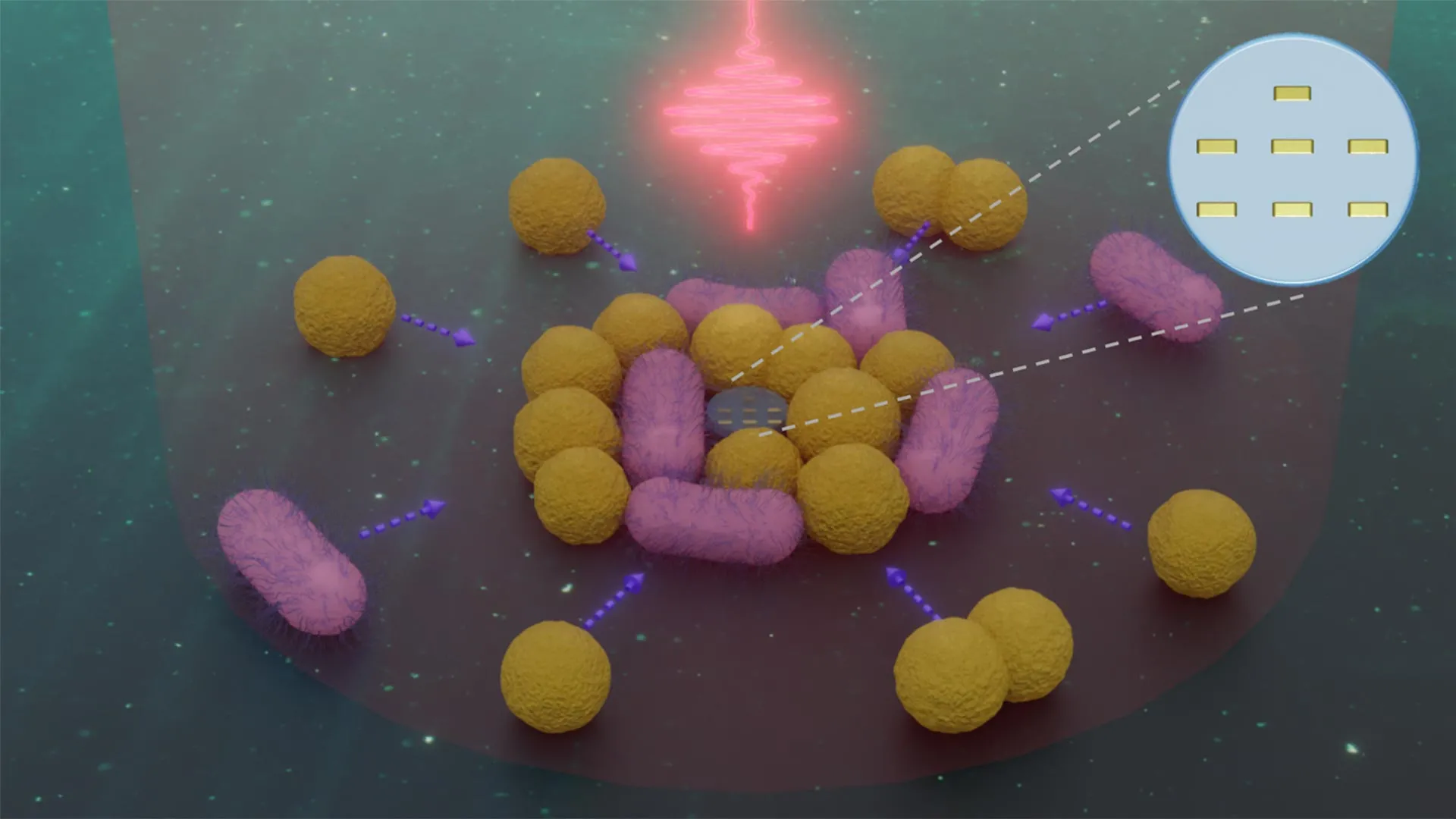
To overcome this, the JMU team utilized the momentum of light. By integrating plasmonic nanoantennas into the structure of the robots, the researchers harnessed the recoil force generated by emitted photons. Much like a rocket expels gas to create thrust, these nanorobots absorb light of specific wavelengths and helicities and re-emit them in controlled directions. This photon-based recoil provides the necessary acceleration to propel the device through liquid media.
Perhaps more significant is the steering mechanism. The researchers integrated nanoscale antenna wires that naturally align with the polarization of incoming light. By modulating this polarization, operators can dictate the orientation of the robot, while the photon recoil provides continuous forward momentum. This dual-action system allows for precision navigation, enabling the robots to navigate complex, crowded biological landscapes with the agility of a fleet of micro-vehicles.
Chronology: A Trajectory of Innovation
The development of these nanorobots did not occur in a vacuum; it is the culmination of years of rigorous experimentation in nanophotonics and fluid dynamics.
- Initial Conceptualization (2015–2018): Early research focused on the fundamental interaction between light and plasmonic structures. The team investigated how metallic nanostructures could influence the trajectory of photons, establishing the mathematical foundations for light-induced recoil.
- Proof of Concept (2019–2021): The JMU team successfully demonstrated the ability to move simple metallic structures using laser light. During this phase, the challenges were primarily related to the dissipation of heat and the limitations of propulsion power at the sub-micron scale.
- The "Microdrone" Integration (2022): The team successfully transitioned from static structures to functional "microdrones." They achieved the integration of multiple nanoantennas, allowing for greater stability and, for the first time, consistent movement in aqueous solutions.
- Miniaturization and Control Optimization (2023–2024): The most recent breakthrough involved reducing the device size to below one micrometer. By simplifying the antenna architecture, the researchers achieved a higher power-to-weight ratio, allowing the robots to perform complex tasks, such as capturing and transporting biological samples like bacteria.
Supporting Data: The Physics of the Invisible
To understand the magnitude of this achievement, one must look at the physical constraints under which these robots operate. At the micrometer scale, the "Reynolds number"—a dimensionless quantity used to predict flow patterns—is very low. This means that the environment is dominated by viscous forces; if a robot stops applying force, it effectively freezes in place instantly.
The JMU robots overcome this through a sophisticated use of plasmonics. A single device can contain up to four nanoantennas. The recoil force generated by each photon, while minuscule, is sufficient to move the low-mass robot at speeds that are remarkable for its size.
Key Technical Specifications:
- Size: Sub-micrometer dimensions (significantly smaller than a standard bacterium).
- Steering: Polarization-dependent orientation control.
- Propulsion: Photon recoil via plasmonic emission.
- Maneuverability: Capability for 90-degree turns within a fraction of a millisecond.
- Payload Capacity: Capable of transporting multiple bacterial cells, though with a measurable decrease in velocity due to the increased drag and mass.
The data indicates that while speed is slightly sacrificed when the robot acts as a "carrier," the maneuverability remains robust. This trade-off is negligible when compared to the operational utility of being able to pick up a specific cell and deposit it at a predetermined coordinate within a fluid sample.
Official Responses and Scientific Perspective
The lead experimental scientist on the project, Jin Qin, highlights the functional nature of these devices, comparing them to automated janitors for the microscopic world. "In essence, we have built a light-driven nanorobot that can track down and collect bacteria," Qin stated during the press release of the findings. "By simplifying the design, we reached a size at which these robots can operate directly in the microbial world—almost like microscopic cleaning devices."
Professor Bert Hecht, who has overseen the project’s evolution, views the development as a foundational shift in how we approach microbiology. "This is a striking example of how light can be used not only to observe the microscopic world, but also to actively shape it," Hecht explained. He emphasized that while the concept may seem like science fiction, the laboratory results provide an empirical, physical framework that is already being utilized to move, organize, and sort biological materials.
The scientific community has noted the implications of these findings, particularly in the fields of photonics and lab-on-a-chip diagnostics. The ability to manipulate materials without physical contact—using only the "pressure" of light—opens doors to experiments that were previously considered impossible due to the risk of contaminating the sample with physical probes.
Implications: A New Era for Biotechnology
The successful demonstration of these light-driven robots is not merely a triumph of engineering; it is a gateway to a variety of transformative applications.
1. Targeted Drug Delivery and Diagnostics
In the biomedical realm, the ability to maneuver nanorobots could lead to the development of "smart" diagnostic tools. By utilizing these robots to isolate individual cells or bacteria from a patient’s blood sample, doctors could perform highly precise tests on specific pathogens, potentially speeding up the diagnosis of rare diseases or antibiotic-resistant infections.
2. Environmental Remediation
As the researchers suggested, these robots act as "microscopic cleaners." In water treatment or environmental monitoring, fleets of these robots could theoretically be deployed to track down and concentrate micro-pollutants or specific bacterial colonies, effectively filtering microscopic environments with a level of precision that chemical or mechanical filters cannot replicate.
3. Precision Assembly of Bio-materials
In the burgeoning field of tissue engineering, the ability to move cells at will could allow for the "bioprinting" of complex, three-dimensional cellular structures. By placing cells in specific, programmed patterns, researchers could create synthetic tissues that mimic the architecture of human organs more accurately than current methods allow.
4. Future Challenges: The Road Ahead
Despite the optimism, the path to commercial or clinical application is long. The current robots operate under controlled laboratory conditions, primarily in clear water environments. Moving these systems into the complex, opaque, and highly viscous fluids found inside the human body presents a new set of challenges. Furthermore, the reliance on external light sources requires the ability to focus lasers through biological tissue, necessitating further research into optical transparency and light-scattering mitigation.
However, the team at JMU remains undeterred. Their work has successfully crossed the threshold from the "observation" of the microscopic world to the "manipulation" of it. As the technology matures, the prospect of having a fleet of tiny, light-steered machines working on our behalf—cleaning, organizing, and diagnosing at the scale of the individual cell—moves from the realm of the theoretical into the tangible reality of modern science.
The microscopic world, once a distant frontier, is becoming a workspace. Through the quiet, precise force of photons, humanity has taken the first step toward reclaiming agency over the smallest building blocks of life.