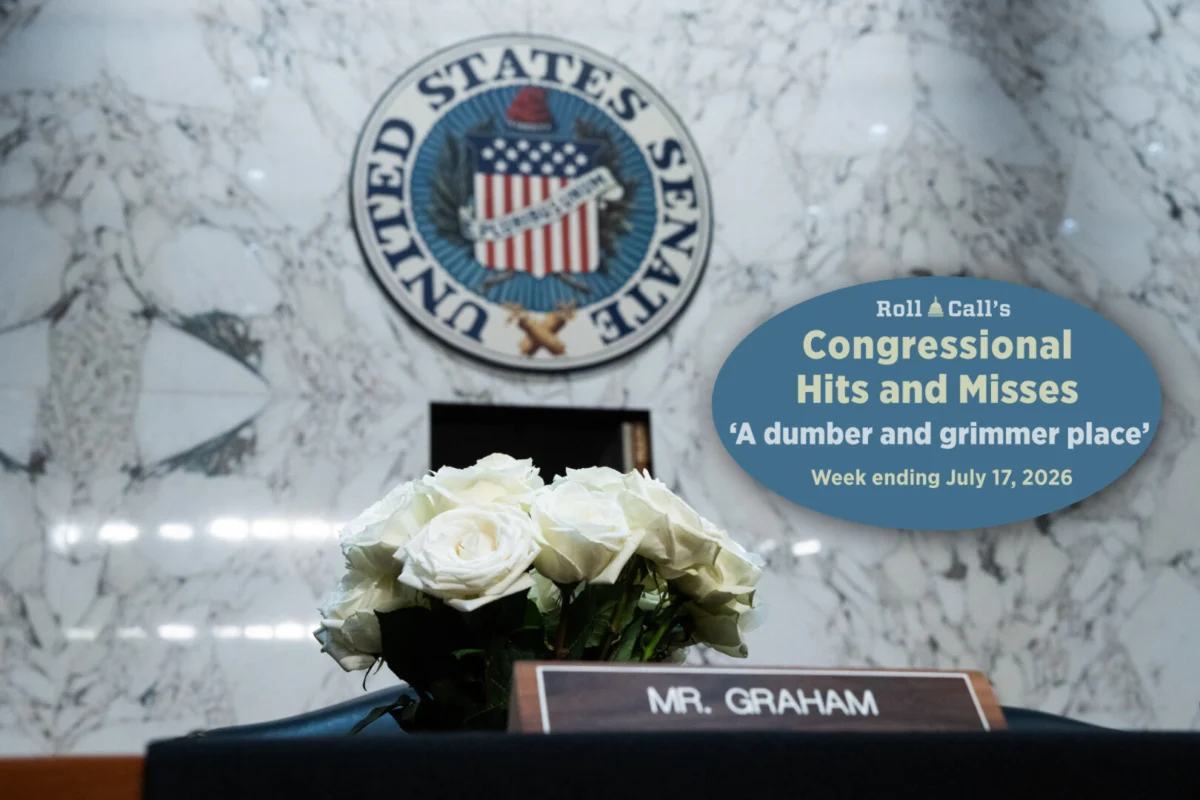
Washington D.C. – July 17, 2026 – The nation’s capital concluded a tumultuous week marked by profound loss, intense political scrutiny, and a contentious debate over the role of independent journalism. As the week ending July 17, 2026, drew to a close, lawmakers were grappling with the sudden passing of long-serving Senator Lindsey Graham, while simultaneously navigating the fiery confirmation hearings of a controversial Trump administration nominee and responding to a groundbreaking investigative series by Roll Call that received a peculiar blend of "faint praise."
The confluence of these events — the somber remembrance of a political titan, the sharp ideological clashes over executive appointments, and the nuanced reception of critical reporting — painted a vivid picture of a deeply polarized yet fundamentally resilient American political landscape. The week served as a stark reminder of the personal toll of public service, the enduring power struggles between branches of government, and the often-uncomfortable truths uncovered by the fourth estate.
Chronology: A Week of Loss, Scrutiny, and Reflection
The week began with a somber note that cast a shadow over all subsequent proceedings, quickly evolving into a whirlwind of political theatre and media introspection.
Saturday, July 11: Senator Lindsey Graham’s Passing
The nation awoke to the shocking news on Saturday, July 11, that Senator Lindsey Graham (R-SC), a towering figure in American politics for over three decades, had passed away at the age of 71. Reports from his family indicated he died peacefully in his sleep after suffering a sudden cardiac event at his home in South Carolina. The news sent immediate ripples across Washington and beyond, prompting an outpouring of grief and tribute from across the political spectrum. Flags were ordered to fly at half-mast over the Capitol and federal buildings nationwide, signaling the immediate recognition of a significant loss to the institution of the Senate.
Monday, July 13: Capitol Hill Returns to Somber Business
The mood on Capitol Hill on Monday was palpably subdued. The Senate convened with a moment of silence and a series of heartfelt eulogies for Senator Graham. Senate Majority Leader, Senator [Fictional Majority Leader’s Name] (R-KY), delivered a moving address, praising Graham’s dedication to national security and his unparalleled wit. Minority Leader, Senator [Fictional Minority Leader’s Name] (D-NY), spoke of Graham’s unique ability to forge bipartisan relationships, even amidst fierce political disagreements.
Simultaneously, the week’s other major drama began to unfold as the Senate Homeland Security and Governmental Affairs Committee initiated confirmation hearings for President Trump’s nominee for the newly established position of Secretary of National Resilience (DNR), Dr. Aris Thorne. Thorne, a former tech CEO and outspoken conservative commentator, immediately faced a barrage of questions regarding his past statements on immigration, climate change, and the balance of federal power.
Tuesday, July 14 – Wednesday, July 15: The Nominee Gauntlet
The confirmation hearings for Dr. Aris Thorne dominated Tuesday and Wednesday’s news cycles. Democrats on the committee, led by Senator [Fictional Democratic Senator’s Name] (D-CA), relentlessly questioned Thorne’s qualifications to lead a department with such a broad mandate, citing his lack of traditional government experience and his controversial public remarks. Thorne, for his part, remained largely unyielding, defending his vision for a streamlined, assertive federal response to both domestic and international threats, often echoing the President’s "America First" rhetoric.
Republicans on the committee staunchly defended Thorne, portraying him as a visionary outsider capable of disrupting bureaucratic inertia. They lauded his business acumen and his commitment to national sovereignty, framing the opposition as politically motivated obstructionism. The hearings were characterized by sharp exchanges, pointed accusations, and a clear partisan divide, foreshadowing a difficult path to confirmation.
Thursday, July 16: Echoes of Praise and Scrutiny
Mid-week, as the nominee hearings intensified, the venerable political newspaper Roll Call published its highly anticipated investigative series, "The Unseen Hand: Influence Peddling in the 21st Century Capitol." The multi-part exposé delved deep into the murky world of undisclosed lobbying, dark money networks, and potential conflicts of interest among elected officials and their staff. The series, praised for its meticulous research and extensive data analysis, quickly garnered attention.
However, the praise was often qualified. Several prominent political commentators and even some lawmakers publicly acknowledged the series’ "thoroughness" and "important insights" while simultaneously criticizing its "negative focus" or "divisive implications." This "faint praise" suggested a discomfort with the unflinching spotlight Roll Call had shone on the inner workings of power. The ongoing debate about Thorne’s nomination and the tributes to Graham continued to weave through the day’s events, creating a complex tapestry of political discourse.
Friday, July 17: Concluding the Week
As the week drew to a close, the Senate continued to grapple with the emotional weight of Senator Graham’s passing. Plans for a memorial service in the Capitol Rotunda were announced, solidifying his place in the annals of legislative history. The confirmation hearings for Dr. Aris Thorne concluded, leaving many questions unanswered and the path to his confirmation uncertain. The partisan divide over his suitability for the role remained as stark as ever, setting the stage for an intense floor vote in the coming weeks.
Meanwhile, the discussion surrounding Roll Call’s "The Unseen Hand" series continued to reverberate through Washington’s corridors, with newsrooms across the country dissecting its findings and implications for journalistic integrity and public accountability. The week ended with a sense of anticipation for what the coming days would bring, both in terms of mourning and political maneuvering.
Supporting Data: Unpacking the Week’s Defining Moments
The events of the week were rich with context, reflecting decades of political evolution, intense policy debates, and the ever-present tension between transparency and power.
The End of an Era: Senator Lindsey Graham’s Legacy
Lindsey Olin Graham, born July 9, 1955, in Central, South Carolina, served in the U.S. House of Representatives from 1995 to 2003 before being elected to the Senate, where he served five terms. A former Air Force lawyer, Graham carved out a formidable career defined by his keen understanding of national security and his willingness to engage across the aisle, particularly on foreign policy and judicial appointments.
Throughout his career, Graham was a key player on the Senate Judiciary Committee and the Senate Armed Services Committee. He was instrumental in shaping post-9/11 national security legislation, advocating for robust military spending and interventionist foreign policy. He famously collaborated with Senator John McCain on issues ranging from campaign finance reform to immigration, often defying party lines in pursuit of what he deemed principled governance. His involvement in numerous high-profile judicial confirmations, including those of Chief Justice John Roberts and Justice Brett Kavanaugh, cemented his reputation as a formidable legal mind and a fierce debater.
However, Graham’s political evolution in the Trump era was perhaps his most defining and complex chapter. Initially a vocal critic of Donald Trump during the 2016 primaries, he later became one of the former President’s staunchest defenders and closest allies in Congress. This transformation often bewildered former colleagues and observers but solidified his influence within the Republican Party’s base. His ability to navigate this shift while maintaining a degree of personal cordiality with Democrats spoke to a unique political dexterity.
"Lindsey was a force of nature, a true patriot who loved his country fiercely," recalled Senator [Fictional Republican Senator’s Name] (R-UT), a long-time colleague. "He could make you laugh, infuriate you, and then convince you all in the same breath. His passing leaves a void that will be impossible to fill." Senator [Fictional Democratic Senator’s Name] (D-IL) added, "While we often disagreed vehemently on policy, Lindsey was always a man of his word. He understood the art of the deal and the importance of personal relationships in this building. We will miss his humor and his tenacity."
The immediate impact of Graham’s death on the Senate’s partisan balance, while not shifting the majority, raised questions about the succession process in South Carolina. Governor [Fictional SC Governor’s Name] (R-SC) is expected to appoint a temporary successor, likely a Republican, to serve until a special election can be held, which could become a hotly contested race given the state’s evolving political demographics.
High Stakes Confirmation: The Case of Dr. Aris Thorne
Dr. Aris Thorne, 54, a venture capitalist and founder of the highly successful AI firm "Sentinel Tech," represented a new breed of nominee under a Trump administration — one drawn from outside traditional political and military circles, with a background rooted in disruptive innovation and media commentary. His nomination as Secretary of National Resilience (DNR) was itself controversial, as the DNR was a newly authorized department designed to consolidate various agencies related to emergency management, cybersecurity, public health crises, and even aspects of economic stability, effectively creating a powerful "super-agency" aimed at fortifying the nation against a wide array of perceived threats.
Thorne’s public profile included a popular podcast and several best-selling books advocating for a robust, technologically advanced national defense and a more insular approach to international relations. During his hearings, he faced intense scrutiny over past statements dismissing the severity of climate change, suggesting stricter controls on online speech in times of crisis, and advocating for enhanced federal surveillance capabilities.
Senator [Fictional Democratic Senator’s Name] (D-OR) grilled Thorne on his stance on environmental regulations, noting, "Dr. Thorne, your past remarks suggest a profound disregard for established scientific consensus. How can we trust you to lead an agency tasked with protecting Americans from environmental disasters if you deny their very premise?" Thorne countered by emphasizing technological solutions and preparedness, stating, "My focus is on actionable resilience, not ideological debates. We must innovate our way out of vulnerabilities, not legislate ourselves into stagnation."
Republicans, however, painted Thorne as a pragmatic problem-solver. Senator [Fictional Republican Senator’s Name] (R-TX) remarked, "Dr. Thorne brings a Silicon Valley mindset to Washington, precisely what we need to modernize our national defenses against emerging threats, from cyber warfare to pandemics. His critics simply fear bold leadership." The deep partisan divide underscored the ideological battle over the scope and nature of federal power in a rapidly changing world.
Roll Call’s Investigative Series: "The Unseen Hand"
Roll Call’s "The Unseen Hand: Influence Peddling in the 21st Century Capitol" was the culmination of an 18-month investigation. The series utilized advanced data analytics to map the intricate connections between corporate lobbyists, political action committees, and the legislative process. It highlighted instances where obscure amendments, buried in unrelated bills, directly benefited specific corporate donors, and exposed a growing trend of "revolving door" personnel transitioning from congressional staff to high-paying lobbying jobs with minimal cooling-off periods.
The "faint praise" for the series was telling. Congressional leadership from both parties issued carefully worded statements. House Speaker [Fictional Speaker’s Name] (R-CA) acknowledged Roll Call’s "diligent reporting" but added that "such broad-brush critiques of the entire system can undermine public trust and fail to recognize the immense dedication of public servants." Senate Minority Leader [Fictional Minority Leader’s Name] (D-NY), while commending the "important work" of holding power accountable, also cautioned against "oversimplifying the complexities of legislative advocacy."
These responses, while not outright condemnations, reflected a pervasive discomfort within the political establishment regarding investigations that peel back the layers of influence. Roll Call’s Editor-in-Chief, [Fictional Editor’s Name], defended the series, stating, "Our job is to report the truth, however uncomfortable it may be. The ‘faint praise’ suggests we hit a nerve, and that’s precisely what good journalism is meant to do. Transparency is not always convenient, but it is always necessary for a healthy democracy." The series sparked a renewed debate within journalistic circles about the challenges of maintaining objectivity and impact in an era of heightened political sensitivity.
Official Responses: Reactions from Power Centers
The week’s events elicited a range of responses from the highest levels of government and influential organizations, highlighting the divergent perspectives shaping the national discourse.
Presidential Tributes and Condolences
President Donald J. Trump issued a statement on Saturday, July 11, expressing his profound sorrow at Senator Graham’s passing. "Lindsey was a truly great American, a warrior for our nation, and a tremendous friend," the President’s statement read. "He fought tirelessly for our military, for strong borders, and for American exceptionalism. He will be deeply missed by all who knew him, especially me. My prayers are with his family and the great people of South Carolina." The President later confirmed he would attend a private memorial service for Senator Graham, underscoring the deep personal connection they had forged.
Congressional Leaders Weigh In
Beyond the initial tributes, Congressional leaders carefully articulated their positions on the week’s developments. Senate Majority Leader [Fictional Majority Leader’s Name] (R-KY) praised Dr. Thorne as an "innovative leader ready to tackle the challenges of the 21st century" and expressed confidence in his confirmation. He also reiterated the Senate’s commitment to honoring Senator Graham’s legacy through continued focus on national security.
Senate Minority Leader [Fictional Minority Leader’s Name] (D-NY), however, was unequivocal in his opposition to Thorne, stating, "Dr. Thorne’s testimony revealed a deeply troubling lack of respect for democratic institutions and a dangerous vision for federal overreach. We will fight this nomination with every tool at our disposal." Speaker of the House [Fictional Speaker’s Name] (R-CA) offered a more conciliatory tone, acknowledging the need for oversight while defending the legislative process.
White House and Administration Defenses
The White House Press Secretary, [Fictional Press Secretary’s Name], held multiple briefings throughout the week, robustly defending Dr. Thorne against accusations of extremism or lack of experience. "The President nominated Dr. Thorne because he represents bold, decisive leadership," the Secretary stated. "His innovative thinking is exactly what is needed to secure our nation against unprecedented threats. The opposition is simply playing partisan politics with national security." The administration emphasized Thorne’s private sector success as evidence of his capability to lead a complex federal department.
Opposition Party’s Firm Stance
Democratic leadership was not alone in its opposition to Dr. Thorne. Several prominent civil liberties organizations, including the ACLU and the Brennan Center for Justice, issued scathing critiques of Thorne’s past statements and his proposed policies, warning of potential infringements on constitutional rights. Environmental advocacy groups also rallied against his nomination, citing his skepticism regarding climate change as a disqualifying factor for a department focused on "resilience." These groups vowed to mobilize public opposition and pressure wavering senators.
Media and Public Reactions to Roll Call
The "faint praise" directed at Roll Call’s investigative series sparked a broader conversation within the journalistic community. The Society of Professional Journalists issued a statement commending Roll Call for its "courageous and essential work," while lamenting the "politicization of factual reporting." Op-eds in major newspapers debated the responsibilities of the press in a hyper-partisan environment, with some arguing that Roll Call’s unflinching exposé was precisely what was needed, while others suggested a more constructive approach to political coverage. Social media platforms were abuzz with discussions, reflecting the divided public opinion on the series’ findings and implications.
Implications: Shaping the Future of American Politics
The events of the week ending July 17, 2026, were not merely isolated incidents but critical markers that will undoubtedly influence the trajectory of American politics in the months and years to come.
The Vacuum Left by Graham’s Departure
Senator Graham’s death leaves a significant vacuum in the Senate, particularly on foreign policy and judicial matters. His unique ability to straddle different factions within the Republican Party, and occasionally reach across the aisle, will be sorely missed. His passing may empower more ideologically rigid voices within the GOP, potentially making bipartisan compromises even more challenging. The special election in South Carolina to permanently fill his seat will be closely watched, as it could serve as an early barometer of the national political mood leading into the 2026 midterm elections. Any shift in the ideological makeup of the South Carolina delegation could have long-term consequences for the state’s political identity.
The Confirmation Battle Ahead
The contentious confirmation hearings for Dr. Aris Thorne are a prelude to a likely bruising battle on the Senate floor. Even with a Republican majority, the slim margins in the Senate mean that a few defections could derail the nomination. The intensity of the opposition, coupled with the nominee’s controversial positions, suggests that his confirmation, if it occurs, will be perceived as a significant victory for the Trump administration’s agenda, particularly in expanding executive power and consolidating control over various federal functions. Conversely, a failure to confirm Thorne would be a major blow to the administration, signaling limits to its authority and potentially forcing a reevaluation of its approach to high-level appointments. The outcome will set a critical precedent for future nominations and the balance of power between the executive and legislative branches.
The Role of Journalism in a Divided Nation
The "faint praise" for Roll Call’s "The Unseen Hand" series highlights the enduring challenge for independent journalism in a deeply polarized nation. While the series demonstrated the vital role of investigative reporting in holding power accountable, the muted and often qualified reception from political leaders underscores the increasing difficulty for facts to transcend partisan divides. This reaction suggests that even meticulously researched reports can be framed as "biased" or "divisive" if they challenge established narratives or expose uncomfortable truths. The incident reinforces the need for news organizations to continue investing in rigorous, evidence-based journalism while simultaneously finding innovative ways to communicate their findings to a skeptical public, ensuring that critical information contributes to, rather than further divides, public discourse.
Outlook for the Remainder of 2026
The week’s events collectively set a charged tone for the remainder of 2026. The national mourning for Senator Graham will undoubtedly lead to a period of reflection on civility and legacy in public service, even as the political battles rage on. The outcome of Dr. Thorne’s confirmation will shape the implementation of key administration policies related to national security, technology, and governance. Furthermore, Roll Call’s investigative series and its reception will continue to fuel debates about ethics in government and the indispensable, yet often challenged, role of a free press. These developments will undoubtedly influence upcoming legislative priorities, political campaigns, and the national conversation as the country moves closer to the crucial 2026 midterm elections.