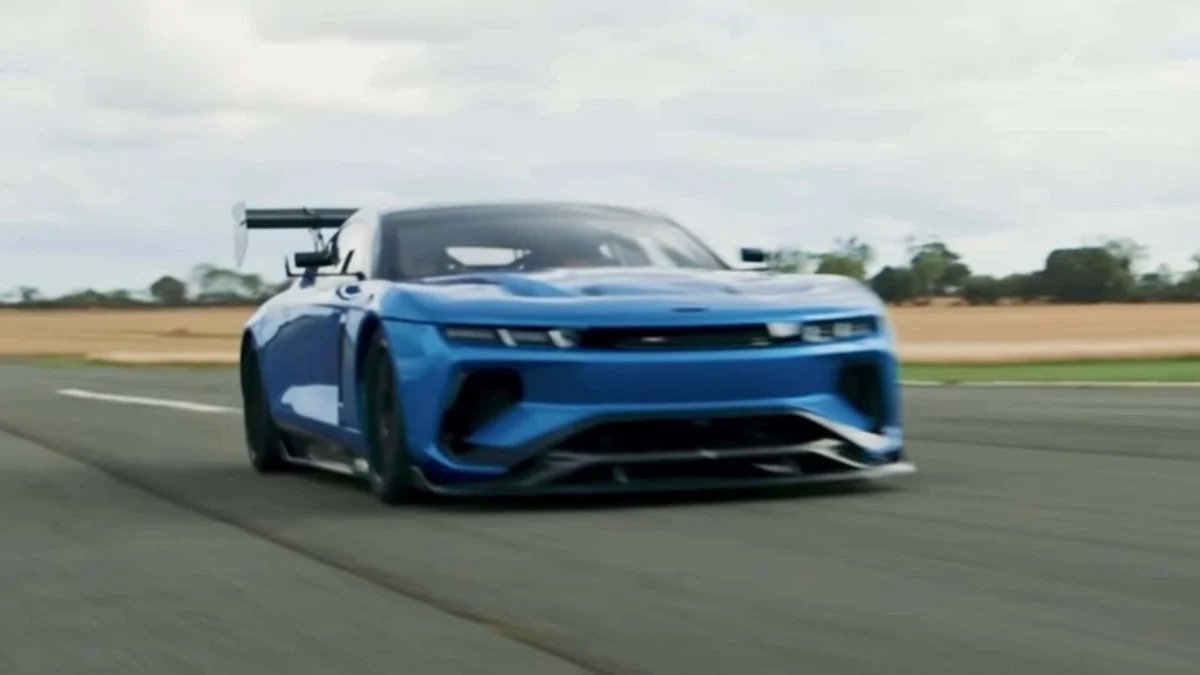
The automotive landscape is often criticized for becoming sterile, a sea of electrified crossovers and silent, digitised commuters. Yet, every so often, a project emerges that reminds us why the internal combustion engine remains the heartbeat of automotive passion. The Jensen Interceptor GTX is precisely that—a thunderous, unapologetic, and technically fascinating resurrection of a British icon. While currently confined to the proving grounds as a track-only prototype, the GTX is sending shockwaves through the enthusiast community, promising a future where old-school muscle meets contemporary engineering precision.
The Genesis of a Legend: Main Facts
At its core, the Jensen Interceptor GTX is an exercise in "restomod" philosophy taken to its absolute logical extreme. The original Jensen Interceptor, famous for its Italian-designed bodywork and American V8 power, was the definitive gentleman’s express of the late 1960s and 70s. The new GTX prototype seeks to honor that lineage while stripping away the reliability woes of the 20th century and replacing them with 1,000-horsepower-capable architecture.
The vehicle is, for now, a track-focused beast. It is built not merely to be a showpiece, but to test the thermal and structural limits of a platform that Jensen intends to bring back to the public market. It represents a trans-Atlantic collaboration: the soul of a British GT car infused with the raw, displacement-heavy power of American engineering.
A Chronology of the Resurrection
The path to the current prototype has been a long, deliberate climb. Jensen, a name that had drifted into the annals of "forgotten British brands," began its quiet resurgence several years ago.
- Initial Teasers: The company first signaled its intent to return to the fray by hinting at a modern high-performance luxury GT that would rival the likes of Aston Martin.
- Nameplate Confirmation: Enthusiasts were delighted when the official name was confirmed as the Interceptor GTX, signaling a direct link to the brand’s most celebrated model.
- The Track-Only Phase: Recognizing the immense challenge of homologating a modern vehicle for road use, Jensen opted to lead with a track-only development prototype. This allowed engineers to focus on performance metrics, handling, and powertrain durability without the immediate constraints of emissions regulations and crash-safety mandates.
- The Public Debut: With the recent unveiling of the prototype, the world finally heard the machine "at full chat." The auditory experience of the 6.8-liter supercharged V8 has effectively moved the project from the realm of "speculative renders" to "must-watch development."
Engineering the Fury: Supporting Data
The centerpiece of the Interceptor GTX is, without question, its engine. Jensen has opted for a sophisticated approach to American muscle. Rather than building from scratch, they source high-displacement blocks from General Motors, which are then shipped to Late Model Engines (LME) in Texas—a firm renowned for building some of the most potent street-legal engines in the world.
The Anatomy of the Powerplant
- Base Engine: A 6.8-liter (416 cubic-inch) GM V8.
- The Overhaul: The block serves as the foundation, but the internal components are heavily modified.
- Cylinder Heads: Custom CNC-machined heads are fitted to improve airflow efficiency and combustion pressure.
- Rotating Assembly: Upgraded components capable of handling immense boost and high RPMs are installed to ensure longevity under track conditions.
- Valvetrain: Titanium valves replace standard steel units, reducing reciprocating mass and allowing for a higher, more stable redline.
- Management: The entire system is governed by a MoTeC ECU, allowing for precise control over ignition timing, fuel maps, and boost pressure.
The result of this collaboration is a power output that currently sits at approximately 973 horsepower. However, Jensen engineers have noted that the engine is capable of hitting the 1,200-horsepower mark with a more aggressive tune. Perhaps most impressively, this power is routed through a traditional manual gearbox—a rarity in an age dominated by dual-clutch transmissions and torque-converter automatics.
Official Strategy and Future Roadmap
Jensen has been remarkably transparent about the long-term intent behind this track-focused prototype. The company is treating the Interceptor GTX as a rolling laboratory.
The goal is to evolve the prototype into a road-going vehicle available in two distinct flavors:
- The Grand Touring (GT) Version: Aimed at the traditional luxury market, focusing on long-distance comfort, high-end cabin materials, and effortless power delivery.
- The Sporting (GTR) Version: A more aggressive iteration, likely retaining more of the track-car’s suspension geometry and aero-focused styling, designed for the enthusiast who wants a visceral, raw driving experience on public roads.
Jensen’s leadership has indicated that while the path to road-legal status is complex, the data gathered from the track prototype is essential. "The car is being built for public consumption," a spokesperson suggested, noting that the feedback from the track-only phase will directly dictate the final suspension tuning and cabin ergonomics.
Implications for the Automotive Market
The return of Jensen is not just about nostalgia; it is a commentary on the current state of the performance car market. There is a palpable hunger for cars that offer a "pure" driving experience. By combining a classic aesthetic with modern, high-output, manual-transmission-equipped powertrains, Jensen is positioning itself as a boutique alternative to the mass-produced supercars from larger manufacturers.
The Challenges Ahead
Despite the excitement, the road ahead is fraught with hurdles.
- Regulatory Compliance: Transitioning a track-only prototype into a road-legal car involves monumental hurdles regarding safety crash testing, noise pollution standards, and modern emissions compliance—a significant challenge for a boutique manufacturer using a large-displacement V8.
- Pricing: Given the bespoke nature of the engine, the custom fabrication, and the low-volume production nature of the brand, the Interceptor GTX will almost certainly be an expensive proposition. It will likely sit in a price bracket that targets the ultra-high-end luxury segment.
- Brand Perception: Jensen must prove that it can offer the reliability and after-sales support expected by owners of vehicles costing hundreds of thousands of dollars.
The Verdict: A Sound of Things to Come
The Jensen Interceptor GTX represents a defiant stand for the internal combustion engine. When you hear the supercharged 6.8-liter V8 at full song, the implications are clear: performance is not dead; it has simply migrated to the workshops of those who still value the mechanical symphony of a well-tuned motor.
While we wait for official word on the launch of the road-going version, the prototype serves as a promising beacon. Jensen is doing things the hard way—track first, then road—and that rigor suggests they are serious about creating a car that lives up to the Interceptor name.
If they can successfully bridge the gap between this 1,000-horsepower track monster and a drivable, road-legal Grand Tourer, the Jensen name will once again stand for what it always did: British elegance married to raw, terrifying, and absolutely glorious American power. For now, we listen to the prototype, we watch the progress, and we wait for the day we can finally get behind the wheel. The industry is changing, but with projects like this, the future of the classic GT car looks louder and more exciting than ever.