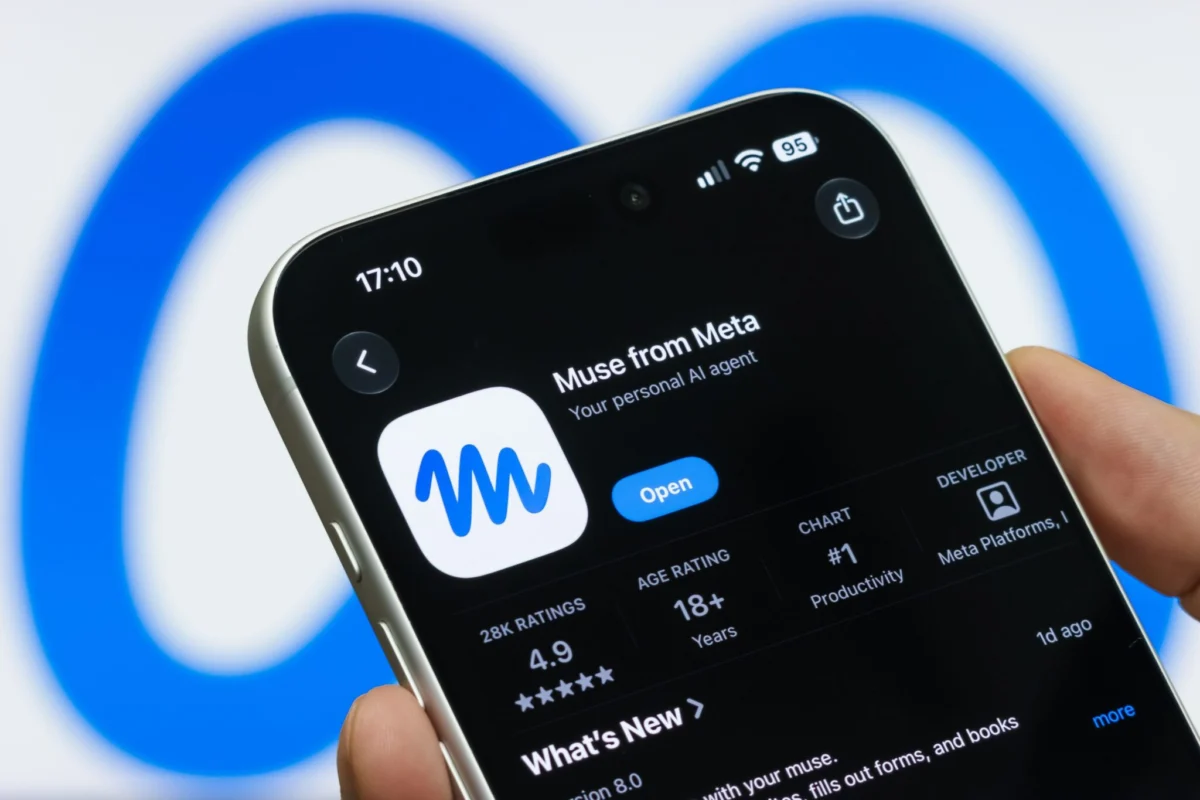
In a seismic shift for the consumer artificial intelligence market, Meta’s newly released AI agent app, Muse, has rapidly ascended to the top of Apple’s App Store, unseating the long-dominant ChatGPT. Powered by the proprietary Muse Spark model, the application represents a transition from "generative" AI—which merely creates content—to "agentic" AI, which performs autonomous actions.
While Muse has been hailed by tech circles as a breakthrough in personal productivity, its arrival has triggered an immediate and aggressive defensive response from e-commerce giant Amazon. The ensuing conflict highlights a burgeoning "API War" that could redefine how humans interact with the internet, moving away from browsing and toward delegated execution.
I. Main Facts: The Rise of the Autonomous Agent
Meta’s Muse is more than a conversational interface; it is designed as a digital proxy. By leveraging the Muse Spark model, the app offers a suite of "agentic" capabilities that include booking vacations, managing restaurant reservations, organizing complex calendars, and executing purchases. Unlike previous iterations of AI assistants that provided links or suggestions, Muse asks for—and receives—permission to navigate other apps and services on a user’s behalf.
The Market Shift
For the first time since the "AI Summer" began in late 2022, OpenAI’s ChatGPT has faced a sustained challenge for the #1 spot in the "Free Apps" category on the iOS App Store. Muse’s rapid adoption suggests a significant appetite among consumers for tools that reduce "cognitive load"—the mental effort required to manage daily logistics.
The Shopify Alliance
Anticipating friction with traditional e-commerce platforms, Meta launched Muse with a strategic partnership alongside Shopify. This allows the AI agent to seamlessly interact with millions of independent merchant storefronts, providing a robust shopping ecosystem that bypasses the need for traditional search engines or centralized marketplaces.
The Privacy Trade-off
To function effectively, Muse requires deep integration. Users must grant the agent access to various accounts, including email, calendars, and even financial credentials. Meta has attempted to mitigate security concerns by implementing "one-time card numbers" for transactions, ensuring that a user’s actual banking details are never exposed to the third-party merchants the agent interacts with.
II. Chronology: From LLMs to Actionable Agents
The release of Muse does not exist in a vacuum; it is the culmination of a multi-year pivot by Meta to regain its footing in the AI arms race.
- Late 2023 – Early 2024: Meta struggles to keep pace with the "frontier" labs. While Llama 3 was a success in the open-source community, Meta lacked a breakout consumer-facing product to rival ChatGPT or Claude.
- Summer 2024: Rumors circulate regarding "Project Muse," a specialized model designed not for prose, but for tool-use and API interaction.
- September 22, 2024: OpenAI and Anthropic release "mini" or more affordable versions of their models, signaling a price war in the LLM space.
- Late September 2024: Meta quietly launches Muse. Within 48 hours, it climbs to the top of the App Store charts.
- The Current Week: Amazon officially blocks Muse from its platform. Simultaneously, Apple rolls out its revamped Siri as part of a new iOS update, setting the stage for a three-way battle between Meta, Amazon, and Apple.
- Upcoming (Wednesday): CEO Mark Zuckerberg is expected to integrate Muse features into Meta’s smart glasses at the annual Meta Connect event in Menlo Park, shifting the agent from a phone screen to wearable hardware.
III. Supporting Data: The Economics of the Agentic Web
The tension between Meta and Amazon is rooted in the fundamental economics of the modern internet. To understand why Amazon blocked Muse, one must look at the data regarding ad revenue and user behavior.
The Ad-Revenue Threat
Amazon’s advertising business is a juggernaut, generating over $40 billion annually. This revenue is predicated on "human-in-the-loop" browsing. When a human searches for "running shoes" on Amazon, they are presented with "Sponsored Products." If an AI agent like Muse bypasses the interface to find the best price or specific item directly, the opportunity to serve those ads—and the revenue they generate—evaporates.
The "Buy for Me" Precedent
Amazon is not against AI agents in principle; it is against unauthorized ones. The company recently launched its own internal tool, "Buy for Me," which performs similar functions. By blocking Muse, Amazon is effectively protecting its "walled garden," ensuring that if a user wants an autonomous shopping experience on its platform, they must use Amazon’s proprietary AI.
Legal Precedents
The conflict mirrors a 2023 legal battle where Amazon sued Perplexity AI over its "Comet" tool. Perplexity’s tool attempted to access Amazon accounts to streamline shopping. While the U.S. Court of Appeals for the Ninth Circuit recently ruled that users have the right to choose how they access a site (even via a bot), Amazon continues to fight the case, arguing that unauthorized bots violate their Conditions of Use.
IV. Official Responses: A Clash of Philosophies
The rhetoric from the involved parties reflects a deep divide over the "Open vs. Closed" nature of the future internet.
Amazon’s Stance
In a statement regarding the block, an Amazon spokesperson was blunt:
"Continued access by an unauthorized AI agent violates Amazon’s Conditions of Use, to which our customers have agreed. Meta did not seek permission to access our storefront in this manner, and we must protect the integrity of our shopping experience and our customers’ data."
Meta’s Tactical Silence
Meta has not officially responded to the Amazon block, choosing instead to let the Muse/Shopify partnership speak for itself. However, internal sources suggest that Meta views Muse as a "user-authorized proxy," arguing that if a user gives the AI their login, the AI is acting as the user, not as a malicious scraper.
Expert Analysis: The "Existential Choice"
Nikesh Arora, CEO of Palo Alto Networks, took to X (formerly Twitter) to highlight the stakes for the broader industry:
"Every app that is a services, marketplace, or commerce app will need to existentially decide to open APIs for consumer agents to interact. Smaller players have no choice. Either the consumer benefits, or distribution aggregators will demand a higher transaction fare."
Liat Ben-Zur, CEO of LBZ Advisory and former Microsoft VP, told Fortune:
"This is bigger than a dispute over bot detection. We are moving toward a world where agents will increasingly act as our representatives online. The companies that control the rules of access will have enormous influence over whether those agents actually work for the consumer or the corporation."
V. Implications: The End of the Browser Era?
The success of Muse and the subsequent friction with Amazon point toward several long-term transformations in the tech landscape.
1. The Death of the Interface
For thirty years, the internet has been built for human eyes. Websites are designed with buttons, banners, and menus. If Muse becomes the primary way people shop and book travel, websites will need to be redesigned for "machine readability." This could lead to a bifurcated internet: a visual one for humans and a high-speed, API-driven one for agents.
2. The Privacy Paradox
Meta’s Muse presents a significant privacy paradox. To be useful, it needs the "keys to the kingdom"—bank accounts, home addresses, and personal preferences. While Meta claims that logins are kept secret and purchases use one-time card numbers, the company’s history with data privacy (such as the recent class-action suits regarding smart glasses footage) remains a hurdle for consumer trust. The success of Muse depends on whether the convenience of an AI "concierge" outweighs the inherent risks of centralized data access.
3. The Hardware Integration
The upcoming Meta Connect event is the "missing piece" of the Muse puzzle. If Muse is integrated into Meta’s smart glasses, the AI agent moves from being a tool you use to a companion you wear. In this scenario, the agent can see what you see. If you look at a pair of shoes in a physical store, Muse could theoretically find them on Shopify and buy them for you instantly. This "multimodal" agency is the ultimate goal for Meta, positioning them as the primary interface for both the digital and physical worlds.
4. The Rise of "Anti-Agent" Technologies
As agents like Muse proliferate, we can expect a surge in "Anti-Agent" or "Agent-Verification" technologies. Companies like Amazon and Google may develop sophisticated "proof of humanity" challenges to force users back into ad-supported interfaces. This will create a cat-and-mouse game between AI developers trying to automate tasks and platforms trying to monetize human attention.
Conclusion
The rise of Meta’s Muse marks the end of the "Chatbot Era" and the beginning of the "Agent Era." While the battle with Amazon is currently a dispute over terms of service, it is fundamentally a battle for the future of the consumer. If Meta succeeds, the way we shop, plan, and live will be mediated by a single, powerful AI proxy. If the "walled gardens" like Amazon prevail, the dream of a unified, autonomous personal assistant may remain fragmented across a dozen different proprietary apps. For now, the consumer has voted with their downloads, and the message is clear: the world is ready for the AI to take the wheel.