BELGOROD, Russia — As the third and final day of voting in Russia’s parliamentary elections commenced on Sunday, September 20, 2026, the atmosphere across the nation remained heavy with the gravity of an ongoing, protracted conflict. The election, which President Vladimir Putin has explicitly characterized as a definitive test of national unity and public support for his "special military operation" in Ukraine, serves as a high-stakes barometer for the Kremlin’s grip on power.
While the ruling United Russia party is widely expected to secure a sweeping victory, the context of this year’s cycle is vastly different from previous iterations. With the borders of the conflict zone inching closer to Russian soil—as evidenced by polling stations being established in sensitive regions like Belgorod—the exercise is as much a psychological mobilization as it is a democratic procedure.
Main Facts: A Election Under the Shadow of War
The 2026 parliamentary elections conclude today, marking the culmination of a three-day voting process that has been carefully orchestrated to maximize turnout and maintain state-sanctioned stability.
The primary objective for the Kremlin is to present a facade of absolute national consensus. By framing the ballot as a referendum on the war, the state has effectively transformed the act of voting into an act of loyalty. Observers note that the political field has been aggressively pruned of genuine opposition. Independent voices, anti-war activists, and liberal-leaning candidates have been largely sidelined, either through administrative disqualification, legal pressure, or self-imposed exile.
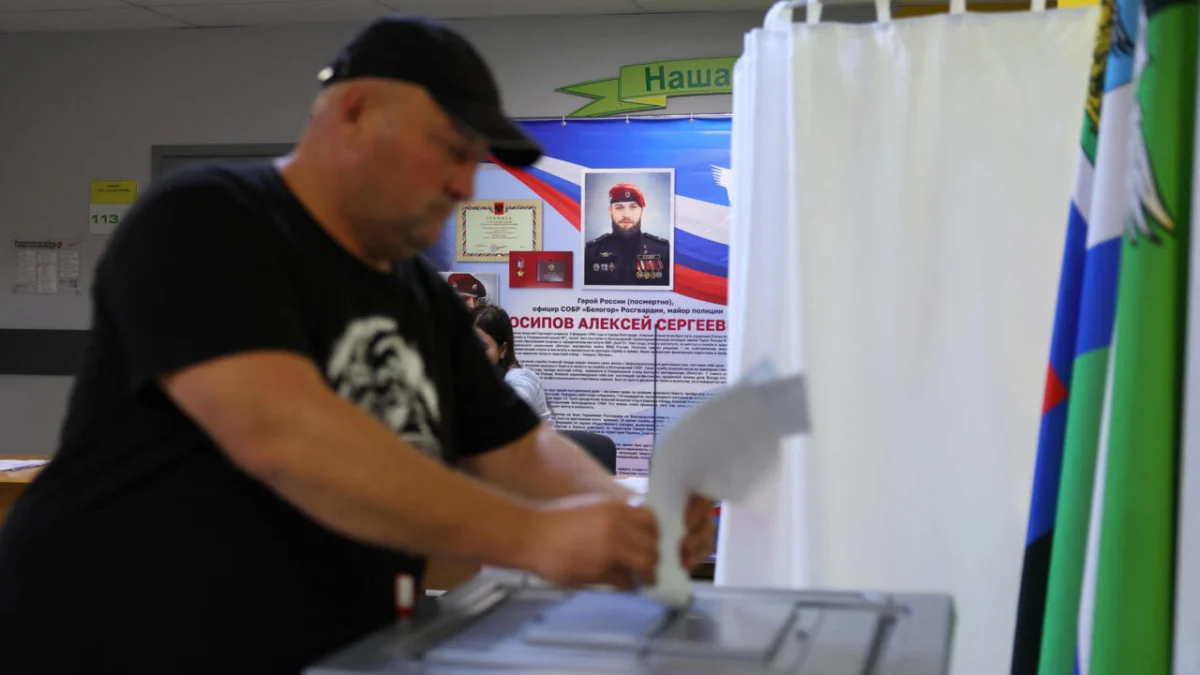
In the Belgorod region, the site of recent border skirmishes, the symbolism of the vote is particularly stark. Voters are casting their ballots in polling stations named after fallen soldiers, such as the school in the settlement of Razumnoye, now named after Alexey Osipov—a Rosgvardiya officer posthumously awarded the "Hero of Russia" medal. This deliberate infusion of military iconography into the voting process underscores the government’s narrative: that the ballot box is an extension of the front line.
Chronology: The Road to the Ballot
Phase One: The Pre-Election Crackdown
Leading up to the September 18 start date, the Russian political apparatus moved to consolidate control. Legislative amendments introduced in the preceding months tightened regulations on campaign funding and media coverage, ensuring that the state-run narrative dominated the airwaves. Independent monitoring groups, including the long-standing NGO Golos, reported systematic harassment of election observers.
Phase Two: The Opening Days
- September 18: The polls opened nationwide. Reports of record turnout in state-controlled sectors and military-adjacent regions surfaced early, though these figures remain difficult to verify due to the lack of international independent oversight.
- September 19: Tensions flared in border areas as reports of sporadic artillery fire and security alerts continued to punctuate the news cycle. Despite the security concerns, officials insisted that the democratic process would not be interrupted.
- September 20: The final day of voting. Election commissions are currently bracing for the tallying process, with exit polls—controlled by state-affiliated research centers—already suggesting an overwhelming mandate for United Russia.
Supporting Data: The Illusion of Competition
In a political system where dissent is treated as a security risk, data regarding "public support" must be parsed with caution. Historically, United Russia has leveraged the "administrative resource"—the ability to mobilize state employees, military personnel, and pensioners—to guarantee turnout.
- Participation Metrics: Preliminary data from the Central Election Commission (CEC) claims high participation rates in newly annexed or conflict-adjacent territories.
- The "Opposition" Vacuum: The parties represented in the State Duma alongside United Russia—the Communist Party, the Liberal Democratic Party (LDPR), and A Just Russia—are widely regarded by political scientists as "systemic opposition." These groups support the Kremlin’s foreign policy agenda, offering only superficial disagreements on domestic economic policy while remaining firmly aligned with the war effort.
- Technological Integration: The use of electronic voting systems has been expanded significantly in 2026. While the Kremlin touts this as a modernization of the democratic process, cybersecurity experts and critics have long warned that digital ballots are highly susceptible to manipulation, as they lack the transparency of traditional paper ballot boxes.
Official Responses: The Kremlin’s Narrative
The Kremlin’s messaging throughout the election cycle has been consistent: the war is not merely a military necessity, but a struggle for Russia’s survival against a "collective West."
In his final address prior to the conclusion of the polls, President Putin emphasized that the elections were "a vital display of the Russian people’s iron will." He warned that any attempt to destabilize the voting process would be met with "a firm and immediate response from the security services."

Kremlin spokesperson Dmitry Peskov echoed these sentiments, dismissing international criticism of the election’s fairness. "This is an internal affair of the Russian Federation," Peskov stated during a press briefing. "The people of Russia are demonstrating their absolute support for the President’s course, and any external commentary regarding the validity of these results is nothing more than an attempt to interfere in our sovereignty."
Implications: A Future of Continued Stasis
The results of this election, once announced, will likely trigger a series of significant political and social shifts within Russia.
1. Consolidation of the "War Cabinet"
A decisive victory for United Russia will be interpreted as a mandate to continue the military campaign in Ukraine indefinitely. It provides the administration with the legislative cover to pass even stricter mobilization laws and economic measures, essentially transitioning the country into a permanent "war economy."
2. The Total Erasure of Dissent
The 2026 election cycle marks the final transition of the Russian Duma from a body of performative debate to a rubber-stamp institution. With the removal of any remaining political space for anti-war discourse, the internal resistance within Russia may be forced further underground, potentially leading to more radicalized, albeit isolated, forms of protest.
3. Geopolitical Isolation
For the international community, the outcome of this election signifies that there is no "peace party" within the Russian government structure. As the Kremlin secures its domestic front, the prospect of diplomatic engagement or a negotiated settlement to the conflict in Ukraine becomes increasingly remote. Western nations are expected to respond with further rounds of sanctions, focusing on the individuals and sectors that facilitated the election process in contested regions.
4. The Demographic Toll
The focus on the Belgorod region and the memorialization of soldiers like Alexey Osipov highlights a grim demographic reality. The war is consuming a generation of young Russian men, and the government is attempting to transmute this tragedy into a source of nationalist fervor. The long-term sociological impact—the "Grozny-fication" of Russian society—remains the greatest unknown. How a nation reacts when the reality of the war eventually outpaces the state’s ability to mask it through propaganda is a question that will likely dominate the post-election period.
Conclusion
As the sun sets on the final day of voting, the result is all but a foregone conclusion. The 2026 parliamentary elections were never designed to offer a choice between competing visions of Russia’s future. Instead, they were designed to serve as a mirror, reflecting a state that is deeply committed to its current trajectory.
For the people of Russia, the choice was not between parties, but between compliance and silence. As the votes are tallied, the message from the Kremlin is clear: the state is at war, the political opposition has been vanquished, and the current path is the only one on offer. Whether this perceived stability can withstand the mounting pressures of a prolonged conflict, economic strain, and social fatigue remains to be seen. For now, the ballot boxes in Belgorod and beyond stand as monuments to a country locked in a cycle of its own making.