In a landmark development for sustainable engineering, a multi-institutional research coalition has unveiled a breakthrough in filtration technology that promises to reshape the energy-intensive landscape of industrial separation. By mimicking the precision of biological systems, scientists have developed a new class of ultra-selective crystalline membranes—dubbed "POMbranes"—capable of filtering molecules with unprecedented accuracy.
The study, recently published in the Journal of the American Chemical Society, represents a collaboration between the CSIR-Central Salt and Marine Chemicals Research Institute (CSMCRI), the Indian Institute of Technology Gandhinagar (IITGN), Nanyang Technological University in Singapore, and the S N Bose National Centre for Basic Sciences. This innovation arrives at a critical juncture, offering a scalable, energy-efficient solution for industries ranging from pharmaceutical production to textile manufacturing.
The Energy Crisis in Industrial Separation
To understand the significance of this breakthrough, one must first recognize the sheer scale of the challenge. Modern manufacturing is built upon the ability to separate substances—isolating active pharmaceutical ingredients, purifying chemical solvents, or extracting dyes from wastewater. However, these essential processes are among the most resource-heavy operations on the planet.
Collectively, separation processes account for an estimated 40% to 50% of global industrial energy consumption. For decades, the industry has relied on traditional thermal methods such as distillation and evaporation. While these techniques are reliable, they are notoriously inefficient, requiring massive inputs of heat and electricity, which in turn drive significant carbon emissions.
While membrane-based filtration has long been proposed as a "green" alternative, conventional polymer membranes have consistently failed to meet industrial demands. Most synthetic membranes suffer from structural inconsistency; their pores are often uneven in size and prone to degradation under the harsh chemical environments typical of manufacturing plants. Over time, these membranes lose their selectivity, leading to poor performance and frequent, costly replacements.
The Birth of the POMbrane: A Chronology of Innovation
The development of POMbranes did not happen overnight. It was the result of a deliberate, multi-year effort to synthesize biological efficiency with material science durability.
1. Drawing Inspiration from Biology
The research team looked to nature, specifically to aquaporins—specialized proteins that serve as water channels in biological cells. Aquaporins are masters of molecular filtration, using precisely sized, static channels to allow water molecules to pass while blocking everything else. The researchers sought to replicate this "molecular sieve" behavior using synthetic components.
2. Engineering the Crystalline Clusters
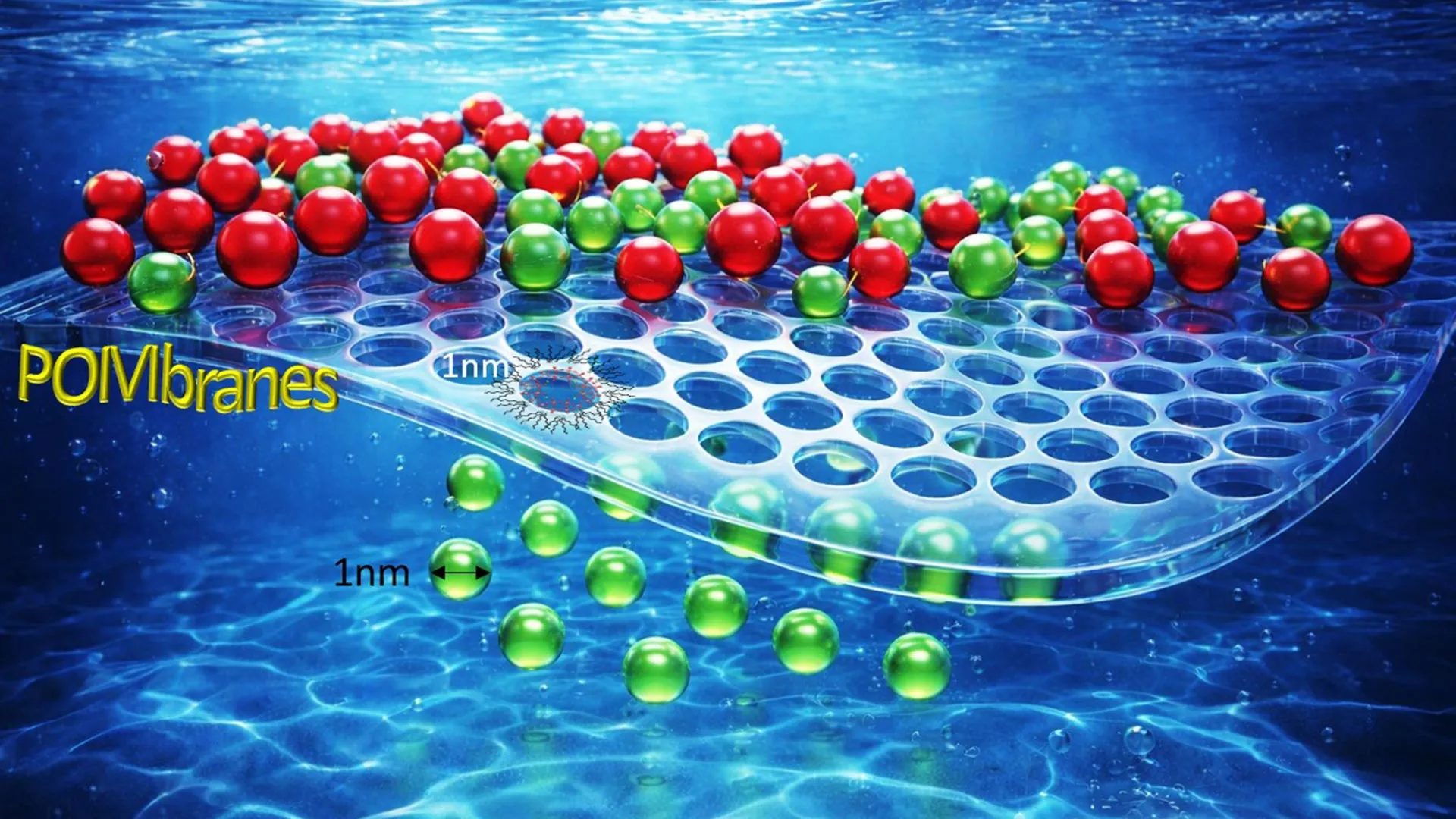
The core of the technology lies in the use of polyoxometalate (POM) clusters. These are crown-shaped metal oxide structures that possess an inherent, rigid, and perfectly sized central aperture—exactly one nanometer in width. Unlike plastic polymers that warp or swell, these inorganic POM structures are chemically and thermally stable, providing a permanent framework that does not lose its shape.
3. Creating the Continuous Layer
A single nanometer-sized cluster is useless on its own. The breakthrough occurred when the team discovered a method to arrange billions of these clusters into a cohesive, defect-free sheet. By attaching flexible chemical "chains" to the POM clusters, the researchers created a system that, when floated on water, spontaneously organized into a large-area, ultrathin film. By manipulating the length of these chains, the scientists could precisely control the packing density of the clusters, ensuring that the only path through the membrane was the one-nanometer hole at the center of each cluster.
Supporting Data: Unprecedented Precision
The performance metrics of the POMbranes have set a new benchmark for filtration technology. In rigorous testing, the membranes demonstrated the ability to distinguish between molecules that differ by as little as 100 to 200 Daltons.
This level of precision is profound. In the context of molecular filtration, most commercial membranes operate on a "coarse" scale, often struggling to differentiate between similarly sized molecules. Achieving this level of selectivity—while maintaining high flux and mechanical flexibility—is a "holy grail" for membrane science.
According to Dr. Ketan Patel, Principal Scientist at CSMCRI, the performance gains are substantial. "Our membranes show almost ten times better separation performance compared to existing technologies," Dr. Patel noted. Furthermore, because these membranes are stable across a wide spectrum of pH levels and acidity, they can be deployed in environments where traditional membranes would quickly dissolve or fail.
Perspectives from the Research Team
The collaborative nature of this project allowed for a unique blend of experimental synthesis and theoretical modeling.
Dr. Shilpi Kushwaha, Senior Scientist at CSMCRI, emphasized the structural uniqueness of the invention: "To address the limitations of current polymer filters, we engineered a new class of ultra-selective, crystalline membranes. These pores are about one nanometer wide—thousands of times thinner than a human hair—offering a level of control that was previously inaccessible."
Ms. Priyanka Dobariya, a research scholar at CSMCRI and co-first author of the study, highlighted the stability of the metal-based design: "These POMs are tiny, crown-shaped metal clusters that have a permanent, perfect hole in their center. That hole does not change or lose shape, which is the biggest hurdle with traditional plastic filters."
From the perspective of material engineering, Dr. Raghavan Ranganathan, Associate Professor at IITGN, explained the mechanism of the "sieve": "By modifying the chemical chains, we forced molecules to cross the membrane through the only open path, the one-nanometer holes built into each cluster. This effectively turns the membrane into a high-tech molecular sieve."
Mr. Vinay Thakur, a PhD scholar at IITGN and co-first author, added that the project utilized advanced molecular-level simulations to confirm that the filtration behavior matched the theoretical design, providing a roadmap for future optimizations.
Implications for Industry and Sustainability
The potential applications for POMbranes extend far beyond the laboratory, with immediate relevance to two of India’s most significant industrial pillars: textiles and pharmaceuticals.
The Textile Revolution
India’s textile and apparel sector is a cornerstone of the national economy, contributing over 2.3% to the GDP and representing roughly 13% of industrial production. However, the sector is also a major source of water pollution due to toxic dyeing and finishing effluents.
POMbranes offer a path toward a circular water economy in textiles. By selectively removing dye molecules from wastewater, these membranes allow the water to be recycled back into the production cycle. This not only reduces the industry’s reliance on fresh water but also minimizes the discharge of hazardous chemical waste, aligning with global ESG (Environmental, Social, and Governance) targets.
Transforming Pharmaceutical Manufacturing
In the pharmaceutical sector, the margin for error is non-existent. Drug purification and solvent recovery are quality-sensitive processes that currently consume massive amounts of energy. The high selectivity of POMbranes allows for cleaner separation with significantly lower energy requirements. By integrating these membranes into production lines, pharmaceutical companies can maintain stringent safety standards while simultaneously lowering their operational costs and carbon footprint.
A Platform for the Future
The researchers characterize the POMbrane as a "platform technology." Because the structure can be adjusted—by changing the attached chemical chains or the composition of the POM clusters—it can be fine-tuned for a wide variety of industrial tasks. Whether it is removing heavy metals from groundwater, purifying specialty chemicals, or facilitating advanced solvent recovery, the fundamental design remains adaptable.
As global industry faces increasing pressure to reconcile economic growth with environmental stewardship, the move toward "molecularly engineered" materials is accelerating. By applying the principles of biological precision to large-scale material manufacturing, the CSMCRI-IITGN team has provided a blueprint for how science can solve the dual challenges of efficiency and sustainability.
The success of the POMbrane project highlights the vital role of cross-disciplinary collaboration. By merging the synthetic expertise of CSMCRI, the material engineering capabilities of IITGN, and the global reach of their international partners, the researchers have turned a theoretical concept into a tangible, scalable, and highly impactful industrial solution. As the technology moves toward commercial pilot testing, it stands as a testament to the power of nature-inspired design in the ongoing quest for a greener industrial future.