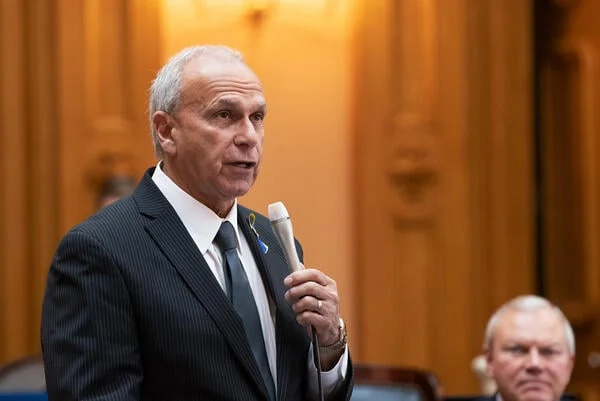
In the halls of the Ohio Statehouse, few figures have cast a shadow over the ivory tower as long—or as polarizing—as State Senator Jerry Cirino. A former CEO of four medical device companies, the 74-year-old Republican has spent the last several years transforming from a local county commissioner into the architect of the most significant legislative overhaul of public higher education in Ohio’s history.
At the center of this firestorm is Senate Bill 1, a sweeping piece of legislation that has fundamentally altered the relationship between the state government, university administrators, and faculty. As Cirino continues to press for further reforms, including the potential overhaul of general education requirements, the academic landscape in Ohio remains in a state of profound flux.
A Chronology of Conflict: From SB 83 to SB 1
The genesis of Ohio’s current higher education landscape can be traced back to 2021, when Cirino was appointed chair of the Senate Workforce and Higher Education Committee. Senate President Matt Huffman, seeking a "bulldog" to rein in what he perceived as ideological drift in the state’s universities, handed Cirino the mandate to "get rid of the wokeness" and bring institutions "back into the fold."
The resulting legislative journey was arduous. Cirino first introduced Senate Bill 83, a controversial measure that ignited years of debate. The bill faced stiff resistance from faculty unions, student organizations, and academic freedom advocates, who warned that it threatened the very foundations of tenure and institutional independence.
Despite the protests, the legislation evolved and was eventually reintroduced as Senate Bill 1. It passed in 2025, solidifying a series of mandates that critics argued essentially gutted the traditional protections afforded to academics. The bill prohibited faculty strikes, empowered administrators to initiate post-tenure reviews leading to termination, and dismantled diversity, equity, and inclusion (DEI) offices across the state.
The Pillars of Reform: What the Law Mandates
Senate Bill 1 is not merely a policy change; it is an administrative restructuring of how Ohio’s public universities operate. Its core provisions include:
- Institutional Neutrality: Public universities are now legally required to maintain a posture of political neutrality, a move Cirino claims is necessary to stop the spread of ideological bias.
- The End of DEI: The legislation prohibits the use of DEI offices, bans DEI statements in hiring, and restricts the use of DEI criteria in scholarships.
- Intellectual Diversity Mandates: Institutions must demonstrate "intellectual diversity" in course approvals, general education requirements, and common reading programs.
- Syllabus Transparency: All undergraduate course syllabi must be posted publicly online.
- The No-Strike Provision: Full-time faculty are strictly barred from striking, a move Cirino justifies as a means to protect the "contract" between the student and the institution.
- Program Consolidation: Perhaps the most immediate impact of the law, the bill mandates the closure of undergraduate degree programs that award fewer than five degrees annually on average.
Data and Disruption: The "547 Program" Reality
The legislative pressure has produced immediate, tangible results. According to a spokesperson for the Ohio Department of Higher Education, 547 academic programs have been shuttered or committed to closure by August 15, 2026.
Cirino views these closures as a victory for efficiency. "These unproductive programs—you have to have tenured faculty, administrative support, teaching assistants—it makes no business sense at all," he said in an interview with Inside Higher Ed. To the Senator, the university is a business, and the student is the customer. By eliminating low-enrollment majors, he argues the state is forcing universities to become more responsive to workforce demands rather than remaining "faculty-centric."
However, faculty organizations see this differently. The American Association of University Professors (AAUP) has long maintained that these "unproductive" programs often serve as the bedrock of a liberal arts education, providing niche expertise that is essential for a well-rounded citizenry.
Official Responses and the Battle Over Governance
The tension between the legislature and the faculty has reached an all-time high. Cirino has been vocal about his disdain for "shared governance," which he characterizes as an obstacle to necessary reform. "I would not go ask the workers—who are members of the union—what we should do in our labor negotiations," he noted, drawing a direct parallel to his time in the private sector.
Faculty groups vehemently dispute this framing. Jennifer Price, executive director of the Ohio conference of the AAUP, points out that since the right to strike was granted in 1984, there have been only two major strike events in the state—a record that suggests faculty are rarely the primary disruptors of the academic "contract." Furthermore, faculty leaders claim they were systematically excluded from the drafting process of SB 1. "At no point during the passage… were OSU faculty invited to meet with Sen. Cirino," said Erynn Beaton, interim president of the Ohio State University AAUP chapter.

Meanwhile, university administrations have been forced to navigate the middle ground. While some institutions, such as Ohio State, have publicly stated they remain committed to hiring the most qualified candidates in compliance with the law, they are operating under a legislative microscope that demands adherence to standards the state defines as "neutrality."
The Ideological Underpinnings: Defining "Woke" and "Neutrality"
When pressed on his motivations, Cirino defines "woke" as a bandwagon movement that has infected academia, particularly following the protests of 2020. He argues that DEI initiatives were a form of "institutional discrimination" that prioritized identity over merit.
"I want everybody to have an equal opportunity," Cirino said. "It doesn’t mean everybody gets equal things… I don’t care if they’re Black, white, pink, yellow, whatever." His push for "intellectual diversity" is, in his view, a return to a center-ground where professors present information without attempting to indoctrinate students.
Critics, however, argue that Cirino’s version of "neutrality" is simply an ideological push to the right. By mandating civic literacy courses and controlling who teaches them through Republican-backed civics centers, they argue the state is replacing one form of bias with another.
Future Implications: The Three-Year Degree and Gen Ed Reform
As of mid-2026, Cirino is not resting on the success of SB 1. He has set his sights on the next frontier: general education reform. He plans to summon provosts to testify on why certain courses are required, suggesting that many are merely "pet projects" of professors that inflate costs for parents and students.
His ultimate goal is to facilitate the widespread adoption of three-year bachelor’s degrees. By cutting down on "unnecessary" gen ed requirements and leveraging programs like College Credit Plus, he believes he can make higher education more affordable and more focused on career readiness.
"I don’t need to be an academic," Cirino said, defending his oversight of the university system. "I need to make sure that the product they produce is working."
The Long-Term Impact on Higher Education
The long-term consequences of Cirino’s tenure in the Senate remain to be seen. Supporters argue that he is a necessary force for accountability in an era of rising tuition costs and perceived academic stagnation. They see him as a champion for the taxpayer and a defender of the student experience.
Conversely, those in the academy fear that the "business model" of higher education is destroying the very autonomy that allows universities to push boundaries, challenge consensus, and conduct critical research. The loss of 547 programs is seen by many as a cultural erasure, a narrowing of the intellectual horizon to prioritize only those subjects that have immediate, quantifiable market value.
As Ohio continues to serve as a laboratory for this new style of legislative intervention, other states are watching closely. Whether this model of top-down, state-led reform will result in a more efficient university system or the hollowed-out remnants of what was once a world-class academic engine is a question that will likely define the state’s political and intellectual discourse for decades to come.
For Jerry Cirino, the mission is clear: he believes he is holding the line for the next generation, including his 40 grandchildren. For the faculty and administrators in Columbus and beyond, the feeling is one of profound uncertainty as they navigate a new, highly regulated reality where the state has become the most influential member of the faculty senate.