After eight years at the helm of Opendoor—the prop-tech giant he steered through the turbulent waters of a public offering and the subsequent cooling of the housing market—Eric Wu spent a year in the quietude of a sabbatical. For many founders, a decade of intense, high-stakes building would be a natural stopping point to pivot toward passive venture investing. Yet, for Wu, the rapid emergence of generative AI felt less like a passing trend and more like a generational shift he could not afford to watch from the sidelines.
"I knew if I looked back in 10 years and didn’t do something related to it, I’d probably regret that," Wu recently shared. This realization has birthed his latest venture: NavigateAI, a startup aimed at solving one of the most stubborn bottlenecks in the modern global economy—the chronic shortage of skilled labor in construction.
The Core Mission: A "Hands-Free" Expert Coach
NavigateAI is not designed to replace the laborer, but to augment them. By leveraging artificial intelligence to create "copilots" for field workers, the company aims to provide a hands-free, real-time expert coach for those physically assembling the world’s infrastructure.
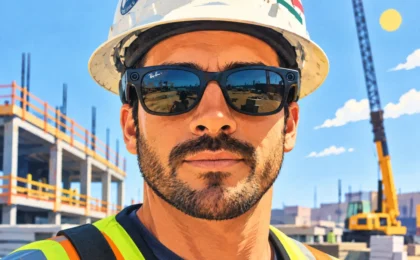
The product operates primarily through a smartphone interface, but its most innovative deployment is through Meta’s AI-equipped smart glasses. By utilizing the glasses’ cameras, a worker can point their gaze at a specific installation, such as electrical wiring or structural steel, and query the system in plain language: Is this installed correctly? Does this torque meet the specific safety code?
The software pulls from a massive repository of building specifications, manufacturer manuals, and proprietary company policies to provide instant, contextual guidance. Crucially, NavigateAI is currently collaborating with Meta to secure safety certification for these glasses, ensuring they meet the stringent requirements of hazardous job sites where protective eyewear is mandatory.
Chronology of a Startup Launch
The genesis of NavigateAI follows a rapid trajectory typical of Silicon Valley’s top-tier operators.
- 2022: Eric Wu steps down as CEO of Opendoor, concluding an eight-year tenure that saw the company navigate the rapid rise and sudden contraction of real estate sales due to soaring interest rates.
- 2023: Wu spends a year of reflection, assessing the technological landscape and determining where his operational experience could be best leveraged.
- May 2024: NavigateAI officially emerges from stealth mode with a massive $25 million seed funding round.
- Present: The company is currently scaling its partnerships with major construction firms and vocational institutions, focusing on integrating the AI into the daily workflows of thousands of laborers across the U.S.
Supporting Data: The Construction Crisis
The necessity for a tool like NavigateAI is underscored by a sobering reality in the construction sector. The industry is facing an existential labor crisis. According to the Associated Builders and Contractors, the U.S. requires approximately 349,000 additional workers this year alone just to maintain pace with existing demand.
This shortfall is being exacerbated by three compounding factors:
- Demographics: The workforce is aging rapidly, with a significant cohort of experienced journeymen nearing retirement.
- Immigration Policy: Increased enforcement and restricted labor flows have thinned the ranks of the manual labor force.
- The AI Infrastructure Boom: Perhaps the greatest pressure on labor is the surge in data center construction. Massive projects—such as Meta’s Hyperion campus in Louisiana and OpenAI’s "Stargate" site in Texas—require labor forces ranging from 5,000 to over 6,000 workers per site.
Kelly, the global staffing firm, reports that 90% of data center operators now identify labor shortages as the primary constraint on their ability to scale their operations. As construction demand balloons to meet the infrastructure needs of the AI revolution, the "people layer" has become the industry’s most significant bottleneck.
Business Model and Strategic Alliances
NavigateAI’s funding round, valued at $225 million post-money, is a testament to the confidence placed in Wu’s vision. Led by Elad Gil, the round included participation from industry heavyweights including Khosla Ventures, Fifth Wall, Lennar, Tishman Speyer, and Helix Electric. The cap table also boasts a roster of Silicon Valley luminaries, such as Tony Xu (DoorDash), Apoorva Mehta (Instacart), and Brian Armstrong (Coinbase).
The Value-Based Pricing Strategy
Unlike traditional SaaS models that charge per seat, NavigateAI has pivoted toward a value-based pricing structure. If the software helps a builder shave costs off a project, the company captures a percentage of that efficiency. Given that a giant like Lennar spends roughly $9 billion annually on labor and installation, even a 5% to 10% gain in efficiency translates to hundreds of millions of dollars in value, of which NavigateAI claims a slice.
The Long-Term Data Play
While the immediate goal is to assist current workers, Wu is playing a much longer game: the acquisition of "egocentric video data." Every job completed using the glasses generates a high-fidelity, labeled record of how tasks are performed in the real world—the good, the bad, and the error-prone. This dataset is expected to be incredibly valuable for future robotics companies, potentially making NavigateAI a foundational player in the eventual automation of physical construction.
Implications and Challenges
Despite the excitement, NavigateAI faces significant hurdles that could dictate its ultimate success or failure.
The Human Factor: Adoption and Trust
There is a stark generational divide in the reception of the technology. Younger workers, raised in a digital-first environment, are reportedly eager to adopt the AI glasses. Conversely, 30-year veterans of the trades—whose intuition and expertise are the very things the AI seeks to emulate—are often skeptical. If the "institutional knowledge" of these veterans is not captured and digitized, the system may lack the depth required to solve complex, non-standard problems on site.
The Attribution Dilemma
Value-based pricing is inherently prone to conflict. Proving that a project was completed under budget due specifically to NavigateAI, rather than favorable weather or material availability, is notoriously difficult. This creates the potential for contractual disputes, even among investors who are also clients.
Liability and Litigation
The construction industry is one of the most litigious sectors in the economy. If the software provides a recommendation that leads to a structural failure or a safety incident, the question of liability remains murky. NavigateAI will need to navigate a complex web of legal precedents to ensure that its AI "coach" does not become a source of massive professional liability.
The Competitive Landscape
While Wu claims his closest competitors, such as Buildots and OpenSpace, are focused on high-level project management rather than the individual laborer, the shadow of Big Tech looms large. Companies like Meta or OpenAI possess the technical infrastructure and capital to build similar solutions. NavigateAI’s moat, therefore, must be built on deep workflow integration and the proprietary data it collects—assets that take years to accumulate.
A Founder’s Philosophy
Perhaps the most telling aspect of NavigateAI’s current state is Wu’s decision to operate without a board of directors. Drawing from the constraints he faced while running the publicly traded Opendoor—where governance often competed with product innovation for his time—Wu is intentionally delaying the formation of a board.
He is prioritizing the "builder" mindset, focusing on the customer experience and the messy, physical reality of the construction site rather than the demands of shareholders. In an era where AI is often treated as a black-box software challenge, Eric Wu is betting that the real frontier is the physical world, and that the biggest winners will be those who can help the person on the ground build it better.