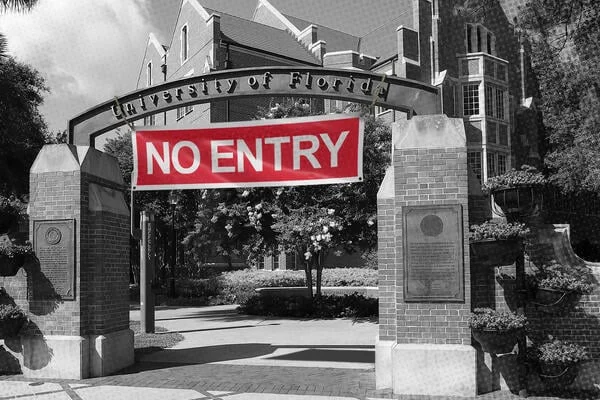
Introduction: A New Paradigm for Florida’s Public Universities
In a landmark decision that underscores a deepening divide in American education policy, the Florida Board of Governors voted unanimously on Thursday to bar undocumented students from enrolling in the state’s most selective public universities. The new regulation, which was passed without discussion, marks a significant escalation in the state’s efforts to restrict access to public institutions for individuals without legal immigration status.
Starting in the upcoming academic year, any individual “present in the United States unlawfully” will be prohibited from enrolling in any of the state’s 12 public universities that failed to admit all academically qualified applicants over the previous two academic years. This policy effectively seals off the most prestigious and resource-heavy institutions in the state from an entire demographic of students, many of whom have lived and studied in Florida for the majority of their lives.
Chronology of Legislative Restriction
The recent vote by the Board of Governors is the latest in a series of aggressive legislative and administrative maneuvers designed to decouple Florida’s public education system from undocumented populations.
The Path to Exclusion
- February 2025: Florida took its first major step in this direction by eliminating in-state tuition for undocumented students, effectively ending a long-standing practice that allowed long-term residents to pay the same rates as their peers.
- June 2026: Following a broader federal trend of litigation, the Florida State Board of Education voted to ban undocumented students from the state’s 28-college system and all state-run adult education programs. This move set the stage for the Board of Governors’ recent decision, signaling a unified state strategy.
- June 2026 (Federal Context): The Trump administration initiated a wave of lawsuits against various states, arguing that offering in-state tuition to undocumented students constitutes a form of discrimination against U.S. citizens from other states.
- September 2026: The Board of Governors finalized the restriction for the university system, aligning the state’s four-year institutions with the restrictions already imposed on its community and state colleges.
With this decision, Florida joins a growing bloc of states—including Alabama, Georgia, and South Carolina—that have implemented comprehensive bans on the enrollment of undocumented students in public higher education.
Supporting Data: Understanding the Scope
To understand the gravity of the Board of Governors’ decision, one must look at the criteria established for the ban. By focusing on universities that “did not admit all academically qualified applicants” for the past two years, the regulation specifically targets the state’s most sought-after research institutions.
Institutional Impact
Florida’s public university system, which includes heavyweights such as the University of Florida and Florida State University, often operates with high admissions standards. Because these institutions are selective, they inherently fall under the umbrella of this new rule.
Historically, while exact numbers are difficult to verify due to privacy concerns and the precarious nature of undocumented status, thousands of students in Florida have navigated the K-12 system only to find the path to higher education increasingly obstructed. By removing access to the state’s top-tier universities, the policy effectively caps the professional trajectory of these students, limiting their ability to contribute to the state’s high-growth sectors.
Official Responses and Political Rationale
The policy has ignited a firestorm of debate, pitting proponents of strict immigration enforcement against educators and civil rights advocates who argue that the policy is exclusionary and counterproductive.
The Argument for Restriction
Florida’s leadership has framed the policy as a matter of fiscal responsibility and legal adherence. Florida Lt. Gov. Jay Collins took to social media platform X to celebrate the move, stating, “Florida’s public universities are for students who are here legally. Period.”
Collins continued his argument by invoking the role of the taxpayer, asserting: “Florida taxpayers should not be expected to subsidize opportunities for people who broke our laws to come here.” This narrative—that public higher education is a benefit reserved exclusively for those with legal citizenship or residency status—has become a cornerstone of the current Florida administration’s educational platform.

The Dissent: Faculty and Advocates
Conversely, the academic community has voiced vehement opposition to the measure. Robert Cassanello, president of the United Faculty of Florida (UFF), issued a searing critique of the Board of Governors, accusing the body of abandoning its mandate to provide education for the public good.
“The Board of Governors has lost sight of its responsibility to safeguard higher education for the common good,” Cassanello said in his official statement. “Rather than increasing our university system’s capacity to educate Florida’s future workers and leaders, this rule stymies growth and closes doors that have helped our communities.”
Cassanello further noted that the timing of the ban is particularly problematic given Florida’s current economic landscape. The state is currently grappling with acute labor shortages in critical fields, including healthcare, primary and secondary education, and the skilled trades. Advocates argue that by limiting the pool of potential students, the state is actively undermining its own workforce development goals.
The Broader Implications for Florida
The implications of this policy extend far beyond the individual students affected. Experts in higher education policy suggest that the ban could have long-term consequences for the state’s intellectual and economic vitality.
Economic and Workforce Impacts
Florida’s economy relies heavily on a pipeline of trained professionals. Many students who grow up in the state and attend local schools are the very individuals who would eventually fill the roles currently in short supply. By creating a barrier to entry, the state risks a "brain drain," where talented individuals who are barred from Florida institutions seek education and employment in states with more inclusive policies.
Legal and Constitutional Debates
The legal foundation of these bans remains a subject of intense scrutiny. Critics argue that these policies create a tiered system of education that ignores the fundamental contributions undocumented residents make to the state’s tax base. Furthermore, the interplay between state-level bans and potential federal challenges creates a climate of uncertainty for university administrators, who must now grapple with the complexities of residency verification and enforcement.
The Erosion of the "Common Good"
Perhaps the most significant, if intangible, implication is the philosophical shift in how Florida defines its public institutions. Historically, the land-grant university model was predicated on the idea of accessibility and the democratization of knowledge. By explicitly excluding a specific group of residents, the Board of Governors has redefined these institutions as exclusive rather than inclusive entities.
Conclusion: The Future of Higher Education in Florida
As the new academic year approaches, the full impact of the Board of Governors’ decision will begin to materialize. Universities are now tasked with the administrative burden of implementing these new verification processes, while students are forced to reconsider their educational futures in a state that has become increasingly hostile to their presence.
For supporters of the measure, the vote represents a necessary step in protecting state resources and upholding the rule of law. For critics, it represents a retreat from the mission of higher education and a failure to invest in the potential of all young people living within the state’s borders.
As Florida charts this new course, the rest of the nation watches closely. The debate over who has the right to access public education is far from settled, and the ripple effects of Florida’s decision will likely be felt in courtrooms and legislative chambers for years to come. The state’s universities, once beacons of opportunity, now face a future defined by new, rigid boundaries that will test the resilience of the state’s academic and professional ecosystem.