In the high-stakes race to build the "brain" for general-purpose robots, the industry has hit a familiar wall: data. While large language models (LLMs) gorged themselves on the entirety of the internet, physical robots lack a digital repository of human movement. Enter XDOF, a startup that has emerged as the linchpin of the robotics revolution. In a stunning display of investor confidence, the company is now in late-stage talks to secure a Series B funding round that would catapult its valuation to $1.2 billion—a feat achieved less than three months after the company emerged from stealth.
Led by 8VC, the prospective deal underscores a desperate hunger among frontier AI labs for the "dirty, unglamorous work" of collecting high-quality, real-world teleoperation data. For XDOF, this rapid ascension is not just a triumph of fundraising; it is a signal that the robotics industry has finally identified its primary bottleneck.
The Genesis: From Berkeley Labs to Industry Titan
The story of XDOF is rooted in the academic rigor of UC Berkeley. In 2024, PhD researchers Philipp Wu and Fred Shentu identified a glaring systemic failure in robotics development. While studying how robots learn from large datasets, Wu found his progress constantly stalled by a lack of scalable, diverse, and high-fidelity real-world data.
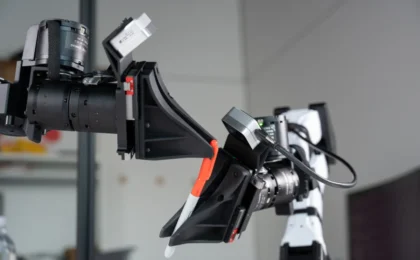
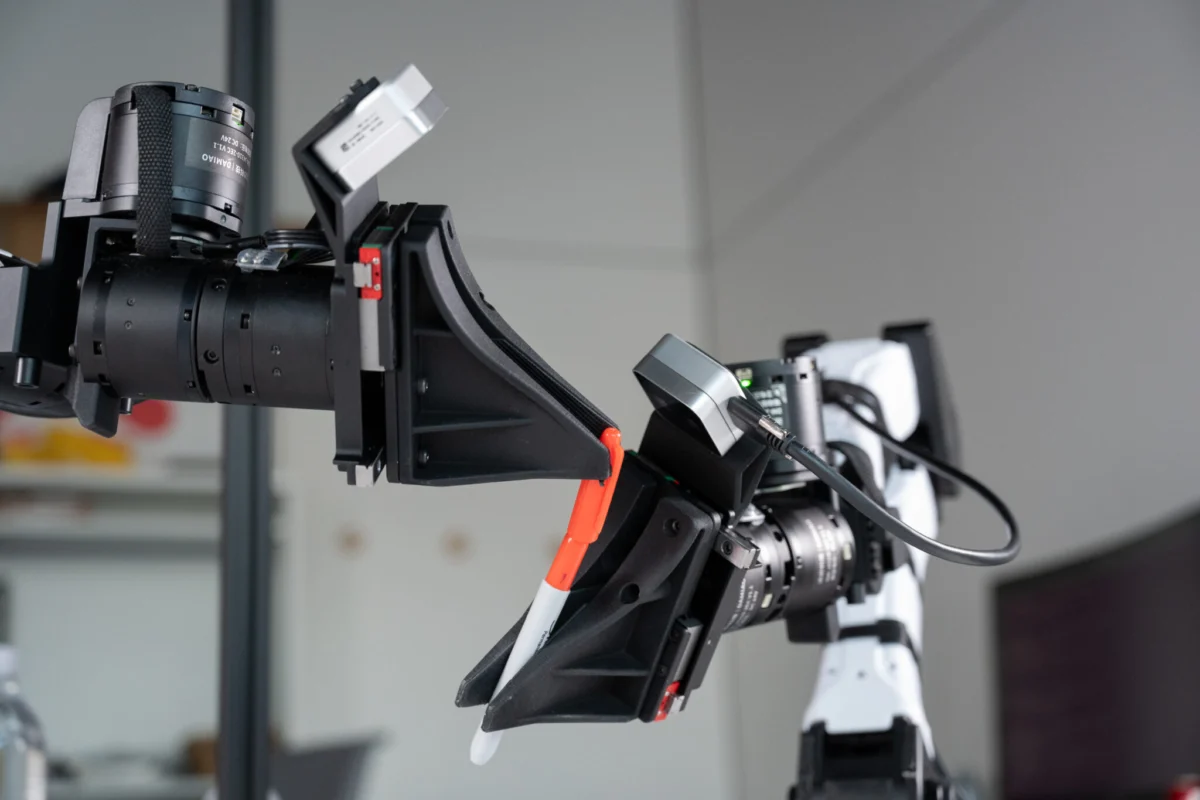
Determined to bridge this gap, Wu and Shentu developed GELLO, a low-cost teleoperation system. GELLO allowed human operators to control robotic arms remotely with enough precision to generate high-quality training data. The subsequent research paper became a cornerstone of modern robotics, proving that if you could digitize human intuition, you could teach a machine to replicate it.
That project served as the proof-of-concept for XDOF. By moving from the lab to the commercial sector, the founders effectively positioned XDOF as the "Scale AI of physical robotics." Much like Scale AI and Mercor provided the essential data labeling for the LLM explosion, XDOF is providing the "data-supply chain" for the physical world.
A Meteoric Financial Trajectory
The financial metrics supporting XDOF’s valuation are as aggressive as the technology itself. Following a $70 million Series A round in June—which saw participation from heavyweights like Thrive Capital, Andreessen Horowitz, Lux, and Spark Capital—the company was not formally seeking additional capital.
However, the sheer velocity of XDOF’s growth changed the equation. With annualized revenue currently approaching $50 million, the company became a target for aggressive venture capital interest. VCs, seeing a company that could potentially monopolize the "ground truth" of robotic motion, approached XDOF to accelerate its capital position.
While the exact structure of the $1.2 billion valuation—and whether it includes the new capital—remains unconfirmed due to ongoing negotiations, the move is a clear indicator of the "winner-takes-most" dynamic currently playing out in the AI infrastructure space. Neither XDOF nor 8VC have provided formal comments, but industry insiders suggest the deal is moving toward a close.
The Mechanics of Data Collection: How XDOF Works
To solve the "data desert" in robotics, XDOF has developed a multi-layered infrastructure. The company does not simply collect data; it curates it. The process is twofold:
- Teleoperation: XDOF employs a global fleet of remote operators who steer robots through complex environments. By mapping human dexterity onto robotic actuators, they generate thousands of hours of successful task completion data.
- Egocentric Sensor Arrays: Beyond remote control, the company utilizes human collectors equipped with body sensors. These collectors perform everyday tasks—folding laundry, flattening boxes, or navigating cluttered kitchens—while the sensors record the nuances of human movement, force, and spatial awareness.
This data is then funneled into XDOF’s annotation systems, where it is refined and prepared for neural network training. By acting as an outsourced pipeline for frontier AI labs, XDOF allows robotics companies to focus on model architecture while the startup handles the grueling logistics of data gathering.
The ABC Project: A Public Good for Private Ambition
Perhaps the most ambitious component of XDOF’s strategy is the "ABC" (Autonomous Behavior Collection) project. In partnership with UC Berkeley’s AI Research lab, XDOF is working to release what is billed as the largest collection of high-quality robot training data ever assembled.
This initiative is a strategic masterstroke. By providing a massive, high-quality dataset, XDOF establishes itself as the gold standard for the industry. It effectively sets the baseline for what "good" robot training looks like, ensuring that any company attempting to compete in the robotics space will eventually need to reckon with the datasets XDOF has helped define.
The Competitive Landscape
XDOF is not operating in a vacuum. The race to capture the "physical data market" is intensifying. The company faces competition from:
- Dedicated Robotics Data Startups: Companies like Mecka AI are aggressively targeting the same market, seeking to prove that their specific approach to data synthesis is superior.
- Platform Giants: Established players like Scale AI, which built its empire on text and image data, are rapidly pivoting to address the demand for robotic motion data.
- The "Micro" Challengers: Startups like Micro1, which recently raised capital at a $500 million valuation, are also eyeing the lucrative market of outsourced AI labor and data synthesis.
Despite this, XDOF’s first-mover advantage—rooted in its academic prestige and its early partnership with top-tier labs—has allowed it to maintain a significant lead. With 20 customers already on the books, including several of the most well-funded frontier AI labs in the world, XDOF has successfully cemented itself as a vital part of the robotics value chain.
Implications for the Robotics Industry
The implications of XDOF’s rise are profound. We are witnessing the industrialization of "robot muscle memory."
For decades, robotics was hindered by the need for hard-coded instructions—if a robot encountered a box it hadn’t been programmed to handle, it would fail. XDOF’s approach replaces brittle, hard-coded rules with generalization. By training models on the massive, diverse, and nuanced data collected by XDOF, robots are becoming increasingly capable of handling the unpredictability of the real world.
However, the reliance on an outsourced data-supply chain raises critical questions about data ownership and the sustainability of the AI ecosystem. If the "brain" of a robot is built on data collected by a third party, the lines of accountability—and the intellectual property of the learned behaviors—become blurred.
Furthermore, the scale at which XDOF is operating suggests that the future of robotics will be defined by whoever can hire the largest, most efficient army of data collectors. This is a shift from pure software engineering to a hybrid model that involves global logistics, human-machine interface design, and massive-scale data management.
Looking Ahead
As the deal with 8VC nears completion, the pressure on XDOF will shift from proving its technology to scaling its operations. A $1.2 billion valuation carries the expectation of massive expansion. The company must now scale its worldwide teams of teleoperators and egocentric collectors while maintaining the high quality of data that attracted its initial roster of 20 customers.
The company’s growth is a bellwether for the broader robotics market. If XDOF succeeds in becoming the standard-bearer for robotic data, it will likely dictate the speed at which general-purpose robots move from the lab to our homes, warehouses, and factories.
In the final analysis, XDOF has turned the "dirty work" of robotics into the most valuable commodity on the planet. By capturing the nuances of human movement, they aren’t just selling data; they are selling the foundational knowledge required to bring machines into the physical world. For the investors at 8VC and beyond, this is not just a bet on a startup—it is a bet on the next era of human civilization, where the physical world is finally as programmable as the digital one.