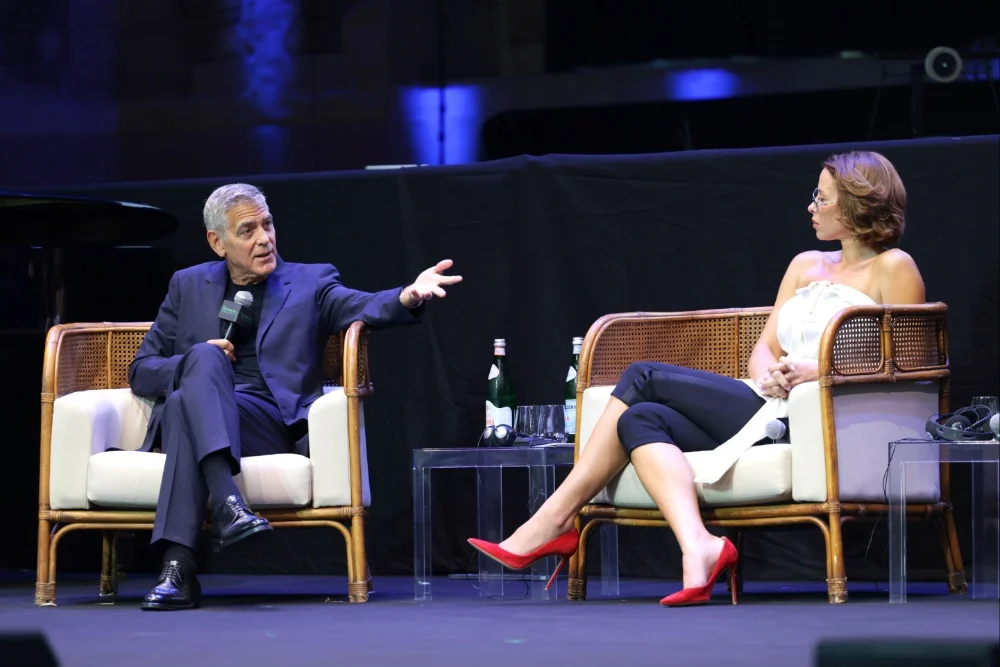
At the recent Venice Film Festival, amidst the glitz and high-minded discourse of the cinematic elite, George Clooney delivered a sobering critique of the technological tidal wave currently reshaping human society: Artificial Intelligence. Speaking at a symposium hosted by Creative Artists Agency (CAA) and Finch & Partners, the actor, director, and activist offered a candid, albeit deeply skeptical, assessment of the intersection between AI, governance, and the future of truth.
Clooney’s remarks—delivered alongside a diverse panel featuring artist Kennedy Yanko, filmmaker Giuseppe Tornatore, Cardinal José Tolentino de Mendonça, and National Gallery of Art president Darren Walker—went beyond the usual industry concerns about copyright and labor. Instead, he framed AI as an existential threat to the democratic fabric, warning that the technology is outpacing our ability to govern it, verify it, and ultimately, trust it.
The Legislative Deficit: Why Washington Isn’t Ready
The central thrust of Clooney’s argument centered on a profound distrust of the current political apparatus to regulate a technology as complex as artificial intelligence. His critique was laced with dark humor, highlighting the disconnect between the rapid evolution of Silicon Valley and the aging halls of power in Washington, D.C.
"I don’t know that you want government to be regulating this either," Clooney remarked, pointing to the optics of tech moguls testifying before Congress. "Because I sit and watch when [Mark] Zuckerberg is testifying in front of, you know, a 94-year-old Chuck Grassley, and they’re like, ‘Well, how do you turn that computer on?’"
For Clooney, the "holy grail" of AI regulation cannot be entrusted to legislators who lack a fundamental grasp of the digital architecture they are tasked with overseeing. This legislative deficit creates a dangerous vacuum. If the people writing the laws do not understand the mechanics of the systems they are policing, the resulting regulations are likely to be either toothless or dangerously restrictive, failing to address the nuanced reality of algorithmic bias, hallucination, and deep-fake proliferation.
The Erosion of Objective Truth
Perhaps the most chilling aspect of Clooney’s warning was his analysis of how AI threatens the very concept of historical record. We are entering an era, he argued, where the line between empirical fact and synthesized fiction is dissolving.
"It’s not just that you’ll see lies," Clooney explained. "It also makes you question things that really do exist. It’s that sort of world of fake news—suddenly you’re able to take things that really happened and say, ‘Well, that didn’t happen either.’"
This, he noted, provides a potent tool for historical revisionism. By creating high-fidelity deep fakes or generating authoritative-sounding but entirely fabricated accounts of events, AI allows bad actors to undermine established history. "You’ll have people who deny the Holocaust, and that will have the same weight in AI as facts," he warned.
This sentiment is echoed by media analysts and historians who fear that the "liar’s dividend"—a phenomenon where real evidence is dismissed as "fake" because the public can no longer discern truth—will become the dominant paradigm of political discourse.
The Hallucination Crisis in Law and Policy
Clooney’s concerns were not merely theoretical; they were grounded in the experiences of his household. His wife, Amal Clooney, a world-renowned human rights attorney, has encountered the creeping influence of AI within the legal system itself.
The couple noted that AI tools, which are increasingly being utilized by legal professionals to conduct research, have a propensity to "hallucinate"—the technical term for an AI confidently presenting false information as fact.
"They will hallucinate and make up fake cases, and lawyers who don’t check it will quote those cases, or judges will quote those cases," Clooney stated. This creates a cascading failure of the judicial process. If the bedrock of the legal system—precedent and case law—is compromised by fabricated citations, the entire structure of justice begins to buckle. It serves as a stark reminder that the efficiency promised by AI comes at the cost of accuracy, accountability, and the integrity of institutional knowledge.
Global Security and the "Nuclear" Scenario
Moving from the courtroom to the geopolitical stage, Clooney raised the stakes of AI-driven disinformation to the level of global security. He posed a hypothetical scenario that feels increasingly plausible: "That’s a joke for people, but what happens when you see a video of Putin saying he’s launched the first nuclear strike in the United States? And how do you discern it?"
The "deep fake" is no longer just a source of amusement or social media trolling; it is a potential trigger for kinetic conflict. In a world where nuclear launch decisions rely on intelligence that can be spoofed or manipulated in real-time, the inability to verify the authenticity of a message could lead to catastrophic misunderstandings. This "black swan" event, where an AI-generated video leads to a military escalation, remains a top priority for cybersecurity experts and international relations scholars.
The Wealth Gap: Who Controls the Algorithms?
Clooney’s critique also touched on the socioeconomic implications of AI development. He pointed out that these powerful tools are concentrated in the hands of the "richest people in the world."
This concentration of power raises fundamental questions about the direction of human innovation. When a handful of private, profit-driven corporations hold the keys to the most transformative technology since the internet, the public good is often treated as an afterthought. Clooney’s point is that we are witnessing the privatization of cognitive labor and historical memory, overseen by entities whose primary responsibility is to shareholders rather than the citizenry.
The Path Forward: Renewing Democratic Vitality
Despite the bleak outlook, Clooney offered a prescription for the malaise of modern governance: a generational shift. When asked about his hopes for the American political landscape, he moved away from the current stalwarts and looked toward a new cadre of leadership.
"We’re all very excited by this young senator from Georgia named Jon Ossoff. We’re all excited about Jimmy [J.B.] Pritzker. I’m from Kentucky, I like Andy Beshear as a governor," he noted.
For Clooney, the solution to the challenges posed by technology is not just technical; it is political. It requires "young voices" who are not beholden to the obsolete frameworks of the past and who possess the intellectual agility to engage with a rapidly evolving technological landscape.
However, he emphasized that the solution is not to seek a monolithic consensus. "We need to have a check and balance," he argued. "We’re not supposed to agree. That’s the whole idea of democracy."
Implications and Future Outlook
The implications of Clooney’s remarks are far-reaching. As society grapples with the transition into the AI era, the following areas remain critical:
- Algorithmic Literacy: There is an urgent need for the public to develop a high degree of skepticism regarding digital content. Education systems must prioritize critical thinking skills to help individuals navigate a world of deep fakes.
- Legal Accountability: The legal community must establish strict standards for the use of AI in case law research. Judges and lawyers must be held accountable for the verification of AI-generated citations.
- Governance Evolution: Rather than relying on aging politicians to write technical regulations, there is a need for a "techno-legislative" hybrid model, where experts in AI ethics and computer science are directly integrated into the legislative process.
- Institutional Trust: As Clooney noted, the goal of those using AI for disinformation is to make us "not sure where this is going to end, and we’re not sure who’s fully in charge." Rebuilding trust in verifiable, fact-checked journalism and institutional reporting is the only defense against this erosion of reality.
As the Venice Film Festival symposium concluded, the message from the panel was clear: AI is not merely a tool for artistic or commercial convenience. It is a tectonic shift that challenges the foundations of law, history, and national security. Whether humanity can navigate this transition without sacrificing the core tenets of democratic society remains the defining question of our time.
George Clooney’s intervention serves as a necessary, if uncomfortable, wake-up call. We are in the midst of a transition where the speed of innovation has outpaced our social, legal, and cognitive defenses. The "holy grail" of progress is currently in the hands of a few, and as the actor suggested, if we do not find a way to re-center human oversight and democratic accountability, we may soon find ourselves unable to distinguish the truth from the algorithm.