The rise of complex ecosystems on land represents one of the most transformative chapters in the history of life on Earth. As the first pioneers ventured beyond the safety of the oceans, they laid the foundation for the diverse terrestrial world we know today. Central to this transformation were the insects—the most species-rich animal group in history. Yet, for decades, the early transition from aquatic habitats to a fully terrestrial existence remained obscured by a frustratingly incomplete fossil record.
An international team of paleontologists has now shattered this silence. By identifying a previously misclassified "stem group" insect from the Late Mississippian period—approximately 324 million years ago—researchers have finally bridged a major gap in the evolutionary timeline. This breakthrough, published in the journal Nature, suggests that the "conquest of land" was not a sudden leap, but a protracted, amphibious journey that lasted millions of years.
The 80-Million-Year Missing Link
The mystery of insect origins has long been a source of tension between two scientific disciplines: molecular biology and paleontology. Molecular clock studies—which analyze genetic mutations to estimate divergence times—have long suggested that hexapods (the group containing insects) split from their marine crustacean ancestors as early as the Cambrian-Ordovician interval.
However, the fossil record painted a far more fragmented picture. While undisputed hexapod fossils appear in the Early Devonian Rhynie Chert (roughly 405 million years ago), clearly recognizable, diverse insect fossils do not become abundant until the Late Carboniferous, roughly 320 million years ago. This left an "evolutionary chasm" of approximately 80 million years. For generations, scientists lacked the intermediate fossils necessary to understand how early insects moved from the water’s edge into the heart of the forest, or how their anatomy shifted to facilitate life in a low-density, oxygen-rich environment.
Chosha praecursor: A Case of Mistaken Identity
The discovery of Chosha praecursor provides the smoking gun that paleontologists have sought for nearly a century. Found within the calcareous claystone of the Tesnus Formation in the Marathon Uplift of western Texas, these fossils were long ignored, having been erroneously categorized as crustacean larvae.
Led by Professor Chenyang Cai of the Nanjing Institute of Geology and Paleontology (NIGPAS) and Erik Tihelka, a Ph.D. candidate at the University of Cambridge, the research team employed advanced cross-polarized light imaging to peer through the mineralized matrix of the fossils. What they revealed was not a simple crustacean, but an adult female insect with a remarkably sophisticated anatomy.
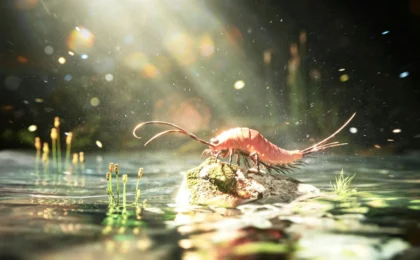
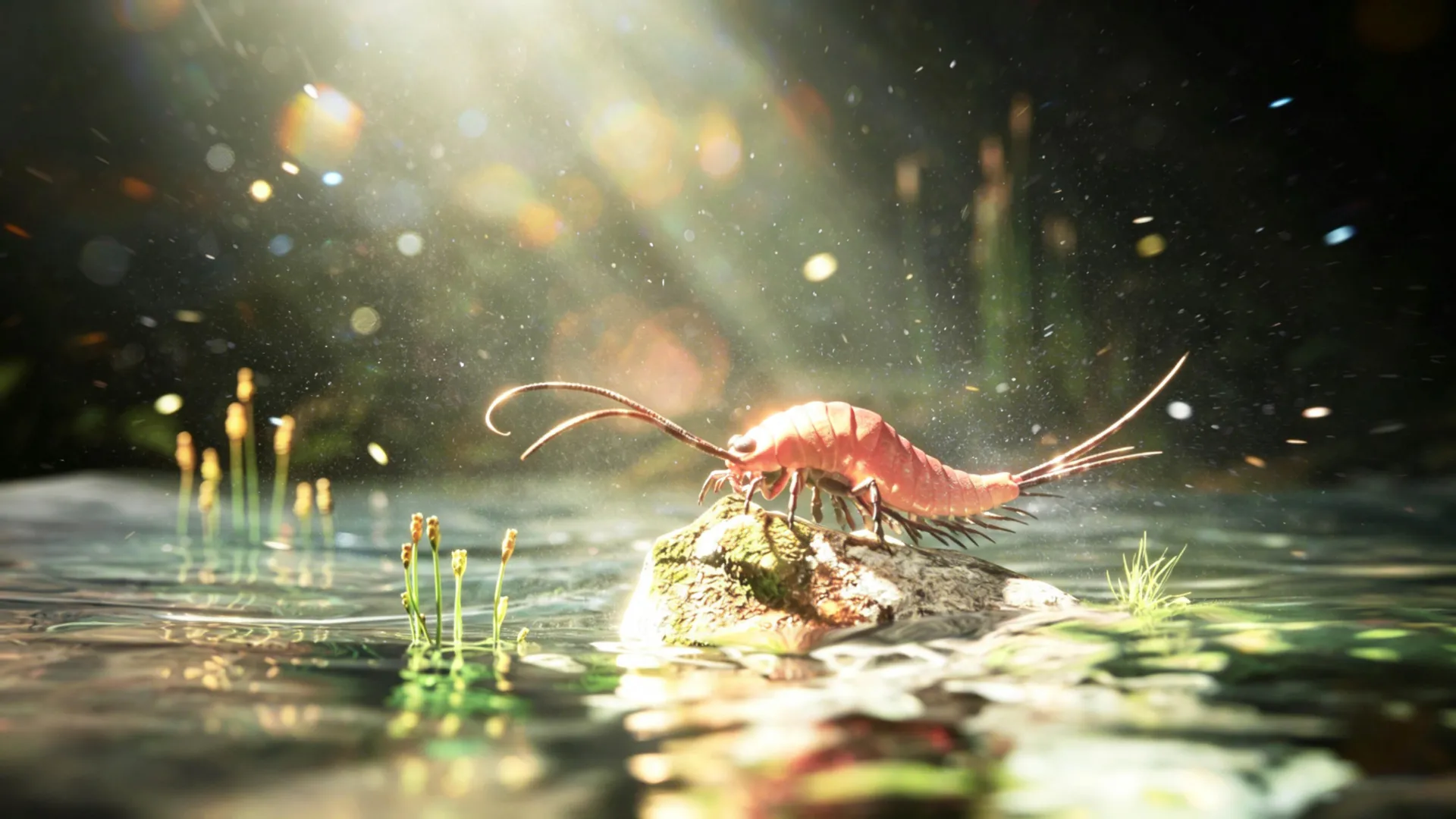
Measuring roughly 32 millimeters in length—or nearly 50 millimeters when including its elongated caudal filaments—C. praecursor possessed a body that bridged the gap between primitive aquatic ancestors and modern insects. While it maintained the classic six-legged, segmented trunk organization of a hexapod, its abdomen told a different story. Unlike any modern insect, the first nine segments of its abdomen were adorned with segmented appendages, with the rear-most limbs modified into paddle-like structures. This unique morphology suggests that C. praecursor was an amphibious specialist, using its paddle-limbs to navigate shallow-water coastal deltas while using its walking legs to scramble across humid, terrestrial mudflats.
Reconstructing the Evolutionary Timeline
To understand the full significance of C. praecursor, the team conducted a comparative analysis of other "enigmatic" Paleozoic specimens, including Leverhulmia from the Early Devonian of Scotland and an unnamed hexapod from the Illinois Mazon Creek biota.
The researchers concluded that these three fossils form a primitive stem lineage. By situating these specimens along a chronological trajectory, the team has effectively filled the 80-million-year gap. This evidence shifts the early diversification of insects back from the Late Carboniferous to the Early Devonian, aligning the fossil record much more closely with molecular clock estimates.
The Chronology of Adaptation:
- Early Devonian (405 MYA): Initial emergence of hexapods in semi-aquatic habitats, as evidenced by Leverhulmia.
- Late Mississippian (324 MYA): The appearance of Chosha praecursor, showing the persistence of ancestral abdominal limbs repurposed for amphibious life.
- Late Carboniferous (300+ MYA): The eventual loss of abdominal appendages and the rise of fully terrestrial insects, which would go on to colonize the interior of the continents.
Mechanisms of Transition: Losing the Extra Limbs
Perhaps the most significant anatomical insight provided by the research is the documentation of how insects shed their aquatic "baggage." Modern insects are characterized by a strict anatomical blueprint: six legs attached exclusively to the thorax. Paleozoic stem insects, however, were "limby," with segments along the abdomen still bearing appendages.
The researchers argue that the reduction of these abdominal limbs was a deliberate evolutionary adaptation to terrestrial life. In a water-based environment, these limbs were functional oars; on land, they were likely a hindrance to efficient locomotion. As natural selection favored those that could navigate terrestrial microhabitats more effectively, the swimming appendages were progressively simplified and eventually lost.
Furthermore, the presence of an ovipositor in C. praecursor indicates that early insects had already evolved specialized equipment for egg-laying. This allowed them to exploit diverse terrestrial environments, such as decaying plant material and fungal spores, effectively creating new ecological niches and setting the stage for the explosive radiation of insect species that defines our modern biosphere.
Implications for Paleozoic Ecology
The findings published in Nature carry profound implications for our understanding of how life conquered the continents. Rather than a "sudden" colonization, the transition appears to have been a prolonged evolutionary migration.
Early insects acted as crucial ecological intermediaries. By feeding on humus and fungal spores, they occupied the space where the aquatic and terrestrial worlds collided. They were the original recyclers, breaking down organic matter and accelerating the nutrient cycling that allowed terrestrial plants to flourish and build more complex structures.
"The fossils of C. praecursor and related Paleozoic stem insects provide a new view of how the most species-rich animal group on Earth began its move onto land," said Professor Cai. "They challenge previous ideas about changes in insect body size, ecological adaptation, and the way insects evolved alongside terrestrial ecosystems."
Official Perspectives and Future Research
The international nature of the collaboration—involving experts from China, the United Kingdom, the United States, and Spain—highlights the global effort required to piece together this deep-time puzzle. By re-evaluating long-held assumptions and utilizing non-destructive imaging techniques on museum-bound fossils, the team has turned a "misidentified" curiosity into a cornerstone of evolutionary biology.
For the scientific community, the focus now shifts to the next phase of inquiry: if insects spent such a long time in an amphibious state, what were the specific environmental pressures—such as fluctuating sea levels or the rise of forest canopies—that finally pushed them to commit to a life on land?
As this research makes clear, the history of insects is not merely the history of a single animal group; it is the history of the terrestrial world itself. The transition from the coastal tide-pools of the Mississippian to the vast, insect-dominated landscapes of the Carboniferous remains one of nature’s greatest success stories—a story written not in ink, but in the slow, persistent adaptation of a creature that learned, over millions of years, to walk away from the water and never look back.