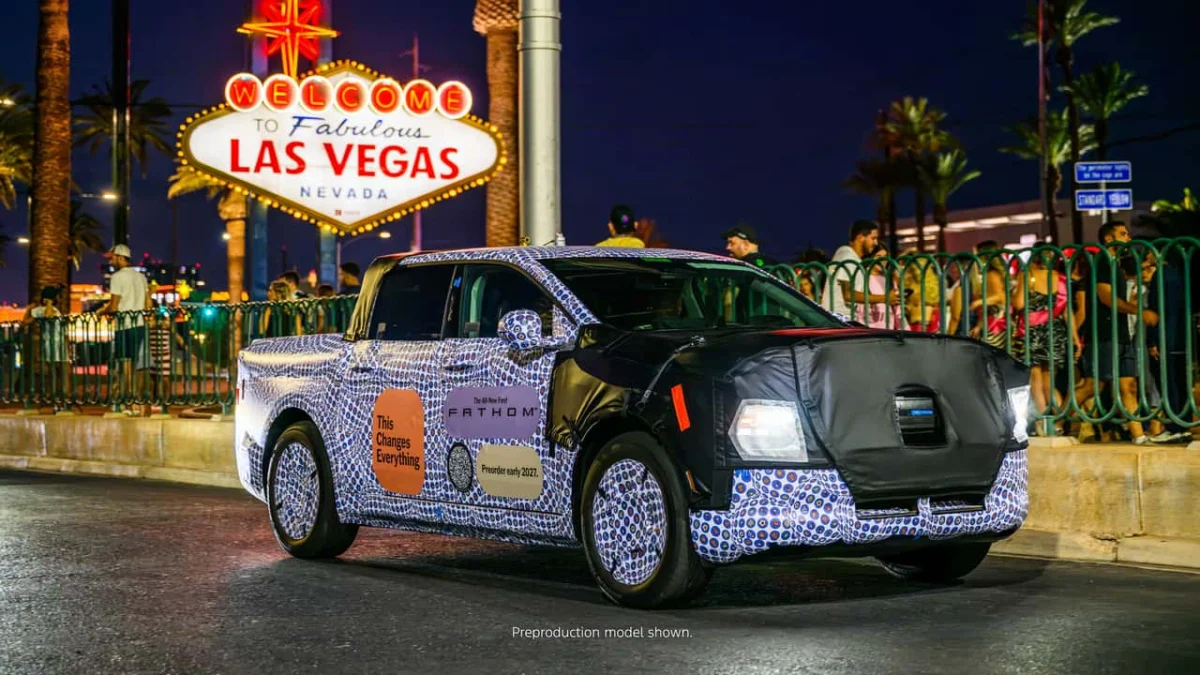
In the sweltering heat of the Nevada desert, Ford is currently putting the final touches on what could arguably be the most disruptive vehicle of the decade. The "Fathom," Ford’s upcoming midsize electric pickup truck, was recently spotted undergoing rigorous hot-weather testing. While the prototypes were heavily shrouded in black-and-white camouflage, the message emblazoned on their flanks was unmistakable: "Camo Off in 2027" and "This Changes Everything."
For a company that has long dominated the truck market with the F-Series, the Fathom represents a fundamental shift in strategy. By targeting an aggressive entry price of $29,945—including a $1,595 destination fee—Ford is not merely dipping its toes into the electric pickup segment; it is aiming to cannonball into the affordable EV market, creating a new category of utility-first transportation that currently exists only in concept.
The Strategy: Redefining Value at the Entry Level
The automotive industry has spent years chasing the "affordable EV" unicorn. While many manufacturers have struggled to balance battery costs with profit margins, Ford is banking on its new "Universal EV Platform" to bridge the gap. Announced in 2025, this modular architecture is designed to scale across a variety of models, with the Fathom serving as the maiden voyage for the platform.
The $29,945 price tag is a strategic masterstroke. It positions the Fathom below many configurations of the internal-combustion-powered Ford Maverick, currently the gold standard for accessible, versatile light trucks. By pricing the Fathom at this level, Ford is putting immediate pressure on competitors who have yet to bring a sub-$30,000 electric truck to scale. It is a clear signal to both fleet managers and cost-conscious consumers that the era of the premium-only electric truck is coming to an end.
Technical Foundations: Efficiency Over Excess
At the heart of the Fathom’s value proposition is a deliberate choice in battery chemistry. Base models will utilize a lithium iron phosphate (LFP) battery. While nickel-based chemistries often offer higher energy density, LFP batteries provide a more stable, durable, and significantly cheaper solution. This choice is pivotal for fleet operators who prioritize longevity and lower total cost of ownership over maximum range.
For those requiring more capability, Ford will offer a dual-motor, all-wheel-drive configuration paired with a larger battery pack. Ford vice president of advanced development Alan Clarke has confirmed that the lineup will feature two battery sizes, with the top-tier configuration targeting a 300-mile range. While the base sub-$30,000 trim will likely fall short of this 300-mile benchmark, the compromise is clearly intended to keep the entry price competitive.
The vehicle is built to be a workhorse, not a lifestyle accessory. With five-passenger seating and an interior volume that outpaces the Toyota RAV4, the Fathom is engineered to balance the dual roles of a commercial tool and a family hauler.
A Comprehensive Feature Set
Perhaps the most surprising aspect of the Fathom is the inclusion of "standard" technology that is typically gated behind expensive trim levels or luxury packages. Every Fathom, regardless of the price point, will come equipped with:
- BlueCruise: Ford’s hands-free highway driving system, bringing advanced driver-assistance features to the entry-level segment.
- Bidirectional Power: The ability for the truck to act as a mobile power station, perfect for running heavy-duty power tools at a job site or providing backup power for a home during a grid outage.
- Digital Integration: Wireless Apple CarPlay and Android Auto, a digital key system, and embedded Apple Maps navigation.
This commitment to tech-forward, high-utility features suggests that Ford is not just selling a budget truck; it is selling a productivity suite. For contractors, the ability to power tools from the bed of the truck is a tangible business advantage that pays for itself in efficiency.
The Production Timeline: From Kentucky to the Streets
The journey of the Fathom from concept to driveway is a well-choreographed dance of manufacturing and logistics. Ford is currently in the process of a massive retooling effort at its Louisville Assembly Plant in Kentucky. Unlike a simple repurposing of existing lines, the plant is being transformed to support the new Universal EV Platform.
- Q1 2027: Prototype builds commence at the Louisville facility.
- Early 2027: Official order books open to the public and fleet managers.
- Late 2027: Customer deliveries begin, with the Fathom arriving as a 2028 model-year vehicle.
The phased rollout is designed to ensure that when the truck finally hits showrooms, the manufacturing process is dialed in. By the time the camo comes off in 2027, Ford intends for the Fathom to be more than just a novelty; it is intended to be a robust, high-volume product that validates their entire affordable EV manufacturing strategy.
Industry Implications: A Shift in Power
The introduction of the Fathom forces the entire industry to reassess the viability of the "entry-level" electric vehicle. For years, the narrative has been that EVs must be expensive, luxury-oriented, or highly niche to be profitable. Ford’s decision to target the fleet and commercial sector first—the buyers who care most about cost, reliability, and utility—suggests a more pragmatic approach to EV adoption.
If the Fathom succeeds, it will likely trigger a ripple effect. We may see an influx of competitors rushing to develop their own sub-$30,000 electric platforms. Furthermore, the standardization of features like bidirectional charging could become a new industry baseline for any truck marketed toward the professional class.
Motor1’s Take: Is It Truly a Game Changer?
The "This Changes Everything" slogan splashed across the Fathom’s camouflage is bold, but it is supported by a compelling business case. The electric vehicle market has reached a point where early adopters have already made their purchases; the next phase of growth depends on capturing the mass market.
The Fathom, with its sub-$30,000 starting price and fleet-ready features, addresses the biggest barrier to EV adoption: accessibility. While we are still waiting for final EPA range ratings and the full breakdown of trim levels, the current data suggests that Ford has identified a massive, underserved gap in the market.
If the range and capability hold up to the expectations Ford has set, the Fathom could do for electric trucks what the Model T did for the automobile: make it attainable for the average person. Whether it truly "changes everything" remains to be seen, but it is undoubtedly the most significant step toward the democratization of electric pickup trucks we have seen to date. As we approach 2027, the industry will be watching the Louisville plant with keen interest. The desert testing in Las Vegas is merely the warm-up; the real test will begin when the first Fathom is handed over to a buyer who needs a truck that works as hard as they do.