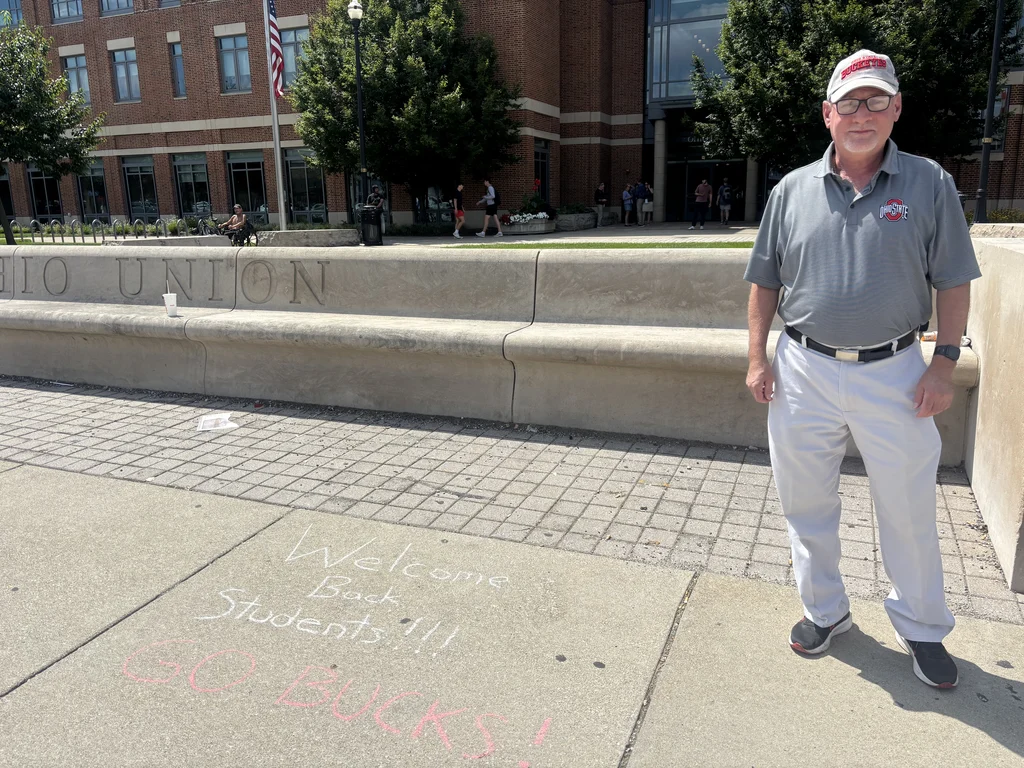
In a brazen act of civil disobedience that has further intensified the national debate over free speech on college campuses, Ohio State University (OSU) state senator Bill DeMora took to the sidewalks of the Columbus campus this Wednesday to challenge a controversial administrative policy. With a piece of chalk in hand, DeMora defied a year-old university ban on sidewalk chalking, scribbling a defiant, yet spirited, "Welcome back students! Go Bucks!" directly in front of the Ohio Union.
The act was more than a mere greeting; it was a targeted protest against a policy that critics—including the American Civil Liberties Union (ACLU)—have decried as a blatant violation of First Amendment rights. As the university faces mounting legal pressure and accusations of viewpoint discrimination, DeMora’s demonstration has brought the simmering conflict between campus administration and free speech advocates to a boiling point.
A Chronology of Contention
The origins of this standoff date back to the autumn of 2023, when Ohio State University quietly implemented a comprehensive ban on chalking across its sprawling campus. The policy, framed by the administration as a maintenance and grounds-keeping measure, declared that all chalk markings would be subject to immediate removal by Facilities Operations and Development. Furthermore, the policy warned that the university reserved the right to charge individuals for the costs of cleaning and that students found in violation could face formal conduct referrals.
For months, the policy remained a point of friction for student organizations and activists. However, the tension escalated significantly last month when the ACLU of Ohio issued a scathing formal letter to the university’s new president, Ravi V. Bellamkonda. The letter served as a precursor to potential litigation, demanding that the university immediately rescind what the organization termed a "flatly unconstitutional" policy.
The controversy reached a new milestone this Wednesday when Senator DeMora, a Democrat whose district encompasses the university, chose to publicly challenge the administration. DeMora confirmed that he had alerted university officials of his intentions beforehand. Despite being discouraged by a university vice president, DeMora proceeded with his demonstration, successfully marking the pavement without immediate interference from campus security.
The Constitutional Argument: Censorship or Cleanliness?
At the heart of the dispute is the question of whether a public university can restrict a medium of expression based on its content or potential to offend. The university’s stance, maintained by official spokespersons, is that their policies are content-neutral and designed to maintain the aesthetic and physical integrity of campus property.
However, the ACLU and other free speech advocates argue that the university’s stated justification is a thin veil for viewpoint discrimination. In their letter to President Bellamkonda, the ACLU pointed to internal university records, suggesting that the chalking ban was not borne out of a sudden concern for sidewalk cleanliness, but rather as a direct response to complaints regarding pro-Palestine and anti-Zionist speech.
"By OSU’s own public account, it silences an entire medium of speech because OSU received too many complaints about the content that was being expressed," the ACLU stated. The organization further argued that the ban was enacted specifically to suppress particular political viewpoints, asserting that the university lacks any "compelling justification" to restrict such a traditional and accessible form of public expression.
Senator DeMora’s Defiance: "Clearly Unconstitutional"
For Senator DeMora, the issue is one of fundamental democratic principle. Speaking to Inside Higher Ed following his act of protest, DeMora expressed little concern for the university’s threats of disciplinary action.
"Ohio State has a stupid policy," DeMora stated flatly. He noted that while he had been cautioned by university leadership prior to his arrival, he felt compelled to highlight the absurdity of a policy that would criminalize a harmless, temporary, and traditional form of student expression.
DeMora’s confidence stems from his belief that the university is in a precarious legal position. "It’s clearly unconstitutional," he said. When asked if he feared being arrested, he dismissed the possibility, arguing that the administration would be unlikely to target a state legislator for writing a friendly greeting to students. "They’re not dumb enough to arrest a state senator who’s going [to write], ‘Welcome back students,’" he remarked.
His protest serves as a powerful symbol of the tension between legislative oversight and the autonomy of public universities. By physically occupying the space the university seeks to regulate, DeMora has challenged the administration to either enforce its policy against a public official or acknowledge that the policy is unenforceable and discriminatory.
The University’s Response: A Commitment to "Free Expression"
In response to inquiries regarding the incident and the broader legal threats, a spokesperson for Ohio State University reiterated the institution’s commitment to academic freedom.
"Ohio State is committed to protecting free speech and expression on our campuses, and we support the right of students, faculty, staff and visitors to speak out about issues that are important to them," the spokesperson wrote in an email.
However, the administration simultaneously defended the removal of the chalk. "The chalking in question has been removed in accordance with our policy," the spokesperson confirmed. This response highlights the internal contradiction that critics frequently cite: the university claims to uphold the principles of free speech while simultaneously deploying maintenance crews to erase the physical evidence of that speech the moment it appears.
Implications for Public Higher Education
The situation at Ohio State is not an isolated event but rather a microcosm of a national trend. As political tensions continue to flare on campuses across the United States, university administrators find themselves caught between competing pressures: the mandate to provide a safe and orderly learning environment, and the legal obligation to uphold the First Amendment as state-funded entities.
1. The Legal Precedent
If the ACLU moves forward with its threatened lawsuit, the case could set a significant legal precedent for how public universities manage "traditional public forums" on their grounds. Historically, sidewalks on public university campuses have been considered public forums where speech is afforded the highest level of protection. If the court finds that OSU’s policy is content-based—as the ACLU claims—the university could be forced to abandon the ban entirely.
2. The Chilling Effect on Student Activism
Student activists are the primary demographic affected by the ban. By removing chalk messages, the university effectively erases the voices of marginalized groups or those with minority political views. This creates a "chilling effect," where students may feel discouraged from engaging in activism altogether, fearing that their efforts will be scrubbed away and that they may face disciplinary conduct hearings for the simple act of writing on a sidewalk.
3. The Role of Legislative Oversight
Senator DeMora’s intervention highlights a growing trend of state legislators involving themselves in campus affairs. While some critics argue that legislative interference can threaten academic independence, others argue that when a public institution behaves in a manner that appears to violate the Constitution, legislative oversight is not only appropriate but necessary to ensure accountability to taxpayers.
Looking Forward: A Campus in Transition
As the fall semester begins at Ohio State, the sidewalks of the Columbus campus remain a contested landscape. The university’s decision to remove Senator DeMora’s message—a benign "Go Bucks!"—only serves to underscore the rigidity of the administration’s current approach.
For the student body, the message is clear: the administration is watching, and the tools of expression are under constant threat of erasure. For the university, the challenge is mounting. With the ACLU keeping a close watch and a state senator willing to use his own hands to expose the policy’s flaws, the administration at Ohio State may soon find that the costs of maintaining their "clean" sidewalks are far higher than the price of the chalk they are so eager to remove.
The incident has transformed a seemingly minor administrative rule into a defining test of the university’s values. As the legal and political pressure mounts, Ohio State University will be forced to determine whether its commitment to free speech is truly foundational, or if it is merely a convenient slogan, easily wiped away with a broom and a bucket of water.