By [Your Name/Staff Writer]
August 22, 2026
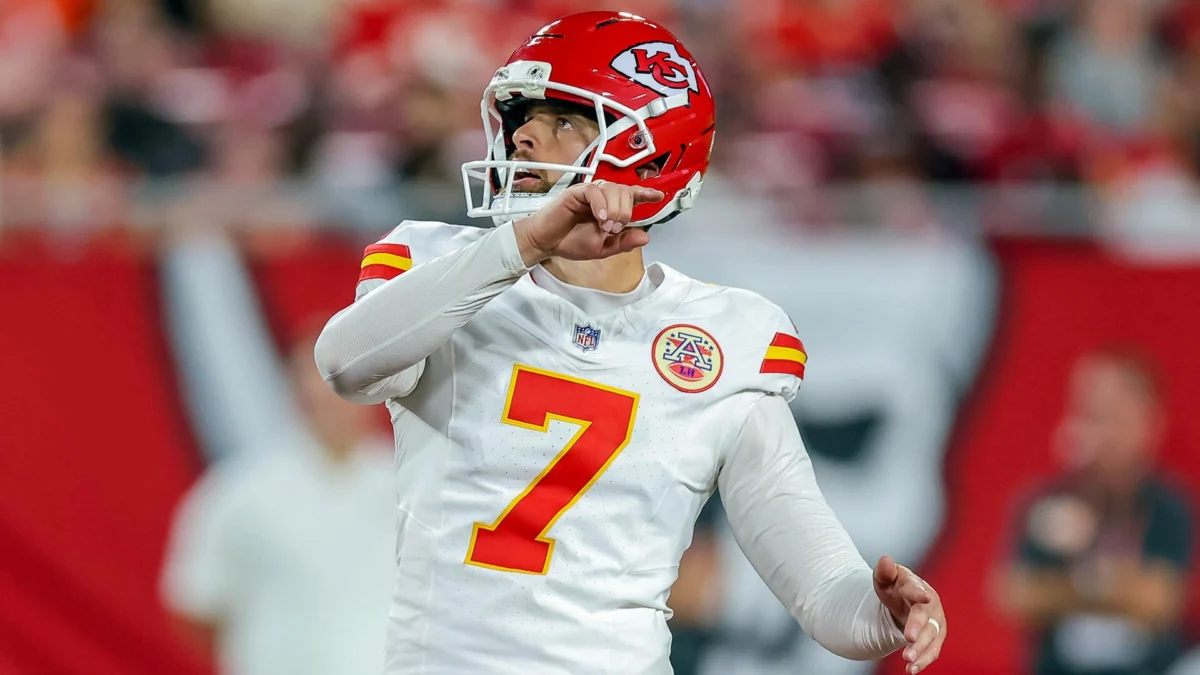
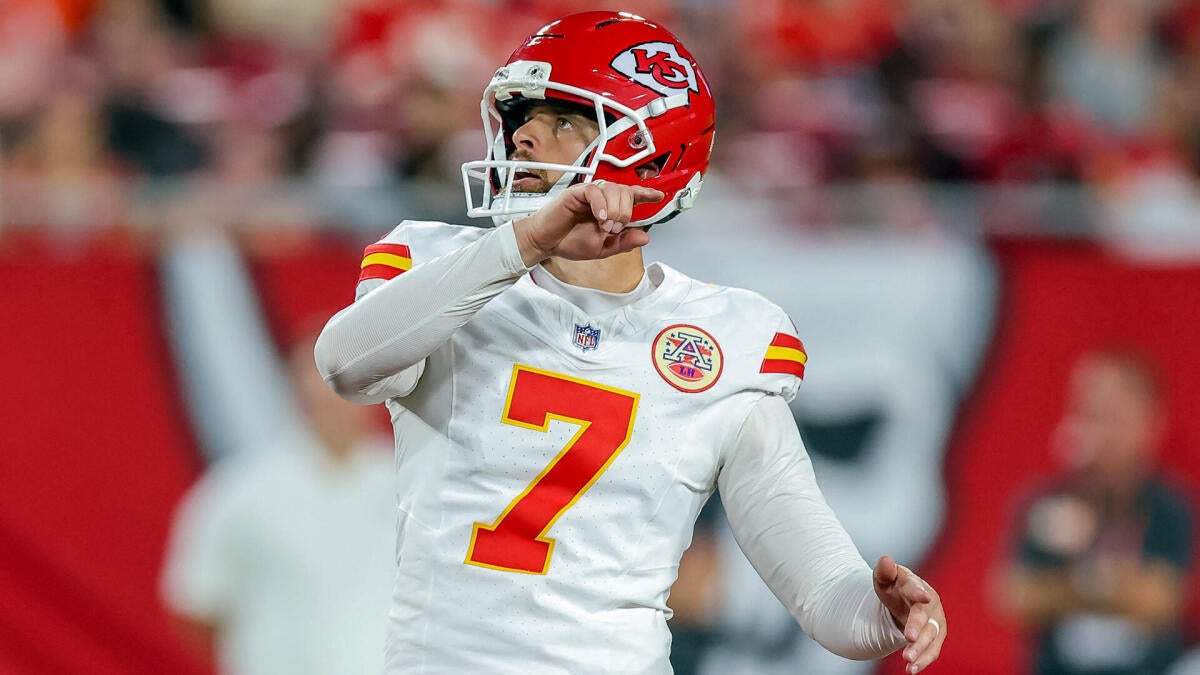
In the modern NFL, the distance at which a field goal is considered a "sure thing" has undergone a seismic shift. On a crisp Saturday night in August 2026, Kansas City Chiefs kicker Harrison Butker provided the latest evidence of this evolution, launching a 69-yard field goal that split the uprights with room to spare.
While the kick stands as a monumental personal achievement and a testament to the raw power now present in the league’s special teams units, it comes with a frustrating caveat for the history books: it occurred in the preseason. Because the NFL does not recognize statistics from exhibition games, the official record remains in the hands of Jacksonville Jaguars standout Cam Little. However, for those watching in the stadium, the visual evidence of the ball sailing through the net behind the goalposts suggested that the ceiling for what is possible in professional football is higher than ever before.
The Sequence: A Coach’s Gamble and a Kicker’s Precision
The setup for the kick was as dramatic as the execution. With the clock winding down in the second quarter against the Tampa Bay Buccaneers, the Chiefs’ defense forced a pivotal stop. Tampa Bay, looking to capitalize on a fourth-and-5 situation from the Kansas City 49-yard line, opted to bypass a punt in favor of an aggressive conversion attempt.
The gamble failed when quarterback Jake Browning’s pass fell incomplete, turning the ball over to the Chiefs with only three seconds remaining in the half. Most coaches would have headed to the locker room to regroup, but Kansas City’s Andy Reid—known for his willingness to test the limits of his personnel—sent Butker onto the field.
Butker’s 69-yard strike was not an isolated fluke; it was the centerpiece of a busy night for the veteran, who also converted from 58 and 45 yards. Despite a singular miss from 43 yards in the fourth quarter of an eventual 16-15 loss, the narrative of the night remained centered on the sheer audacity of the 69-yard conversion. The ball traveled with a trajectory that suggested it would have cleared the crossbar from 75 yards out, providing a stark reminder of the evolving standard for NFL placekickers.
Chronology of the Long-Distance Revolution
To understand the magnitude of Butker’s kick, one must look at the history of the "long ball" in American football. Since the inception of the sport in 1869, the 69-yard threshold has been an almost mythical barrier.
- 1976: The Abilene Christian Milestone. For decades, the name Ove Johansson served as the gold standard for long-distance kicking. His 69-yarder for Abilene Christian remains a legendary moment, though historians often asterisk it due to the college rules of the era, which permitted the use of a 1- to 2-inch kicking block.
- 2021: The Justin Tucker Benchmark. For years, the NFL record sat at 66 yards, held by Baltimore Ravens legend Justin Tucker. His incredible kick in Detroit became the gold standard of the modern era, a feat many thought might stand for a generation.
- 2025: The Cam Little Surge. The landscape changed drastically when the Jaguars’ Cam Little began testing the limits of the new rulebook. Little hit a 70-yarder in the 2025 preseason—which, like Butker’s, did not count—but he followed it up by drilling a 68-yarder during the regular season to claim the official league record. He later added a 67-yarder, further distancing himself from the field.
Butker’s Saturday night performance puts him in elite company, tying him with Johansson for the second-longest field goal in the history of competitive American football. The fact that Butker and Little are achieving these distances without the aid of the now-banned kicking blocks proves that we are witnessing a fundamental shift in the technical proficiency of the position.
Supporting Data: The Mechanics of the "K-Ball" Rule
Why are we seeing such a dramatic increase in field goal range across the league? The answer lies in a significant regulatory change implemented by the NFL prior to the 2025 season: the "K-Ball" rule.
Previously, from 1999 to 2024, teams were provided with three brand-new footballs on game day, with roughly one hour to "break them in." These balls were notoriously stiff, with leather that had not yet been softened by extensive handling. Much like a brand-new baseball glove, they were difficult to manipulate and even harder to kick with consistent accuracy and distance.
Under the current rules, each team is provided with 60 specially designated "K-Balls" at the start of the season. This allows special teams units to break the balls in over the course of weeks of practice. Furthermore, teams are now permitted to use brushes to treat the balls, smoothing out the thousands of tiny bumps that cover the surface of an NFL football.
The result? A ball that is softer, more aerodynamically responsive, and far easier to compress upon impact. Players and coaches alike estimate that this single change has added between five and ten yards to the effective range of the average NFL kicker.
Expert Insight: The View from the Sidelines
Bengals special teams coordinator Darrin Simmons, an NFL veteran with nearly three decades of coaching experience, believes the league is only beginning to see the impact of this policy shift.
"I believe it makes a big difference," Simmons stated in a late-July briefing. "That’s why the distances on some of these long field goals have gone up, and I think it will continue to just skyrocket as long as that rule stays in place."
The sentiment is echoed by kickers across the league who feel more confident than ever approaching a 60-plus yard attempt. The psychological barrier that once prevented coaches from attempting long-distance kicks has evaporated. When a kicker can effectively reach the crossbar from the mid-field logo, the entire offensive strategy for the final minutes of a half changes. It creates a "no-man’s land" for defenses, where even a modest gain of 5-10 yards can suddenly put the offense into high-percentage scoring territory.
Implications: The Quest for the 70-Yard Goal
As we look toward the 2026 regular season, the implications of Butker’s 69-yarder are clear: the 70-yard field goal is no longer a pipe dream—it is an eventuality.
For the Kansas City Chiefs, the realization that they possess a weapon capable of scoring from beyond their own 40-yard line provides a massive tactical advantage. If Butker can maintain the form he displayed on Saturday, he becomes a primary threat in high-leverage situations. More importantly, he joins Cam Little in the vanguard of a new generation of kickers who treat the 65-yard mark as a routine boundary rather than an outlier.
The records held by Justin Tucker and Cam Little are no longer static monuments; they are targets. With the K-Ball rule providing the necessary equipment efficiency, the only remaining variable is the talent and leg strength of the specialists. If the current trajectory holds, the 2026 season could see the record books rewritten once again, perhaps by the very man who proved his mettle in a preseason game under the lights in Kansas City.
For now, Harrison Butker can claim the bragging rights of a 69-yard boot. But as the regular season approaches, the question isn’t whether someone will hit a 70-yarder, but rather, who will be the first to do it when it truly counts.